

Nicholas Cabasilas
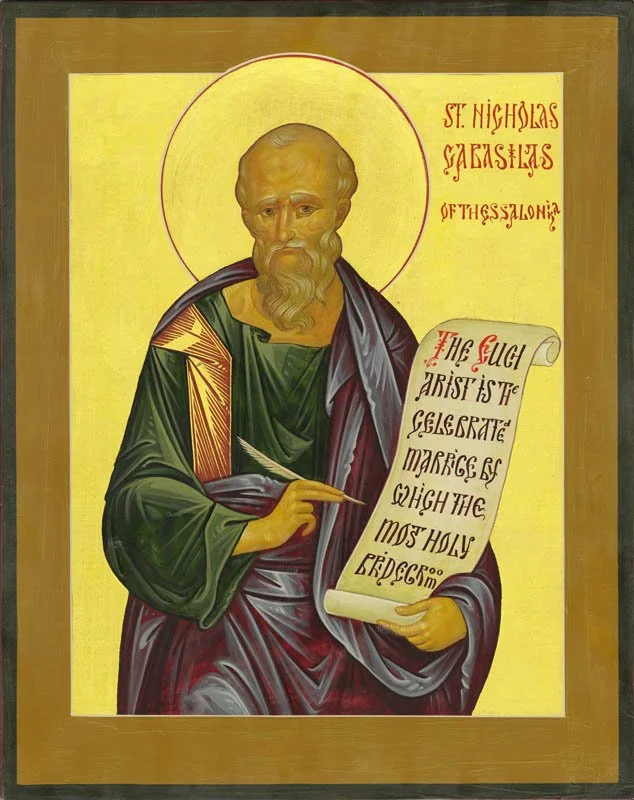
Nicholas Cabasilas, born in 1322 or 1323, was not a bishop. He took his uncle’s last name, Nilus Cabasilas, who in fact succeeded Gregory Palamas as Archbishop of Thessalonica in 1351. According to Carmino J. DeCatanzaro, the translator of Cabasilas’s The Life in Christ (1974), he, Nicholas, was “a prominent figure” in theological controversies of his time involving the Latinizers (Cabasilas, 1974: 9, 11). He sided with Palamas during the hesychast controversy that ended in the Council of 1351 (See OCA’s Venerable Nicholas Cabasilas).
Starting in 1354 Nicholas devoted himself to philosophy and theology after leaving his post “as an official and friend of the emperor John VI Cantacuzenos,” who was in turn deposed in the same year and retired to monastic life (Cabasilas, 1974: 10). It is now firmly established that Nicholas Cabasilas entered the Manganon monastery near Constantinople and became a priest (Id.). He died there shortly after the tragic fall of his native city Thessalonica to the Ottoman Turks in 1387 (Id.). Some 60 years later, the eternal city Constantine, too, fell to the Ottoman Turks in May 1453. Nicholas was “glorified as a saint on July 19, 1983” (Venerable Nicholas Cabasilas).
As DeCatanzaro notes, Nicholas Cabasilas “was well acquainted with Latin theology” (11). This essay is an attempt to show Anselm’s influence on Nicholas Cabasilas, as it impacts on the latter’s interpretation of the Eucharist and how Cabasilas’ interpretation in turn further influenced the subsequent understanding of the Eucharist in the east (the Orthodox churches). Cabasilas demonstrates the Latin theology’s penetration into Orthodoxy, on one hand; as the influence of Pseudo-Dionysius, once dominant, began to wain in the east, on the other. Ironically, Dionysius’ influence increased in the west in the 13th-century in radically altered forms by both St. Bonaventure and St. Aquias.
Both St Bonaventure and St Aquinas died in 1274 while traveling to attend the Second Council of Lyon. Cabasilas died around 1392.
Arriving about a century after Bonaventure and Aquinas, Cabasilas must have known them both.
While the east is forgetting Pseudo-Dionysius, the west is discovering him in its own way. The critical Greek texts of Pseudo-Dionysius Areopagite, Corpus Dionysiacum, were first published only in 1990 (vol. 1) and 1991 (vol. 2) respectively by K. Aland and E. Mühlenberg.
Three of the five centers of Christianity fell to Caliphate: Antioch in 637, Jerusalem in 638, and Alexandria in 646. The two remaining Christian centers, Rome and Constantinople, are generally referred to henceforth as the west and the east. After the fall of Rome in 476 Constantine took on the name of the New Rome and survived as a Roman city for another millennia.
Rome fell in 476 to Visigoths and the Vandals (the Germanic tribes); Constantinople fell in 1453 to Sultan Mehmed II of the Ottoman Empire.
Between the fall of Rome in 476 and of Constantinople in 1453, there were nine Crusaders who attempted to capture Jerusalem. Only the first Crusaders succeeded in 1099. Despite these wars, the churches survived both in the east and the west, including the five patriarchies in Alexandria, Antioch, Jerusalem, Constantinople, and Rome.
There was no significant theological exchanges, however, between the eastern and the western churches before and shortly after the Great Schism of 1054. Only after the Franks and the Venetian merchants (in the 4th Crusaders) broke through the walls of Constantinople and installed Baldwin, the Count of Flanders, as the emperor in 1204 (to begin the Latin rule for the next 57 years), did the exchanges between the two theological regions began in earnest.
Since Pax Constantiana of 313 (Peace of Constantine, or the Edict of Milan), theologies of the east and the west developed in relative independence, largely due to the language difference and the caliphate expansions and their empires, including the Abbasid Caliphate (750-1258), the third major Islamic caliphate, who built metropolis of Baghdad in 762.
Christian theological exchanges between the east and west earnestly began only in the 13th-century with the discovery of Pseudo-Dionysius in the west, while he was beginning to be forgotten in the east. In Cabasilas, for example, there is hardly any trace of Dionysius, as I will examine below.
Augustine (d. 430) as the father of the western theology and culture dominated the west. Anselm of Canterbury came on the scene in the late 11th-century and Bonaventure and Aquinas both in Paris arose two centuries later. Still, Augustine was never eclipsed by these subsequent theologians or, I submit, by any other later theologians both in the east and the west.
Despite Augustine’s theological dominance in the west, however, the first of his books to be translated into Greek was De Trinitate (400) in late 13th century (circa 1280) by Maximos Planoudes. His Confessions (401) and City of God (426) were not translated into Greek until the 20th-century by A. Dalezios (The Oxford Guide To the Historical Reception of Augustine, vol. 3, 1480; citing Biedermann, 615).
Pseudo-Dionysius’ influence on the Latin theology, however, is well known. In the early 12th-century Hugh of St Victor (d. 1141) first wrote a commentary on Dionysius’ Celestial Hierarchy. In the early 13th-century Bonaventure wrote The Soul’s Journey into God (1259), adopting and internalizing Dionysius’ celestial hierarchy as the hierarchy of the soul’s journal toward God in the final chapter of the book, The Soul’s Journey. In the same decay, in the same city (Paris), and in the same university, Thomas Aquinas also wrote his own commentary on Dionysius’s Divine Names: An Exposition of the Divine Names (1268).
Both Bonaventure and Aquinas were Masters of Theology at the University of Paris and died in the same year 1274, while traveling to Council of Lyon.
Later in the early 14th-century Dante Alighieri (d. 1321) reproduced the exact celestial hierarchy of Dionysius,’ when he described Paradise in his Divine Comedy (1320; Rorem, 1993: 74).
Perhaps, the first ever, formal theological debate took place between the east and the west in June 1341, when Palamas and Barlaam disputed over hesychasm in Constantinople.
Palamas was born in Constantinople in 1296 and became Archbishop of Thessolonica in 1347. Barlaam was born in a Greek community in Calabria, Southern Italy in 1290 and became the (Roman Catholic) Bishop of Gerace in 1342. Palamas was canonized in the east, as Barlaam was also in the west.
As already mentioned, Cabasilas, who sided with Palamas during the hesychast controversy, was well acquainted with Anselm’s Cur Deus Homo (1098) and, as I will argue, was heavily influenced by him. Cabasilas in turn significantly influenced the subsequent Orthodox’s interpretation of the sacraments (baptism, the Eucharist, and unction), shifting the focus on them toward the historical events of Christ with emphasis on the “incarnational realism” (to borrow Taft’s words). This resulted in viewing the sacraments largely in their representative roles, symbolizing and recalling (as signs) the historical events of Christ, thus planting the roots for later Protestant theology. The real, ontological presence of Christ in the sacraments is acknowledged in Cabasilas; but the meaning thereof becomes, as we will see, largely representational of the historical events one remembers. Thus, the function and the goal of the sacraments become largely pietistic for the benefit of the individual participants. In short, the ontological theology behind the symbolic and participatory rituals become subjective and psychological—paralleling the shift in philosophy from the reality of the objective, realistic Platonic forms to that of the subjective and “clear and distinct” state of ideas, as in Descartes (d. 1650).
Anselm’s Influence on Cabasilas
Anselm’s language and concepts are directly implanted in Nicholas Cabasilas’ The Life in Christ. Consider the following passages, for example:
When a man has fallen it is not possible for him to be raised by human power, nor can human evil be destroyed by human righteousness. … There is need of virtue greater than is found in man to be able to cancel the indictment.
Cabasilas continues:
For the lowest it is particularly easy to commit an injury against Him who is greatest. Yet it is impossible for him to compensate for this insolence to Him who he has injured, and He who is injured is so far superior that the distance between them cannot even be measured. He, then, who seeks to cancel the indictment against himself must restore the honor to Him who has been insulted and repay more than he owes, partly by way of restitution, partly by adding a compensation for the wrong which he has done. Yet how can he who is unable even to attain to the measure of his debts succeed in surpassing it?
It was therefore impossible for any man to reconcile himself to God by introducing his own righteousness. Accordingly neither could the old law overcome the enmity, nor would the unaided efforts of those who live under the new be capable of achieving this peace, since both the former and the latter are works of men’s own power and of human righteousness.
He continues:
[Christ] destroys the enmity in His flesh and reconciles us to God… This He accomplishes not merely by sharing our nature, nor was it only when He died for us, but at all times and for every man. He was crucified then; now He hospitably entertains us whenever we in penitence ask forgiveness.
He alone, then, was able to render all the honor that is due to the Father and make satisfaction for that which had been taken away. The former He achieved by His life, the latter by His death. The death which He die upon the cross to the Father’s glory He brought in to outweigh the injury which we had committed; in addition, He most abundantly made amends for the debt of honor which we owed for our sins. By His life He paid all honor, both that which it befitted Him to pay and also that by which the Father ought to be honored. Even with the many great works by which He gave the greatest honor to the Father He also offered His life which was pure from every sin. He did this by fulfilling His own laws most exactly and perfectly, not only those which He Himself observed… but also those which He prescribed for the lives of men…
Cabasilas, 1974: 117-118.
The idea that man is hopeless to save himself is a biblical idea that both Anselm and Cabasilas accept as the starting premise, the same idea that John Calvin, one of the Protestant Reformers, will later pick up with his own emphasis. See “The Reformers” in Anselm and the Byzantine Synthesis.
Although Anselm does not use the word “indictment” (to my knowledge), as Cabasilas does (as seen in the above quote), it is a word that fits well in the legal system that Anselm sets up to explain the reason for the necessity of Christ’s atoning work (the work of substitution) on the cross. Christ’s perfect obedience in life and death undergone for us cancels the divine indictment (filed) against us (in the heavenly court of reason!).
The other key words or concepts Casabilas employs crucially are directly transplanted from the pages of Anselm’s Cur Deus Homo (Why God-Man?), such as God’s honor, men causing injury to God Himself and His honor, the need to pay compensation, restitution, otherwise to pay back debts owed to God as requirement for reconciliation, etc. The identical metaphors of accounting and of the legal language are hard to avoid in both Anselm and Cabasilas.
For example, the ideas that humans owe God a collective debt which cannot be reconciled by human work and that only a God-Man can make the sufficient repayment to satisfy the condition in which “recompense ought to be proportional to the magnitude of the sin” (Cur Deus Homo, Bk 1. 20; Anselm, 1998: 302)—these ideas were entirely new in the theological vocabulary until Anselm broached them in the 11th-century. Cabasilas in the 14th-century accepts these ideas readily without a qualm.
Moreover, both Anselm and Cabasilas share the idea that the whole schema of redemption can be explained in terms of debts incurred and debts forgiven by Christ’s repayment. Both argues that the compensation for the injury inflicted on God can only be made by Christ’s perfect life lived on earth and by his obedient death suffered on the cross. By His perfect life and his equally perfect atoning death, we are reconciled with God.
But only Christ’s nature as being both fully God and fully Man can substitute for us adequately and sufficiently. No other human being is large enough, dignified enough to receive the punishment adequate to the magnitude of their collective sins; and no other being but God Himself can be large enough to encompass the whole of humanity under God’s just demnation. God’s infinite love and His infinite justice are both satisfied in Christ’s single act of atonement on the cross.
Since only God-Man can adequately sacrifice for the sins of humanity, only Christ’s atoning sacrifice at Golgotha can suffice. No other sacrifices can accomplish the same result. Thus, as Protestants and even thinkers like the anthropologist René Girard (d. 2015) argue, Christ’s sacrifice ends all sacrifices. The Eucharist, then, only reminds us of that fact. Accordingly, its function gets reduced to rekindling our memory—recalling the bygone era of brutality and violence that is no longer required, except in our memory, the thought of which is supposed to arouse in us the sense of gratitude and piety. Since Christ has sacrificed “once and for all,” we have no need to sacrifice ourselves. We need not suffer but only enjoy the benefits thereof in gratefulness and praise.
The legal and accounting language of Anselm, however, does not fit the language of theōsis, the language of participation and having a share in Christ’s divinity—in fact, in God’s own divinity. Participation by imitation is the goal and the meaning of the Eucharist. But in Anselm, as in Cabasilas and in Protestantism, as we will see, the Eucharist is reduced to a function of recollection and subjective or emotional piety.
In Cabasilas, the notion of the union with Christ through the Eucharist, as we will see, is reduced to a physical and symbolic act of ‘taking in.’ In proposing such a meaning, Cabasilas, however, does not seem to be aware of Anselm’s representational and memorial approach to the Eucharist at odds with the patristic understanding of the sacrament. Here, again, Cabasilas readily adopts Anselm’s vocabulary without a qualm.
Cabasilas’ Theology of “Life In Christ”
As his central motif, Cabasilas adopts Paul’s famous declaration: “it is no longer I who live, but Christ who lives in me” (Gal 2.20). Cabasilas understands the Christian life to be a life lived “in Christ.” What does it mean to live “the life in Christ”? If for Pseudo-Dionysius it means a life lived in imitation of Christ, for Cabasilas in contrast it means life lived physically or sacramentally “in Christ.” The expression he uses, “in Christ,” should be taken literally and metaphorically. By the expression “in Christ” he means literally: taking in the Body and the Blood of Christ and consuming them on the altar or in the synaxis (nave):
Union with Christ, then, belongs to those who have undergone all that the Saviour has undergone, and have experienced and become all that He has.
Cabasilas, 1974: 65.
Just as Christ “was united to [our] blood and flesh pure from all sin,” we too must be united to His divine Blood and Flesh by partaking the sacraments. This is possible, because by becoming human He “deified” human nature. By dying “for the sake of the flesh, and [by rising] again,” He also deified us. Repeating the mantra first spoken by St Irenaeus of Lyon and then repeated by St Athanasius of Alexander, Cabasilas says: “He descended in order that we might ascend” (66). We can have a free ride in Christ because He as God has descended to our level; and we can have a free ride to the level of God because Christ as Man has risen to God. Even though neither Anselm nor Cabasilas employed the metaphor of transportation, the idea is there in their thoughts:
He who seeks to be united with Him must therefore share with Him in His flesh, partake of deification, and share in His death and resurrection. So we are baptized in order that we may die that death, and rise again in that resurrection. We are chrismated in order that we may become partakers of the royal anointing of His deification.
Cabasilas, 1974: 65-66.
Absent the Neo-Platonic idea that an image participates in its archetype through imitation and assimilation (ὁμοίωσις), Cabasila is left with the idea of participation by means of a token representation of the union with Christ in the materiality of the Bread and Wine. Our becoming like Christ by assimilation has no place in either Anselm or Cabasilas. We join in Christ life and death by our bodily act of material consumption of the Bread and Wine. The Bread and Wine are only a token of the Flesh and Blood of Christ. Our ingesting of the Bread and Wine, or (as in baptism) our submerging in the water and arising therefrom—these physical acts grant our token participation in Christ life and death. It is through a representational participation in the materiality of the Elements that we are in communion with Christ:
By feeding on the most sacred bread and drinking the most divine cup we share in the very Flesh and Blood which the Saviour assumed.
Cabasilas, 1974: 66.
Participation by feeding on and sharing “in the very Flesh and Blood”—these are the way of joining Christ in his death and resurrection. Absent here is the mystagogy (μυσταγωγία) in which one enters and becomes initiated into the divine Mysteries/Symbols (razé) in the rite (τελετή, initiation). A union achieved through the ritual initiation is not a token participation meant to rekindle our memory of Christ’s life and death that happened 2,000 years ago. It is the present reality: eschaton.
One does not symbolically participate in a token participation; rather, one enters into the divine presence, whereby one is transformed and made divine, like a wig of a candle catching a fire by touching the fire itself. The transformation is real and ontological, not representational or in token reality.
If, as in Pseudo-Dionysius, becoming Christ means becoming like Him ontologically by imitation and assimilation (ὁμοίωσις), living “in Christ” as in Cabasilas means, in contrast, “to be counted worthy of the graces that befit [God’s friends]” (1974: 66)—whether or not one is in fact worthy to be so counted. In fact, to be “in Christ” is to cloak oneself in His righteousness so as to be counted as righteousness, not necessarily to become righteousness oneself by grace. Instead of actually (and ontologically) becoming divine ourselves, like Christ, we bear a token reality of Christ’s divinity, i.e., we participate in His divinity representationally, in token reality. We thereby enjoy a free ride “in Christ,” in His atoning work, as Christ’s righteousness is imputed upon us freely, as we are deemed righteousness thereby. Since Christ’s sacrifice is sufficient for all of us, we need not sacrifice ourselves as Christ did. We do not participate in His sacrifice but reap the benefits thereof. We maintain the distance between what we actually are and what is represented by the Bread and Wine (the Archetype). Representational or token participation keeps the ontological gap between the symbolic and the Divine. The gap is never meant to be closed, like the images and the real things of which they are but the shadows thereof, as in Plato’s allegory of the cave.
Plato’s denigrated notion of idea is at work in Cabasila, as we will see, in contrast to the elevated notion of idea we find in Plotinus—the notion Pseudo-Dionysius readily adopts, knowingly or not. In Plotinus, as in Pseudo-Dionysius, an image assimilates itself into becoming the archetype it images, whereas in Plato in contrast an image denigrates the reality it represents, lessening truth and reality and, as result, dissimulating and misleading the reality of which it is supposed to be an image.
The decisive move by which Plato’s denigrated notion of image makes its effect in Cabasilas is when he changes the metaphor of Light to that of the Sun. Dionysius never refers to Christ as the Sun, as Cabasilas does. The slight change in the metaphor will have a devastating consequences. See Cabasilas on the Eucharist.