

“Let us offer ourselves and each other to Christ our God.”
If the Eucharist is the epitome of the Divine Liturgy, in which Christ brings himself to the altar as sacrifice (“We offer You you own from your own”), our offering of ourselves to Him in response must be the ultimate aim of our participation in his divine Giving.
What does it mean, then, to “offer ourselves and each other to Christ our God”?
Deacon exhorts us to do so four times after commemorating Theotokos, once after the Litany Before the Lord’s Prayer, and once more by Priest after communion in Dismissal.
The usual translation of παραθώμεθα as “commend” is changed here to “offer” to suggest the idea of sacrifice. We are to offer ourselves to God as sacrifice and encourage each other to do the same together.
The more ancient texts from which this exhortation (found in the current Liturgy) is derived justifies the change in our translation. According to Mateos, there are two ancient sources from which this exhortation is derived: the First Apology of Justin (c. 150 CE) and the Apostolic Constitutions (2016: 258-259).
The First Apology reads in relevant parts:
Through Jesus Christ we have disdained these [demons], and have dedicated [ανατιθέμεθα] ourselves to the unbegotten and passionless God.
[In the context of baptism] they have renounced the idols and dedicated themselves to the unbegotten God through Christ.
Just as we have dedicated ourselves to God when we were made new through Christ.
Mateos, 2016: 258-259.
The Apostolic Constitution reads in relevant part:
Catechumens: “Commit [παρατίθεσθʼ] yourselves to the only unbegotten God through his Christ.”
Faithful: “Let us rise, praying fervently, let us commit ourselves and one another to the living God through his Christ.”
Before communion: “Raise us, O God, by your grace. Having risen, let us commit ourselves to God through his Christ.”
After communion: “Let us rise. By the grace of Christ let us commit ourselves to the only unbegotten God through his Christ.”
Faithful, matins: “Let us commit ourselves and one another to the living God through his only-begotten Son.”
Faithful, vespers: “Let us commit ourselves and one another to the living God through his Christ.”
Mateos, 2016: 259.
Ανατἰθεσθαι (as found in Justin) means: “to dedicate (consecrate) oneself.”
Παρατἰθεσθαι (as found in Apostolic Constitutions) means: “to commit oneself to…”
Mateos adds: “the phrasing [of the latter] is sometimes identical to [the former]” (2016: 259).
But both terms are associated with sacrifice. Άνατίθημι means: “to set up as a votive gift, to dedicate.” It is similar to παρατίθημι, which means, among others: “set before, serve up, (of a mother) put to the breast, provide, lay before (one), give a person in charge to, command or commit (into another’s hands), command (by a letter of introduction).”
In Cambridge Greek Lexicon, παρατίθημι is further defined as: “set out (food) beside (someone), serve (a meal, food, drink, etc.), serve up, offer, have (a meal) served to someone; offer, present; entrust, commit (one’s property or in NT one’s spirit into the hands of God); endanger, risk, lay on the line (one’s life).”
Finally, Luke 23: 46 reads: “Then Jesus, crying out with a loud voice, said, ‘Father, into your hands I commend [παρατίθεμαι] my spirit.’ Having said this, he breathed his last.”
Jesus offers himself to God in his last act of sacrifice. The notion of sacrifice is clear and dominant.
As can be seen from the above, the two words in question are terms used for sacrifice. Jesus’ utterance before taking his last breath further solidifies this conclusion.
Furthermore, if we consider the original Hebrew word for ‘sacrifice,’ קרבן (qorban), which means “cause to come near” (Moffitt, 2022:163), it becomes clear that sacrifice does not mean slaughter. Rather, it means: to draw near God by bring the offering; or, to sacrifice (offer) by bringing sacrifice (offering). Drawing near with gifts is the basic idea of sacrifice. Based on these considerations, our translating the two terms as ‘offer,’ as in sacrifice, makes an eminent sense. In the Romanian Liturgy, the text is simply: “Let us offer [sǎ o dǎm] ourselves and each other…”
Consider other Greek words as well: ἀναφέρω, θυσία, ἱεραγέω, προσφέρω. Maintaining the Hebrew meaning of ‘sacrifice,’ these words all have the sense of bringing something for sacrifice or to serve someone (a meal, etc.).
In short, to sacrifice is to serve. But to serve is to offer oneself (to God and others).
If loving God means to love the neighbor (Matt 22.38; Mark 12.28), to offer ourselves to God is to do so for the neighbor.
To love God and the neighbor by offering oneself in sacrifice is what we are commanded to do in the New Testament as well as in the Divine Liturgy (in which we are so commanded six times).
To offer oneself to God and to the neighbor is to live. It gives meaning and purpose to ‘living a life’—as parents, teachers, priests, and many others do. To live for oneself, in contrast, is diametric opposite of a life lived as sacrifice, the life of Christ or that of the good Samaritan (Luke 10.25-37). Darwinism (the survival of the fittest) is not only a distortion of nature but also of human life.
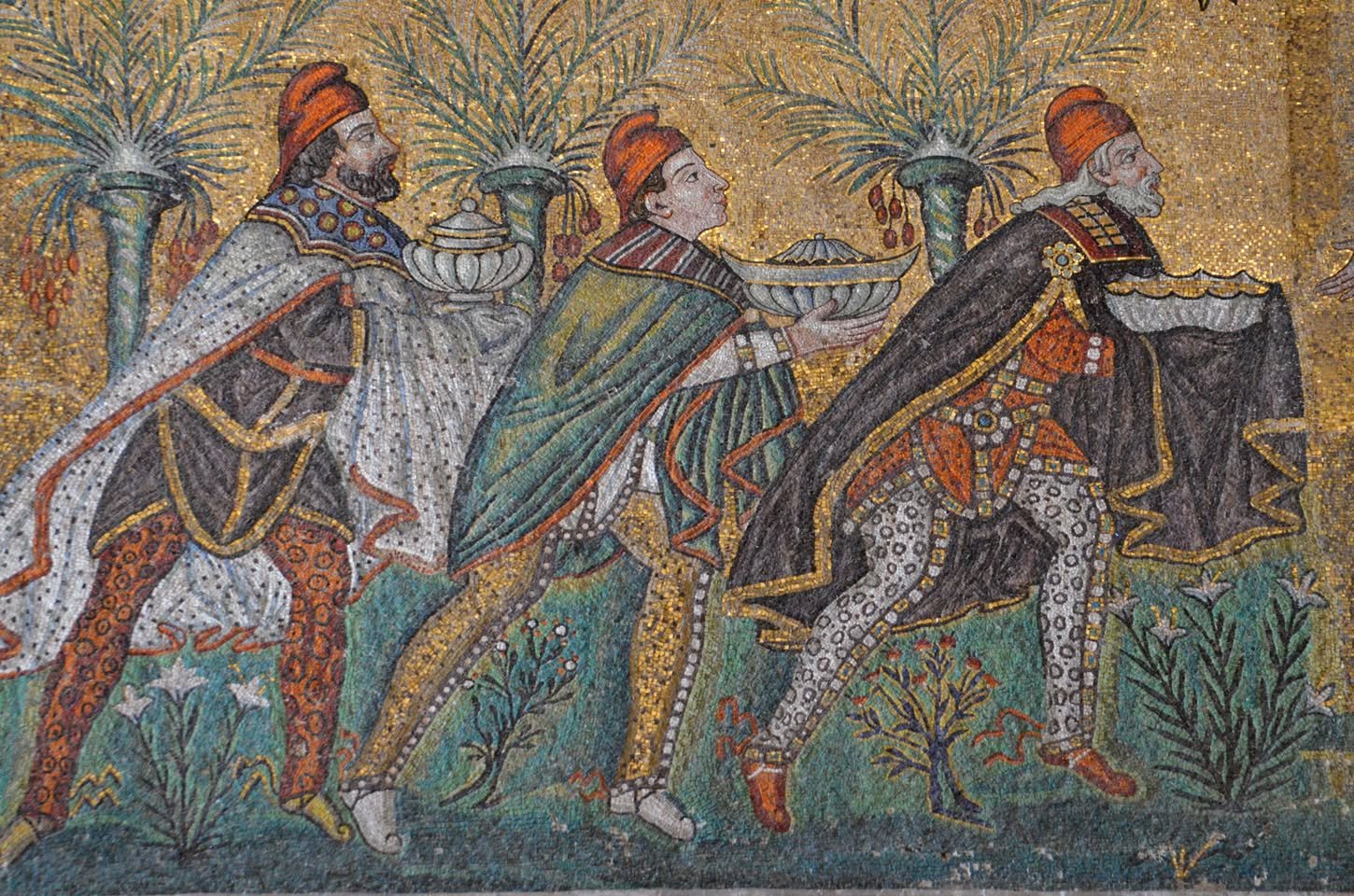
Adoration of the Magi, Ravenna, a 5th-6th century mosaic.