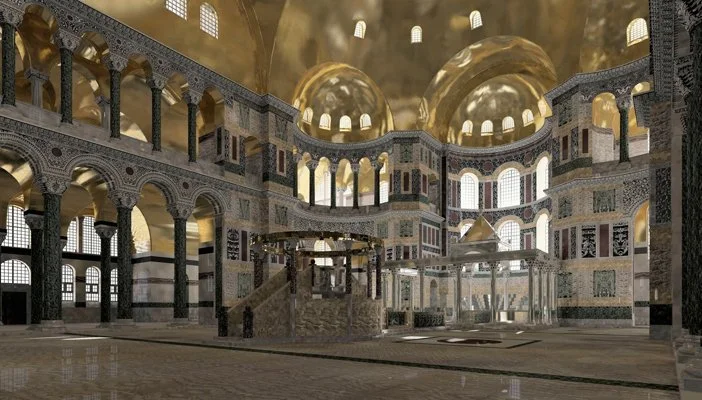
Women in Hagia Sophia
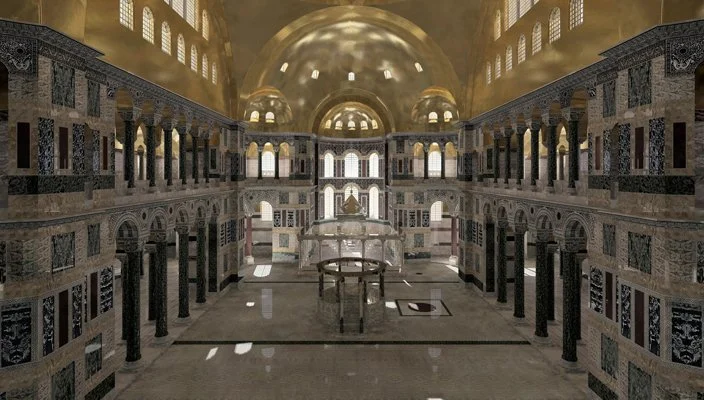
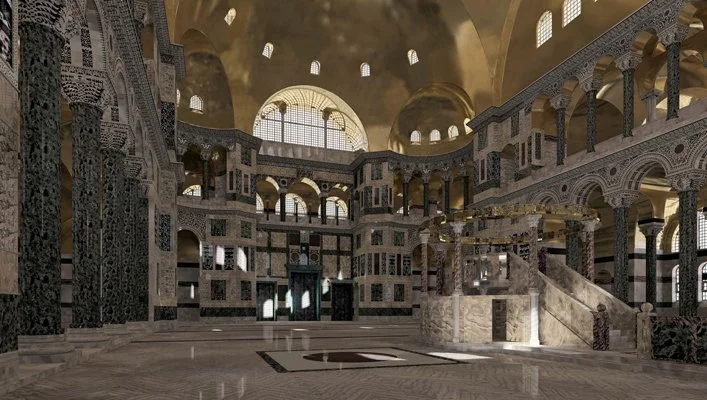
Women participated in the Liturgy of Hagia Sophia (and in other churches) almost everywhere in the church building (Taft, 1998: 87). They were restricted to the areas where men too were restricted for one reason or another.
But the empress attended the Liturgy “not with the emperor but from another metatorion [room], located in the catechumens, doubtless in the south gallery right above the emperor’s metatorion in the aisle below” (Taft, 1998: 41. As discussed below, the galleries were generally referred to as “catechumens,” which had their own stairways leading down to the outside).
From Symeon Metaphrastes’ Life of St. John Chrysostom 27, we read the following episode:
It is said… that, when [Chrysostom] elevated the Divine Bread while celebrating the liturgy, he became completely enraptured and through certain symbols saw the Holy Spirit descend upon the offered gifts. But when one of the ministers serving with him cast an eye at a certain woman of those looking down from above, and stared at her with curiosity, the vision of the Spirit was thereby driven away. [Chrysostom] did not ignore this, but removed the minister from his position forthwith… Then, providing for future eventualities, he ordered that the galleries be curtained off with veils.
Taft, 1998: 49-50; according to Taft, the curtains did not last long, as there are records of noble women showing off their refinery in jewels from the galleries to the ire of Chrysostom.
St Basil is also known to have raised the chancel barriers, when a deacon, serving the Anaphora with him, was eying a woman across the barriers.
But the galleries were not reserved only for women or for catechumens. They had multiple functions used by all sorts of people, male and female, nobles or commoners alike. Having examined various historical records referencing locations where women are sighted in the churches, Tafts summarizes his findings as follows, in part:
It is obvious, therefore, that in the sixth century, in a region not far from the capital, the catechumens were the exclusive preserve of neither the catechumens nor the women, since men of quality, at least, could be permitted to use them even during the liturgical services….
Though by the end of the seventh century the catechumen in Constantinople seems to have stagnated,… the galleries continue to be called ‘catechumena’…..
… we have no evidence whatever … that the galleries were reserved for the use of the catechumens.
Women and the imperial party attend liturgy in the galleries and have the sacrament brought to them there. An abbess with a flow of blood could attend services in the galleries of her monastery church. Ordinations to the priesthood, loyalty oaths, ghostly counsel, miraculous cures, and exorcisms were all administered there. They were used for distributing clergy stipends, for imperial receptions and dinners, for sessions of every sort of ecclesiastical tribunal and meeting of the standing synod, and so on. Oratories and the imperial apartment, refectory, and loge-metatorian could all be located there.
In short, we are faced with a collision of nomenclature and fact: the galleries may be called ‘catechumens,’ but they seem more the place of the women than of the catechumens—and indeed, the place of much more besides.
Taft, 1998: 59-60.
Patriarch Athanasius I (ca. 1309) refers to noblewomen attending liturgy from the galleries, accuses them of “show[ing] off their finery,” and recommends that they should be elsewhere, “which clearly means [for Taft] they could have been elsewhere, and that elsewhere can only have been on the ground floor” (Taft, 1998: 62).
Ordinations of Deaconesses in the Sanctuary
Robert F. Taft writes:
In the earliest extant rite for the cheirotonia of deaconesses in Byzantium, the detailed rubrics of the mid-eighth-century euchology codex Barberini Gr. 336 show an almost exact parallelism between the rite for instituting deacons and deaconesses. Both were ordained in the bema, that is, within the sanctuary, inside the temple or chancel barrier, an area of the church from which the laity—and a fortiori all laywomen—except the emperor were normally barred.
Taft, 1998: 63.
In the diaconal prayers, the deacons are referred to as “ministers at your immaculate mysteries” and were allowed to distribute the chalice at communion to the other clergy. The deaconesses, however, received the chalice in the hand and drank from it, after which they put it back on the altar without distributing it to the other clergy (Taft, 1998: 64).
The ninth-century deaconess St Athanasia of Aegina was described (in a vision her fellow nuns had) to have received the imperial insignia by two angelic visitors, who lead her into the sanctuary, according to Taft, in “the ritual approach to the altar of the Byzantine diaconal ordination rites” as follows:
When it was morning and the Divine Liturgy had begun, two of the leaders of that sacred group of nuns… observed two men, awe-inspiring in appearance and with flashing bright robes; and they had the blessed Athanasia between them. And leading her and making her stand in front of the holy sanctuary, they brought out a purple robe decorated with gems and pearls. They dressed her like an empress and crowned her head with a crown that had crosses in the front and back. They placed in her hand a jewel-studded staff and escorted her into the divine sanctuary.
Taft, 1998: 64.
Up to the 9th century, ordinations of women diaconate were highly regarded, just as male diaconate ordinations. By the 10th century in Hagia Sophia, says Taft, “we find a special place set aside for the order of deaconesses, which at that time had not yet degenerated into a purely titular grade awarded nuns, but was an order of pious women directly dependent on the bishop and attached to Hagia Sophia” (Taft, 1998: 65).
The canon 15 of Chalcedon (451) ruled that women cannot be ordained deaconess before the age of forty. By the 12th century, however, “women ascetics were called ‘deaconesses’ abusively (καταχρηστικῶς),” according to [Theodore] Balsamon, who strongly opposed the ordination of women to any grade,” stating (in his commentary on the Chalcedon canon 15):
For there is a canon ruling that women cannot enter the holy bema [the sanctuary]. How can one unable to enter the holy sanctuary exercise the ministry of the deacons?
As quoted in Taft, 1998: 64.
Canon 69 of Trullo forbids all the laity to enter the sanctuary, male or female (Taft, 1998: 80). But there is no canon banning women from entering the sanctuary, while allowing men to do so under the similar circumstances. There is no canon banning women ordination. To my knowledge, no one knows why the practice of women diaconate ordinations ceased presumably since the 12th century.
Chrysostom in Antioch in 390, still a presbyter, instructed that a virgin should be made to stay at home: “It is necessary to keep her away from funerals and night vigils” (as quoted by Taft, 1998: 72).
Canon 35 of the Council of Elvira in Spain (305 CE) prohibited women from vigils in the cemeteries “because of the well-known abuses accompanying mourning rituals” (Taft, 1998: 72).
However, St Thomaïs of Lesbos, a married laywoman of the first half of the tenth century, a commoner, who spend most of her life in Constantinople “is described in her Vita 10 as moving freely about the capital alone, day and night, visiting shrines and participating in processions” (Taft, 1998: 73).
But as early as 398, Chrysostom preached in Antioch against carousing in the taverns after spending all nights in vigils:
You have turned the night into day by means of holy vigils. Don’t change day into night with intemperance and gluttony… and lascivious songs. You honored the martyrs by your presence [in church], by hearing [the lessons]… honor them also by going home… Think how ridiculous it is after such gatherings, after solemn vigils, after the reading of Sacred Scripture, after participating in the Holy Mysteries… that men and women are seen passing the whole day in the taverns.
As translated and quoted by Taft, 1998: 83.
The same problems existed then, as they do now. But the revival of the venerable tradition of ordaining deaconesses seems to be urgent now more than ever after centuries of neglect.
Thankfully, on May 2, 2024, Angelic Molen of Harare, Zimbabwe, was ordained Deaconess Angelic in the Greek Orthodox Patriarchate of Alexandria and all Africa. She was elevated to archdeacons two days later, with the full title: Archdeacons Angelic-Phoebe Molen. See also St Phoebe Center for the Deaconess.