

Anselm and the Byzantine Synthesis
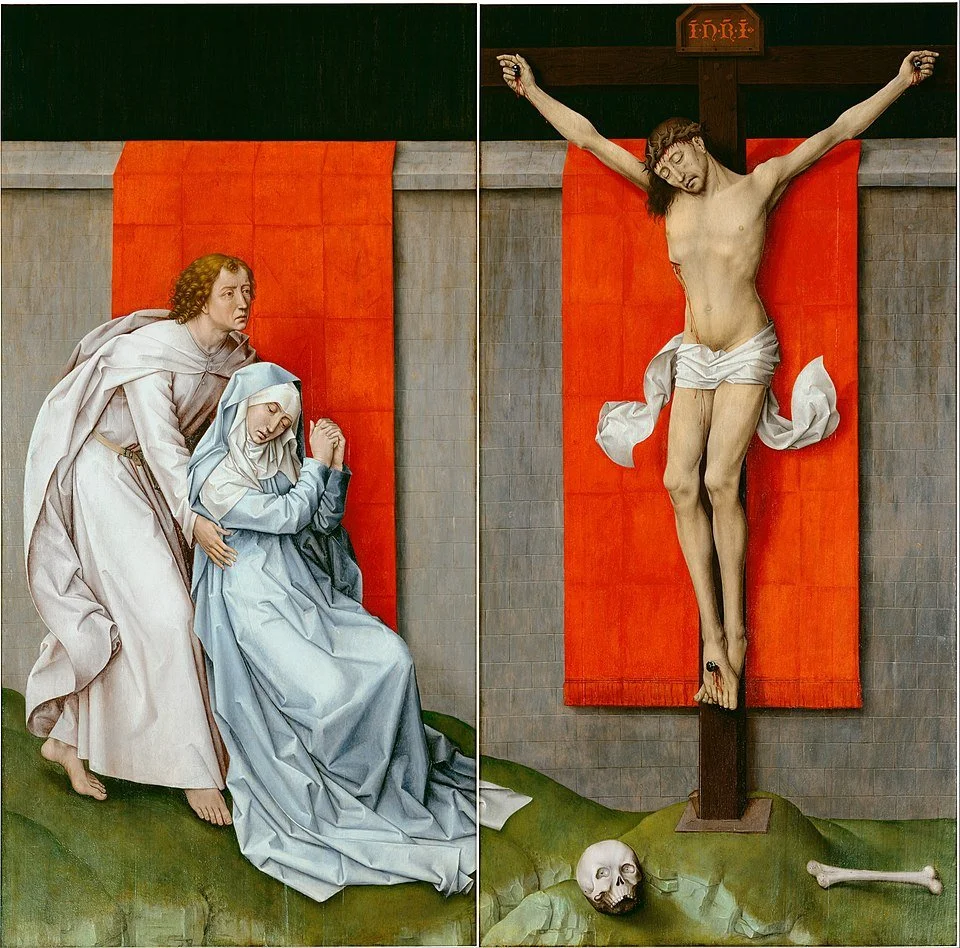
Crucifixion Diptych (c. 1460) by Rogier van Der Weyden
Philadelphia Museum of Art
St Anselm, the Archbishop of Canterbury (1093-1109), is arguably one of the most important theologians in the West. His substitutional theory of atonement was accepted by the Reformers and became a dominant soteriology throughout the subsequent centuries, even to this day and even in the Orthodox churches. (See Cabasilas.) He is largely responsible for the understanding of Christ’s sacrificial work as substitution for our sins: Christ suffered the punishment and sacrificed himself for our salvation; He died so that we may live. Thus, Anselm managed to reduce a thousand-year old history of Christian theology to a single idea: substitutional atonement.
The substitutional theory of atonement is not entirely wrong, however. The following passage from Isaiah, for example, offers a support for the theory:
Surely he hath borne our griefs, and carried our sorrows… he was wounded for our transgressions, he was bruised for our iniquities.
Isaiah 53.4-5; KJV.
If the above passage is a prophecy written in eloquent poetry regarding the meaning of the crucifixion that Christ was to suffer in the future, it was Anselm in late 11th-century who first rationally explained, justified, and reduced the meaning of Christ’s death to a vicarious death. Anselm provides a rational explanation as to why Christ, the God-Man, had to become man and die to recompense for human sin in totality. His argument does not cite the Bible for support, just as his famous ontological argument for the existence of God does not. Anselm excels in human rationality to the detriment of experiencing the Divine as Mysteries.
Even though 1 Peter 3.18, for another example, attests to the idea of substitutional atonement (“For Christ … suffered for sins once for all, the righteous for the unrighteous…”), it was not until Anselm when the idea of substitutional atonement became the dominant theory in Christian soteriology.
His theory achieved remarkable success to the point where the word ‘sacrifice’ became synonymous with ‘substitutional death,’ as in, for example, ‘sacrifice hit’ in baseball. After Anselm ‘sacrifice’ became synonymous with ‘substitutional atonement.’
Influenced by Anselm no doubt, William Tyndale in the 16th-century will invent the word “atonement” in order to translate the Hebrew word for sacrifice, קרבן (qorban). The Hebrew noun literally means ‘cause to come near’ (Moffitt, 2022: 163), as in the Greek verbs, προσφέρω, meaning ‘to present,’ ‘to offer;’ ἱεραγέω, meaning ‘to carry offerings;’ and λατρείω, meaning ‘render as offering,’ from which we get λατρεία, meaning ‘worship’ or ‘service’ [rendered by servant]—the word that Council of Nicaea II in 787 distinguished from ‘veneration,’ προσκύνησις. Even the word for ‘attention’ (προσοχή, ‘attention,’ ‘diligence,’ ‘care,’ ‘soberness’) as in “Let us attend” (πρόσχωμεν) that the deacon shouts during the Liturgy, has the idea of ‘to go to,’ ‘approach’ (προσχωρέω).
Slaughter is not part of the meaning of the word ‘sacrifice’ either in Hebrew or Greek. ‘Sacrifice’ simply means ‘offering,’ or drawing near to offer the sacrifice/offering. Simply put, serving a meal is a sacrifice both in the nominal and verbal sense.
Another Hebrew word that is frequently (mis)translated as ‘atonement’ by Tyndale and the subsequent translators, is כפר, kipper, which refers to “both ransoming and purifying effects” (Moffitt, 2022: 109). Here, too, there is no concept of ‘substitution’ in the Hebrew word. Nonetheless, the word is often mistranslated as ‘atonement.’ See Leviticus 16 in Milgrom’s accurate translation and Robert Alter’s adoption thereof in his own subsequent translation.
The Anselm’s rational justification and reduction of Christ’s salvific work to a concept of (substitutional) atonement had a devastating affect, however, as Vladimir Lossky observes:
It was Anselm of Canterbury, with his treatise Cur Deus Homo [Why God-Man?], who undoubtedly made the first attempt to develop the dogma of redemption apart from the rest of Christian teaching. In his work Christian horizons are limited by the drama played between God, who is infinitely offended by sin, and man, who is unable to satisfy the impossible demands of vindictive justice. The drama finds its resolution in the death of Christ, the Son of God who has become man in order to substitute Himself for us and to pay our debt to divine justice.
Lossky, 1974: 99.
Once the exclusive focus is on Christ’s work on the cross understood as substitutional sacrifice, all other dimensions of His work recedes in the background, such as Incarnation, Resurrection, Ascension. Thus, the entire patristic theology as a whole becomes quaint, if not irrelevant. As Lossky asks: “What becomes of the dispensation of the Holy Spirit here?” (99) As he puts it further:
The price of our redemption having been paid in the death of Christ, the resurrection and the ascension are only a glorious happy end of His work, a kind of apotheosis without direct relationship to our human destiny. This redemption theology, placing all the emphasis on the passion, seems to take no interest in the triumph of Christ over death.
Lossky, 1974: 99.
The vicarious death of Christ has nothing to say about Christ’s victory over “death by death.” Justification by faith says nothing about victory over death, about breaking the bondage of injustice and evil. Christian faith becomes a matter of saving individual souls in the midst of and despite the systemic and global injustice and destruction. One cannot be happy in a republic that is corrupt. This conclusion is reached from the outset before Socrates in Plato’s pen lays out the ideal of just and virtuous soul in the republic that corresponds to it in terms of those same qualities. No matter how virtuous one is, she cannot be happy as an individual, unless the society that surrounds her is just. Likewise, no soul can be said to have achieved salvation without the concomitant redemption of the world. In fact, the Bible hardly speaks of salvation of the individuals. It is Buddhism that speaks of individual enlightenment. No society as a whole can achieve enlightenment. Enlightenment exclusively belongs to the individual so much so that, having achieved it, one loses oneself, including one’s individuality. And yet the surrounding society remains the same. Buddhism is an escape from the society; whereas Christian monasticism retreats from the society in order to save it.
Christ’s work, we should further note, is so broad and cosmic in its implication that it cannot be reduced to His passion on the cross alone. There is His birth—the Incarnation which is as wondrous as Creation itself—the healing of the sick and the liberation of the demon possessed, the proclamation of the Kingdom of God, liberation of the oppressed and the captives, and giving sight to the blind (Luke 4.16-21). Most importantly, as already mentioned, there is Resurrection, Ascension, and the Pentecost. To this list, we must add another important notion: theōsis, the divinization of humans in the vision (θεωρία, ‘beholding’) of God. Do these fundamental theological concepts have anything to do with a soteriology that almost entirely rests on the vicarious death of Christ?
Anselm’s theory of atonement would have very little to say about these fundamental concepts that the patristic theology in contrast have been discussing for centuries. St Athanasius of Alexandria, for example, offers an entirely different understanding of Christ’s work, when he says:
Christ, having delivered the temple of His body to death, offered one sacrifice for all men to make them innocent and free from original guilt, and also to show Himself victorious over death and to create the first fruits of the General Resurrection with His own incorruptible body.
Athanasius, De incarnatione verbi, 20; PG 25, col. 129D-132A; as quoted in Lossky, 1974: 99-100.
The idea of descent in order to assume humanity at its lowest point (the cruel and unjust death) before ascending back to God with the assumed and redeemed humanity along with the other creations to uplift, to divinize, and thus to bring them all to God in union and in offering, is central to Athanasius as it is in other patristic fathers, such as St Irenaeus of Lyon and St. Maximos the Confessor, to cite only a few.
Irenaeus:
… if the Word is made man, it is that men might become gods.
Against Heresies, V pref., col. 1035; as quoted by Lossky, 1963: 42.
Athanasius:
The Word was made a bearer of the flesh (σαρκοφόρος), in order that men might become bearers of the Spirit (πνευματοφόροι).
On the Incarnation, PG 43, col. 172BC; as quoted by Lossky, 1963: 70. Φορέω means: to bear.
Maximos the Confessor:
… just as God by His condescension [συγκαταβáσει] is and is called man for the sake of man, and also so that the power of this reciprocal disposition might be shown forth herein, a power that divinizes man through his love for God, and humanizes God through His love for man. And by this beautiful exchange, it renders God man by reason of the divinization of man, and man God by reason of the Incarnation of God.
Ambigua, Ambiguum 7, 1084C; Constas trans. (2019).
Divinization (theōsis, θέωσις, ‘making divine’) is the goal and apex of Orthodox theology. Luther’s obsession, in contrast, with one’s justification before God—an idea grounded in Anselm’s legal theory of substitutional atonement—cannot be the sum total of Christian soteriology. Justification before God, to be sure, must be a part of the gradual and dynamic process of becoming divine, like God, within (and without abandoning) our humanity as children of God.
Furthermore, is justification a phenomenon that occurs in time and space? Does it begin or take effect when one believes Christ to be ‘the Lord and Savor,’ as the American evangelical mantra puts it. Does it take effect at the moment of our sincerely held belief about Christ and His work?
The faith that rests on historical Jesus ends up resting on one’s subjective belief about Him. Correllarally, the objective fact of Christ then becomes a matter of subjectively and sincerely held belief. Such is the danger we face when everything boils down to one’s own belief. How can God’s cosmic work depend on one’s subjective invididual faith?
More importantly for our purposes, Anselm’s substitutional theory of atonement distorts the meaning of the word ‘sacrifice.’ As we have argued above and elsewhere in these pages, the primary meaning of ‘sacrifice’ does not refer to or imply ‘substitution’ or ‘exchange.’ It strictly refers to the act of ‘giving’ or (bringing the) ‘offering.’ See above, Introduction, and the Great Entrance.
Anselm is largely responsible for the (mis)understanding the concept of sacrifice as substitution or (substitutional or vicarious) death of atonement. He is responsible for the phrase ‘substitutional atonement’ becoming a pleonasm, as the word ‘substitution’ comes to mean ‘atonement.’ This is how William Tyndale in the 16th-century translated the Hebrew words for ‘sacrifice’ or ‘offering.’ In so doing, Hyndale invented the word ‘atonement,’ thus setting a precedence for Shakespeare to do the same when writing his plays.
In short, for Tyndale sacrifice means substitution. René Girard in the 20th-century picked up on this and further pushed the idea of sacrifice to mean ‘scapegoating.’ For Girard, ‘sacrifice’ means ‘scapegoating,’ thus it is intrinsically unjust, immoral, and had to be stopped, as it was by Christ who, as the blameless Son of God took the blame, and was blamed for all humanity’s guilt. His death (i.e., killing God’s Son) was so scandalous, the practice stopped, according to Girard. This is a very ingenious exeggeration and a very creative hypothesis resting on sheer fantacy. But it assumes Anselm’s theory of atonement.
As already said, these deviant concept of sacrifice invented in the medieval and modern times belie the Hebrew text (Lev 16) and the corresponding Greek text, the Septuagint, that the Hellenic Jews translated correctly two centuries before Christ. These modern concepts betrays the ancient texts that gave rise to the concept of sacrifice in the first place.
The following passage in Romans, however, may be taken as giving credence to Anselm’s substitutional atonement theory, as we are accustomed to reading it that way:
Much more surely, therefore, since we have now been justified by his blood, will we be saved through him from the wrath of God.
Rom 5.9.
Here however, if one reads the passage carefully, we do not necessarily find the idea of substitution but rather the Levitical notion of purification by blood, as prescribed and described in Leviticus 16. Steeped in Pharisaic Judaism, Paul is thinking of the Levitical sacrifice of purification rite on the Day of Purgation (Yom Kippur). He does not necessarily refer to slaughter here either, although drawing blood may presuppose it.
In Leviticus blood, functioning as an apotropaic agent, is used to cleanse the certain parts of the Ark in the Holy of Holies and certain parts of the outer altar, so that the sacrifice can begin thereafter—so that the rite of ‘bringing’ and ‘offering’ up the gifts of bread or meat to God (by the priest) may begin, thereby a communion with God can be established or renewed, so that YHWH would be their God and the Israelites His people. The same idea of the communion rite preceded by purification rite persists throughout the Bible—in the Old and the New—even in Revelation, for example, where the whole world must be purged before the New Jerusalem may descend from heaven—the New World in which
He will dwell with them; they will be his peoples; and God himself will be with them and be their God.
Rev 21. 3.
God does not think in terms of (legal) justification. The two Reformers, Luther and Calvin, both former students of law, ran with Anselm’s (legalistic) concept of substitution or quid pro quo. The rest is history, to use a cliche, where Christian soteriology is understood almost exclusively in terms of the theory of substitutional atonement (pleonasm), thanks in large part to Anselm and the Reformers.
When Nietzsche (d. 1900) criticizes Christianity, he is mainly referring to Anselm (i.e., ressentiment) and his contemporary theologian, Schleiermacher (d. 1834) (i.e., the infantile and herd mentality, further developed by Sigmund Freud (d. 1939) subsequently).
The Substitutional Theory of Atonement
More specifically, in his seminal work, Cur Deus Homo (Why God Became Man, or literally, ‘Why the God-Man,’ 1098), Anselm proposes that God’s justice cannot tolerate human sins, on one hand; and God’s love cannot allow punishing humans appropriately and deservedly in accordance with their sins, on the other. To forgive sinful humanity without appropriate recompense would be, as he puts it, “to upset the right order of things, [and, as consequence,] there would be in the universe… a certain ugliness, resulting from the violation of the beauty of order…” (Bk 1. 15; Anselm, 1998: 288). A whole-sale, unconditional cancellation of debts (or forgiveness of sins), according to him, would destroy the order of things and the beauty therein that God had established. Preserving God’s harmonious and beautiful order (that which also obeys logic of reason) is sacrosanct for Anselm.
To resolve the conundrum he projects into God’s logic (namely, the tension between divine justice and divine mercy), Anselm proposes the following solution: Only a being who is equal to God can adequately bear the magnitude of human sin in its totality, on one hand; and only a genuine human being can pay for the sins that they themselves have committed, on the other. As he puts it succinctly, “no one can pay [the recompense] except God, and no one ought to pay except man” (Bk 2. 6; Anselm, 1998: 319). Thus, only Christ—being fully God and fully man—must bear upon Himself the punishment that only humans deserve. Thus, Christ’s vicarious death on the cross satisfies both God’s justice and His mercy at the same time and in the single event of the Crucifixion. In short, only God-Man Christ can satisfy the requirement that Anselm sets forth: “recompense ought to be proportional to the magnitude of the sin” (Bk 1. 20; Anselm, 1998: 302). Proportionality and beauty (as we have seen) are harmonious and sacrosanct.
The outcome of this marvelously rational solution to God’s conundrum (projected anthropomorphologically) is that only Christ’s sacrificial death can substitute for the death we deserve; and only His divine flesh given up for “a ransom for many” (Mark 10.45) can release us from the debt we owe to God or from the bondage of death. Thanks to Christ’s sacrifice in perfect obedience, God can now forgive our debts without upsetting his divine justice and “the right order of things.” Only Christ, and no one else, can pay for our debt. Our redemption is a free grace paid for by Christ’s sacrifice alone. These are familiar sounding shibboleths.
The Protestant Reformers
Martin Luther (d. 1546), John Calvin (d. 1564), and other Reformers will later argue further and maintain that in His death Christ’s own righteousness is transferred and imputed upon us. Thanks to his death in perfect obedience, we are deemed righteous by being covered over by Him. That is, as if God sees us through Christ’s righteous living and his obedient death. We are robed in Christ’s righteous and are thus made righteous in God’s sight. In this view, becoming Christ in imitation and union with Him loses its relevance. Why imitate Him when we can be made righteous through Christ “while we are yet sinners”? Instead of being like Christ, we wear the cloak of His righteousness and be deemed righteous and pleasing to God. Wearing Christ’s robe takes no efforts, furthermore, but only one’s own belief in Him: that, as a Protestant hymn puts it, “nothing but the blood of Jesus washes away my sin.”
Consider Martin Luther:
[T]he moment you begin to have faith, you learn that all things in you are altogether blameworthy, sinful and damnable. When you have learned this, you will know that you need Christ, who suffered and rose again for you, so that if you believe in him, you may, through faith, become a new man, in so far as your sins are forgiven, and you are justified by the retie of another, namely of Christ alone.
Martin Luther, “The Freedom of a Christian” (1520), 1961: 55f.
Consider John Calvin:
… all the righteousness of men collected into one heap would be inadequate to compensate for a single sin. For we see that by one sin man was so cast off and forsaken by God, that he at the same time lost all power of recovering salvation.
Institutes of the Christian Religion (1559), Book 3, Chapter 14, Section 13; Henry Beveridge, trans. 1845.
Calvin, again, employing Aristotle’s four causes:
The efficient cause of our eternal salvation the Scripture uniformly proclaims to be the mercy and free love of the heavenly Father towards us; the material cause to be Christ, with the obedience by which he purchased righteousness for us; and what can the formal or instrumental cause be but faith? […] … Christ is both righteousness and life, and that the blessing of justification is possessed [by us] by faith alone.
Calvin, Institutes of the Christian Religion, 3. 14. 17.
The vicarious salvific death of Christ on the cross can be brought to bear on us now only by faith—by believing that His righteous, unjustly condemned by man and paying for our unrighteousness, becomes our own righteousness freely given in an exchange in which our condemnation is exchanged for His righteousness, and His condemnation for our righteousness. Bonheoffer calls this “cheap grace,” a free credit when you are totally bankcrupted. Grace, then, no longer refers to the free working of the Holy Spirit to deify us. It means ‘free credit’ without works, ‘free lunch’ as it were.
Let me make two more points here against Anselm: (1) It is not clear how the exchange of Christ’s righteousness for our unrighteousness preserves “the order of things,” no matter how great Christ’s righteousness and our unrighteousness may be. Why must there be an exchange? If there must be arguendo, is it fair? Even if, as Anselm says, the magnitude of Christ’s divinity matches proportionally, if not exceeds, the magnitude of our sins; why should there be proportionality in the first place. Why must there be a balance in God’s universe? Is not forgiveness always already disproportionate and does it not exceed the crimes committed? To ‘for-give’ means to give more than deserved. See the parable of the Prodical Son, where the father’s prodicality exceeds the son’s in reverse (Luke 15).
Moreover, still with respect to Anselm, it would not be correct to say that in becoming man Christ substitutes His divinity for our humanity or His righteous for our unrighteousness. To affirm such a substitution or exchange would detail the supposedly beautiful order of things that Anselm holds dearly. For it is fundamentally unfair to replace righteousness for unrighteousness; and it would be degrading for Christ to replace his divinity for our humanity. This is so—unless there is Resurrection that would correct it all—the resurrection about which Anselm remains silent in his theory of atonement.
Resurrection derails exchange logic that Anselm employs. For it is the Event that resets all things, like the initial Creation itself did. In resurrection everything becomes new, including our sinful human nature. Thus, Paul says it: “[Christ] was raised for our justification” (Rom 4.25); “behold, everything becomes [γέγονεν] new” [γέγονεν is perfect active indicative 3rd singular of γίνομαι, which is present middle indicative first singular of γίγνομαι, ‘to become’ or ‘to come to be’]” (2 Cor 5.17, translation mine, following the “ancient authorities” in the text). Being in Christ thus means being created anew: being deified.
To assert yet another point against Anselm, God’s recapitulation does not rely on human logic but God Himself alone. He saves; He makes things new by creation, recreation, and resurrection. Salvation is wholly the work of God that gives new life in Resurrection. That is why we need to join Christ in his death and resurrection so that we may “walk in newness of life” (“Therefore we were buried with him by baptism into death, so that, just as Christ was raised from the dead by the glory of the Father, so we also might walk in newness of life” (Rom 6.4)).
To be sure, this new life in Christ is not a life after death. It is the present (divine) reality expressed in the present indicative: “Behold, now is the day of salvation!” (2 Cor 6.2). The eschaton [ἔσχατος, the fullness or completeness of the reality] has already begun. Salvation is here and now already. This reality does not depend on one’s subjecive faith (no matter how sincerely held) but on God’s act alone and the grace of the Holy Spirit. Salvation requires faith understood as bonding with or adhering to God. In this sense, faith is prayer, an outpourinng of oneself to God (I Sam 1.15), an offering to God that arises like incense, like an evening sacrifice (Psalm 141.2).
Anselm’s View on the Eucharist
The impact of Anselm’s substitutional theory of atonement is direct and far-reaching for the understanding of the Eucharist. In his view, the Eucharist becomes a penitential sacrament that connects the individual to the historical and salvific work of Christ at Calvary. The Sacrament thus becomes individual, devotional, and pietistic—quite similar to the allegorical understanding the Eucharist offered by Philoxenus of Mabbug (ca. 500). See Symbol.
Anselm writes in Meditatio III redemptionis humanae, referring to Christ’s utter obedience in taking the chalice at the Garden of Gethsemane:
This let thy heart chew, O man, this let it ruminate, this let it suck, this let it swallow when thy mouth receives (accipit) the Body and Blood of the selfsame, thy Redeemer. Make this in this present life thy daily bread, thy viand and viaticum, for by means of this and by nothing except this shalt thou at once remain in Christ and Christ in thee….
Meditatio III, p. 89; as quoted by G. H. Williams, 1957: 266. ‘Viand’ is ‘an article of food.’ ‘Viaticum’ is ‘The Eucharist given to a dying person;’ ‘a supply of provisions for a journey.’
By engaging in an individual meditation on the meaning of the Eucharist, one can, according to Anselm, be united with Christ in his perfect obedience. His obedience covers over and purges our disobedience, if we chew, mull over, and swallow the Bread and the Wine, the Body of Christ. The Bread and the Cup become a means of our union with Christ through meditation. The act of receiving the Body of Christ becomes itself an allegory that deepens one’s meditation through which we can “remain in Christ and Christ in three.” The metaphor of chewing or ruminating must be taken to be mental exercise.
If baptism signifies the entry into the new life in Christ (by immersion), the Eucharist is the spiritual daily bread necessary to maintain the new life gained thereby through baptism. As a commentator of Anselm, G. H. Williams, puts it, “all men may participate in the action of the one Man, not preeminently through the sacramental death of baptism… but through the sacramental obedience of the eucharist” (Williams, 1957: 168).
We participate in Christ’s obedience—not so much in Christ’s divinity—that satisfies God’s justice. This is so, because, for Anselm, what matters is the legality of God’s forgiveness, which was offered despite human disobedience. What matters is our justification before God—the idea that obsessed Martin Luther some 400 years later.
Thus, the long standing patristic goal of attaining theōsis (divinization or deification) is entirely forgotten. In fact, Anselm never speaks of theōsis: “Anselm has no trace of the deificatory theory in his writings,” notes Williams (1957: 268).
Implications of Anselm’s Theory
If Christ suffered on our behalf as a payment for our sins, the Body of Christ represented by the Bread and Wine testifies to His suffering on the Cross, the very act of substitution that redeems us. His death offered once and for all in history is sufficient enough for our redemption here and now. The sacrament of the bread and wine in the present, then, only remind us of his salvific act Christ’s carried out in perfect obedience in the past. We are deemed righteous, thanks to His sacrifice on Golgotha. What remains for us is the obligation to be grateful and thankful to Christ for his vicarious suffering and death and for his act of love in substituting Himself for us in death. It is hoped, moreover, that such a gratitude one feels toward Christ for his vicarious death on the Cross would result in our good works. Our piety, it is hoped, would lead to our good deeds. Thus, the Eucharist becomes a penitential means of imputing Christ’s righteousness upon us. From this it is only a small step to arrive at the Reformer’s conclusion: that the bread and wine merely represent the Body of Christ that was once broken and His Blood shed for us to pay for our debts once and for all. The real presence of Christ on the altar of the church, which was in vogue at the time of Anselm (the 11th-century), became unnecessary and later became a heresy to be eliminated.
Moreover, in Anselm’s theory, the meaning of Christ’ resurrection recedes into the background. This short coming rests on the fact that the theory forces us to concentrates on the Cross, the very act of Christ in perfect obedience. The focus on the cross without understanding it as a part of the other side of the coin, resurrection, goes against what St Paul declares: that it is the resurrection by which we are justified: “[Christ] was handed over for our trespasses and was raised for our justification” (Rom 4.25). For Paul, justification rests on the Resurrection, not in his death. When death is defeated by death, our life in Christ receives final justification and vindication. Because of His resurrection, we have the hope of victory over sin and death, and exclaim: “Where, O death, is your sting?’ (1 Cor 15.55). Crucifixion alone cannot accomplish the victory.
Anselm’s Impact
Nevertheless, Anselm’s substitutional theory of atonement is deeply engrained in the West. J. W. Goethe (d. 1832), for example, captures the idea of substitutional atonement perfectly, when he writes about Ottilie’ death in his novel Elective Affinities (1809):
She saw herself as the source of all misfortune, and only in annihilation could she find purity.
Elective Affinities, Part 2, Chapter 18.
Ottillie is portrayed as innocent and pure, despite her love for Eduard that is never consummated. Her death by suicide, however, brings about (it is hoped) purification in the otherwise adulterous marriage involving the quartet within the same household: between Charlotte and Eduard in marriage that leads to the birth of a child named Otto (who is conceived while each was thinking of the other lover outside the marriage), between Charlotte and the Captain in an adulterous relationship that was never consummated, and between Eduard and Ottillie in a similar adulterous relationship without consummation. In this way, the quartet is intertwined in a triple relationship within the same household. The only consummation in these triple pairs of illicit romantic relations takes place within the legitimate but joyless marriage. Otto—the child who is conceived in physically legitimate marriage is, through no fault of his, illicitly borne of spiritual adultery—is sacrificed, though accidentally in a boat incident. Like Otto’s, Ottillie’s death (by suicide), fated by her love for Eduard, substitutes for the deep transgression involving the quartet that permeates the household. It is hope that her and Otto’s sacrificial death would purify the household that harbored the triple adulterous relationships.
For Goethe, as for Anselm, sacrifice must involve death, a vicarious death. To sacrifice is to die in substitution.
Sacrifice in Leviticus
But must sacrifice involve death? If so, how can we offer “our bodies as a living sacrifice”? as Paul exerts us to do (Rom 12.1). A living sacrifice cannot die. Since our lives must be presented as a living sacrifice, death brings to us the end of sacrifice. One must live in order to be a living sacrifice. To sacrifice is to offer oneself to the Other—before one dies. One must sacrifice without dying. In short, one must live in order to offer oneself as sacrifice for God and the others. Death brings an end to sacrifice, as René Girard (d. 2015) argues. For him, sacrifice means vicarious death, as in Anselm. It implies victimization.
If we examine carefully the biblical texts the notion of sacrifice involves the simple act of offering, such as offering a meal or gifts. Consider the grain offering, as described in Leviticus 2 and 6.14-18. Or one of the two goats that is chosen and lives, as it is lead to the wilderness (to Azazel) on the Day of Atonement, as so prescribed in Leviticus 16.6-10, 21-22. That is, the goat bearing the sin of Israel is lead away to the wilderness to live freely. He is not slaughtered.
Even for the bull and the goat that are slaughtered, they are killed in order to draw blood. It is the blood that is used in a certain prescribed manner that acts as the purification agent. The leftover blood, the carcass, and bones are not sacrificed on the altar but discarded outside and away from the camp (Lev 16.27).
During the purification rite, the blood is sprinkled and smeared in specific and prescribed manner to cleanse and to purify the altar (in the courtyard) and the inner curtain (Lev 16. 14, 18, 19). While the hides, flesh, and dung are burned in fire “outside the camp” (Lev 16.27), only the suet (the fat portion) is burnt “into smoke on the altar” in the court yard of the tent (Lev 16.25). It is burnt for sweet smell that arises to God, as is also the case with the grain offering (the unleavened bread or cake either baked in oven or grilled), on which oil and frankincense are smeared to burn “into smoke” on the altar in the court yard (Lev 2.2, 9, 16). The frankincense in the bread that is burnt is important, because God desires the sweet aroma. God does not take, eat, or otherwise consume the sacrifice. He smells the sweetness of the arising aroma, as the offering is burnt on the altar—the fat or the oil and frankincense on the cake.
Belief as a Means of Reaping the Benefits of Christ’s Work
Back to Anselm’s soteriology, we must note that in his theory of atonement the idea of divine life that we are to participate and to partake in here and now in the Liturgy of the Eucharist or baptism is mostly neglected and relegated to the realm of afterlife. Once we are justified by imputation of Christ’s righteousness, we are no longer under condemnation. Our task henceforth remains: How to apply and make efficacious the benefits of Christ’s substitutional death for us.
We maintain the benefits of Christ’s perfect obedience rendered on the Cross by our belief held firmly and persistently on the meaning of Christ’s work on the cross. Faith alone (Sola Fide) connects us to the salvific work of Christ at Golgotha. Faith brings us to the foot of the Cross, thus bridging the gap between the past work of Christ and the present moment of one’s salvation effectuated by one’s faith.
Thus, faith must be affirmed, reaffirmed, and perpetually maintained by refreshing our memory of Christ’s work on the cross in the past history. The Bible and the sacraments, then, function as tools for refreshing our memory, renewing our faith, and rekindling our piety and gratitude, as we saw above in Anselm’s pietistic and meditative interpretation of the Eucharist. As the Eucharist becomes a penitential sacrament, the bread and wine must be chewed and mulled over as the Body of Christ suffered on the cross for us. Our subjective faith on Christ aided by the Eucharist is what unites us to Christ’s obedient and perfect life and to the benefits of His death. The Eucharist, then, recalls Christ’s work on the cross. It does not bring Christ to us to receive—physically (and thus symbolically). We do not receive the Body of Christ, we recall his broken Body and become grateful for his substitutional suffering and death. The more vivid and realistic we recall His suffering on the cross, the more piety we can invoke within us—so it is said. See Mel Gibson’s 2004 movie: The Passion of the Christ.
The Byzantine Syntheses
Anselm’s impact does not stop with Protestants in the Renaissance and in modernity. It infiltrated into the Orthodox theology as well even before the Reformation. See Cabasilas.
The so Called “Byzantine synthesis”—the synthesis between the Antiochene emphasis on historical realism of Christ and the Alexandrian emphasis on theōsis (Taft, 1980/1981: 70)—have unexpectedly resulted in the Orthodox churches’ focus on the salvation of individual souls rather than on the redemption of the whole world. Christian ethics turned inward, toward the purification of individual souls rather than toward the society at large. The focus on hesychastic prayer and the noetic vision of God renders mute systematic and global approach to Christian ethics and politics. For, it is assumed that salvation is a matter of individual souls and that the societal transformation can be only brought about by individual transformation. (Buddhist, too, believes this way: a societal transformation by individual’s mindfulness.)
However, Jesus’ commands to “seek first the Kingdom of God and His righteousness [δικαιοσύνην]” (Matt 6.33). By righteousness He does not mean individual piety and holiness. Rather, ‘righteousness’ can and should be translated as ‘justice.’ And justice cannot be a matter of individual concerns. Justice is universal, like ethics. It aims at the society at large. For without justice peace is not possible. Peace one experiences in isolation from one’s neighbor—in one’s gated community—is not true peace; just as peace cannot be achieved by force (i.e., the so called “Board of Peace” in Palestine). In the Book of Revelations the vision of God involves purging of satanic forces in cosmic scale. A transformation not only of the individuals but of the whole world is necessary, if Christ is to reign. Thus, theōsis in the Book of Revelation refers to the New Jerusalem “coming down out of heaven from God” (Rev 21.2). It comes down to earth with the river of life flowing from its center, as in Ezekiel’s vision (Ezekiel 47) .
The focus on the individuals is a legacy not only of the Renaissance or modern individualism but of Anselm’s substitutional theory of atonement. For Christ’s universal work justifies and provides the ground for each individual’s forgiveness. While Christ carries the sin of the whole humanity by His single act on the Cross, the societal structure of humanity that give rise to the sins of humanity in the first place is entirely neglected. What is the benefit of the individual justification, while the individuals are plunged in the darkness of a corrupt and evil society. How can the righteous live in the city of Sodom and Gomorrah? Abraham’s pleads for the cities’ salvation fell on deaf ears, because the cities as a whole had to be purged. The Kingdom of God must come not only within our hearts but also “on earth as it is in heaven.” Anselm’s theory of substitutional atonement is grossly inadequate to address the collective and systematic evil in the world. A victory over “death by death” must defeat corruption and complicity that perpetuate evil in global scale.
The Cosmic Liturgy
The Liturgy must be for the whole world, as Maximus the Confessor had envisioned, when he said that the Church is both the image/icon of God and the image/icon of the world (Mystag. 2019: 197/54-55). As God’s image, the Church exhibits His glory, goodness, mercy, and justice. As the image of the world, She exhibits the world not as fallen but as uplifted and divinized. Since She exhibits the image of the divinized world, and since the world is not yet fully (or even partially) divivised, the Church is tasked to “baptize” to the ends of the world and thereby to transform it. She is to actualize God’s will on earth as it is in heaven. She is tasked to establish God’s Kingdom and His justice/righteousness on earth. Needless to say, the Church cannot baptize by wielding swords or dropping bombs but only by servitude or sacrifice—by offering and giving oneself to the Others in imitation of Christ.
Jesus said that the Gospel is fulfilled when the following Scripture from the Book of Isaiah is fulfilled:
The Spirit of the Lord is upon me, because he has anointed me to bring good news to the poor. He has sent me to proclaim release to the captives and recovery of sight to the blind, to set free those who are oppressed, to proclaim the year of the Lord’s favor.
Luke 4.18-19, quoting Isaiah 61.1.
The Gospel mandates justice: freedom of the oppressed and of the sick and the blind. Mostly the poor were imprisoned then, as they are now.
At Christ’s crucifixion, the sun became dark, and the earth shook (Matt 27.51). As we sing on Holy Friday:
The whole creation, O Christ, hath been transfigured by fear at beholding thee suspended on the Cross. The sun was darkened, the foundations of the earth were troubled, and everything suffered with the Creator of all. Wherefore, O thou, who didst endure this willingly for us, O Lord, glory to thee.
The Aposticha (Tone 1), Orthros of Holy Friday (The Twelve Passion Gospel), following the Eleventh Gospel.
The whole creation groans with Christ, according to St Paul, awaiting redemption (Rom 8.22). Christ’s work cannot be limited to the salvation of the individuals alone.
The Rise of the American Evangelicalism
If the Gospel is limited to the salvation of the individual souls, the rise of the Evangelicals such as Billy Graham—the first successful American tele-evangelist who had never pastored a church—becomes the inevitable outcome—to be then modeled after and followed by hundreds of other similar evangelists, who in their further evolution run mega churches and promote the prosperity gospel, administered by and re-enforced with the efficiency of entertainment industries and big corporations.
The so called “the later Byzantine synthesis,” I submit, paved the way towards the rise of the Reformation that on its own momentum in the 16th-century revived and brought about the extreme iconoclasm of the 8th-century. Once the sacraments are reduced to the functionality of audio-visual aides (for strengthening and refreshing our memory and faith), the extreme iconoclasm ensues, as we see in church history. If this trajectory were to continue, the Church along with Her magnificent Liturgy—with all its symbolism and pageantry—would peter out. Given this prospect, a retrieval of and revitalization of Pseudo-Dionysius’ liturgical and symbolic theology becomes an urgent task of our time.
The Testimony from the Original Precommunion Prayer
The pristine formula of the Byzantine precommunion prayer (which is now expanded greatly and offered as part of the Great Entrance, while the choir sings the Cherubic Hymn) attests to an entirely different approach toward the Eucharist, namely, that the Eucharist engenders illumination of and union with Christ by way of participation and partaking thereof. The Gifts are offered in exchange for the Gift of the Holy Spirit. There is no trace of Christ’s righteousness substituting for our sins, while the idea of sacrifice as bringing of the Gifts and offering—the proper understanding of sacrifice—is prominent.
According to Taft’s hypothesis, the following is the proposed text of the original precommunion prayer, from which the current, elaborate form of the litany of the Great Entrance (entitled as the precommunion prayers) was evolved:
And for the gift offered to our Lord God let us pray, that the good God receive it, through the mediation of his Christ, on his heavenly altar as a pleasing fragrance.
Taft, 2000: 95. He says: “The petition to receive the oblation … [as] original nucleus [of the prayer is] attested in all sources” (2000:92).
Taft interprets the original precommunion prayer just cited above as follows:
… the primitive nucleus of this litany was a petition that God receive the oblation on his heavenly altar and send down upon us in return his divine grace and the gifts of the Holy Spirit, presumably in communion, which is described, precisely, as a koinonia in the Holy Spirit elsewhere in the precommunion.
Taft, 2000: 102.
In the prayer, then, the priest petitions that God accept our gifts in exchange for sending down the gifts of the Holy Spirit upon us to bring about our communion (koinonia) with the Spirit. In short, we offer our offerings so that we may receive, as Pseudo-Dionysius puts it, “a unifying communion with [God]” (EH 444A; Louth trans.). This is the essence of the pre-communion prayer. It seeks theōsis: our encounter with Christ and thereby becoming divine ourselves.
Chrysostom, too, understands the eucharistic rite in the same way. While employing the trinitarian formula, he says in one of his sermons:
… let us approach this table and the nipple of the spiritual cup. … like nursing children let us eagerly draw out the grace of the Spirit, for to share in the divinity of Christ is to be in communion also with the Father and the Holy Spirit, who share the same divine nature. So to receive the eucharist is to receive the Holy Spirit.
Mt hom. 82 (83), 5; as quoted in Taft, 2000: 119.
Thus, the patristic and the pristine liturgical testimonies are clear: that the goal of the Eucharist is theōsis, our participation in and communion with God/Christ/the Holy Spirit. There is no mention of remembering the historical reality of Christ-Event that we are to believe firmly in faith and to remember always by means of the sacraments. Instead, we are to seek communion with the Risen Lord and His Spirit here and now by partaking in His sacrifice/offering that brings a new life in resurrection, so that God’s Kingdom may actualize “on earth as it is in heaven,” as we are thereby divinized and as God becomes present all in all in His creation.
We note in passing that communion with God/Christ/the Holy Spirit is realized in our participation in the rite of the Eucharist. The communion, however, is often misinterpreted as the communion among the faithful. This is not true. Of course, the union among the participants is implied in the union with Christ Himself, who enables the union among ourselves in the first place as the collective Body of Christ, the Church. God is One; and whoever participates in the One becomes one collectively. We participate in His oneness. But strictly speaking, communion (κοινωνία) implies our intercourse with God and, derivatively, among ourselves, the faithful.
Theōsis, furthermore, presupposes purification, forgiveness, remission of sins, virtuous life, etc. It goes without saying that one cannot commune with God while remaining sinful in darkness and evil.
The main focus of the sacraments in particular and in the Liturgy more broadly should always be our imitation and becoming of, and having communion with Christ. We “receive the Body of Christ and taste the fountain of Life,” as we take a share in His divinity in the Bread and Wine.
In his treatment of the eucharistic rite, Pseudo-Dionysius almost entirely focuses on the ritual movement, which is, according to Louth,
almost exclusively [understood] in terms of God’s love outwards to us in creation and redemption, drawing us back to him in our own answering movement of love. It is the Neoplatonic movement of procession and return …
Louth, 1989: 60, also 61.
Participation (μετουσία, ‘participation,’ ‘communion’) in the initiation (τελετή, ‘rite,’ ‘initiation in the mysteries’) into the divine reality of Christ is what happens in the Eucharist.
In the communion rite we participate in the divine procession of descent and ascent, in Christ’s humiliation, Resurrection, and Ascension—a procession that condescends before it ascends.
In the ascending movement of our sacrifice we arise like the smoke of the burnt offering (holocaust), like prayer that arises like “incense … and the lifting of [our] hands as an evening sacrifice (Ex 29.41; Lev 1.9, 13, 17, 8.28, 17.6, 23.13, 23.18; Ps 141.2). We thus offer our “bodies as a living sacrifice” (Rom 12.1), emitting the sweet aroma of Christ (2 Cor 2.15). This is the aim and reality of the Eucharist in the Divine Liturgy, wherein we participate. This is the height of the Mysteries: ἐποπτεία.
Clement [of Alexandria] reserves the negative way for those who have been initiated into the Christian mysteries. It is a contemplation of God which one reaches by way of intellectual abstractions—a contemplation which, according to Clement, ought to correspond to the ἐποπτεία, the highest degree of the mysteries of Eleusis. The use of the language of the mysteries and the effort to establish parallels between the stages of Christian gnosis and those of the Hellenic mysteries are explained by Clement of Alexandria’s attitude toward Greek wisdom: it profited in large measure by the revelation given to Israel, whether by simply plagiarizing Moses and the prophets or by receiving a partial revelation through the deceit of an angel, similar to the deceit of Prometheus, who stole the fire of Olympus in order to communicate it to mortals.
Lossky, 1974: 19.
It is not by accident that the Orthodox call the Bread and Wine the Mysteries, which in Syriac (raze) means ‘symbols’ as well as referring to the Elements. The sacred Symbols cannot and should not be reduced to rational explanation, as in Anselm. Salvation along with Creation, Incarnation, life, death, and resurrection—all these fundamental “acts of God” remain in mystery. The economy of God’s Providence cannot be reduced to a rational theory. Theology in contrast should and must remain symbolic. Symbolism is perhaps the only and best way to talk among us about God and his work for us.