

Leviticus 16.1-34
Translated by Jacob Milgrom, 1991: 1009-1011.
Leviticus 1-16, a New Translation
with Introduction and Commentary.
The Anchor Bible. New York: Doubleday.
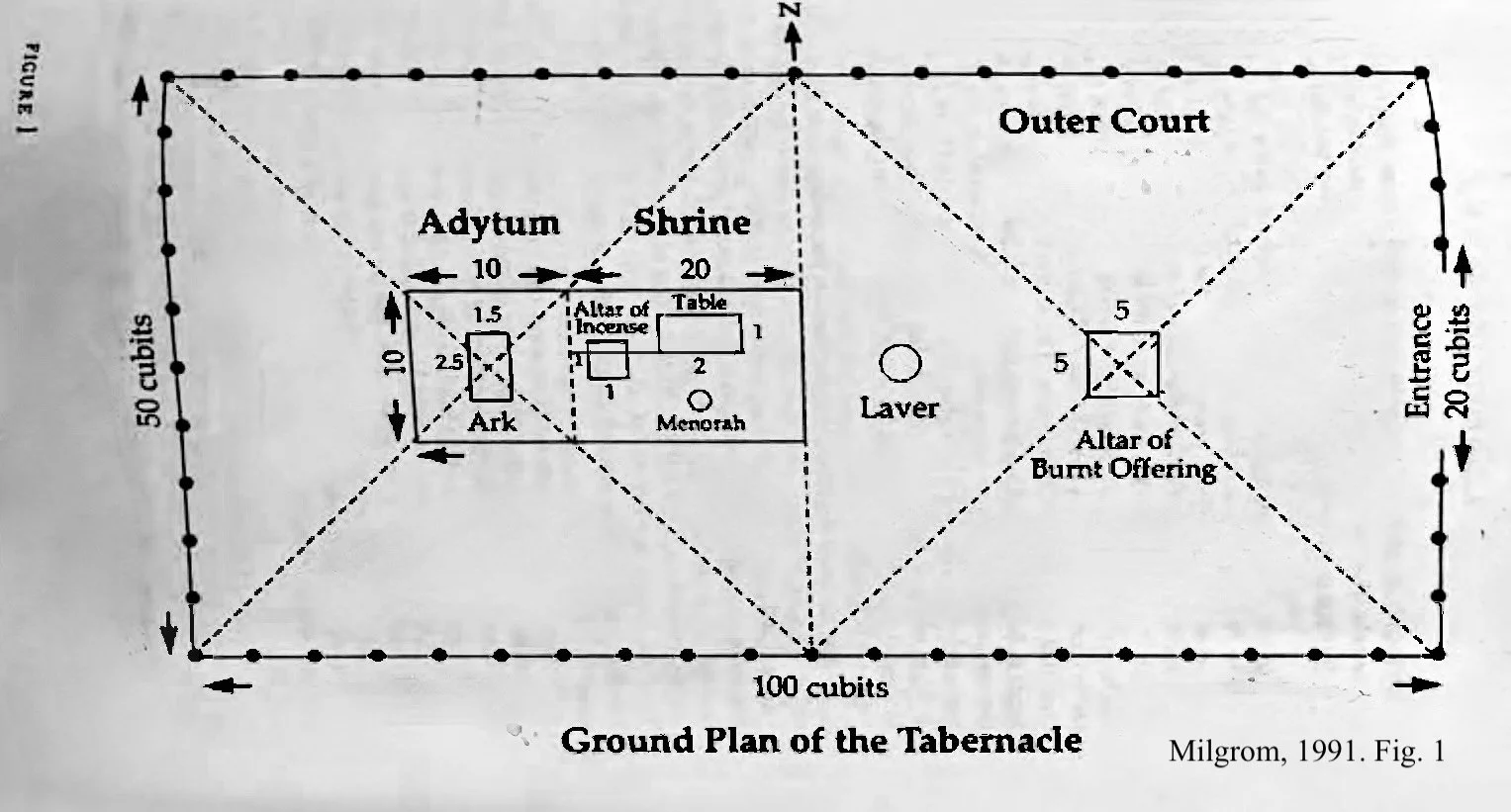
The Day of Purgation
(Yom Kippur)
(Lev 16.1-34)
Jacob Milgrom translation (1991: 1009-1011; inserts in ([…]) are CSP Lee’s).
[Introduction]
16.1. The Lord spoke to Moses after the death of the two sons of Aaron who died when they encroached upon the presence of the Lord.
[Precautions and Provisions]
2. The Lord spoke to Moses: “Tell your brother Aaron that he is not to come whenever he chooses into the adytum ([the Holy of Holies]), inside the veil, in front of the kappõret that is upon the Ark, lest he die; for by means of the cloud I shall appear on the kappõret. ([See below Milgrom’s Figure 1.)
3. This is how Aaron shall enter the adytum: with a bull of the herd as a purification offering and a ram for a burnt offering;
4. He shall put on a sacral linen tunic, linen breeches shall be on his body, and he shall gird himself with a linen sash, and he shall don a linen turban. These are the sacral vestments he shall put on after bathing his body in water.
5. And from the Israelite community he shall take two he-goats for a purification offering and a ram for a burnt offering.
[The Purgation Ritual]
6. Aaron shall bring forward his own bull of purification offering to effect purgation for himself and for his household;
7. And he shall take the two he-goats and set them before the Lord at the entrance of the Tent of Meeting ([Tabernacle]).
8. Aaron shall place lots upon the two goats, one marked “for the Lord” and the other “for Azazel” ([a demon]).
9. Aaron shall bring forward the goat designated by lot “for the Lord” to sacrifice it as a purification offering;
10. While the goat designated by lot “for Azazel” shall be stationed alive before the Lord to perform expiation upon it by sending it off into the wilderness to Azazel.
11. When Aaron shall bring forward his bull of purification offering to effect purgation for himself and his household, he shall slaughter his bull of purification offering.
12. He shall take a panful of fiery coals from atop the alter before the Lord, and two handfuls of finely ground perfumed incense, and bring [these] inside the veil.
13. He shall put the incense on the fire before the Lord so that the cloud from the incense covers the kappõret that is over [the Ark of] the Pact, lest he die.
14. He shall take some of the blood of the bull and sprinkle it with his finger on the kappõret on its east side; and in front of the kappõret he shall sprinkle some of the blood with his finger seven times.
15. He shall then slaughter the people’s goat of purification offering, bring its blood inside the veil, and manipulate its blood as he did with the blood of the bull; he shall sprinkle it upon the kappõret and before the kappõret.
16. Then he shall purge the adytum of the pollution and transgressions of the Israelites, including all of their sins; and he shall do likewise for the Tent of Meeting, which abides with them in the midst of their pollution.
17. No one shall be in the Tent of Meeting when he goes in to effect purgation in the adytum until he comes out. Thus he shall effect purgation for himself and his household and for the entire congregation of Israel.
18. He shall then come out to the altar that is before the Lord and effect purgation upon it. He shall take some of the blood of the bull and of the goat and put it upon the horns around the altar;
19. And he shall sprinkle some of the blood upon it with his finger seven times. Thus he shall purify it of the pollution of the Israelites and consecrate it.
[The Scapegoat Ritual]
20. When he has finished purging the adytum, the Tent of Meeting, and the altar, he shall bring forward the live goat.
21. Aaron shall lean both of his hands upon the head of the live goat and confess over it all of the iniquities and transgressions of the Israelites, including all of their sins, and put them on the head of the goat; and it shall be sent off to the wilderness by a man in waiting.
22. Thus the goat shall carry upon it all of their iniquities to an inaccessible region.
[The Altar Sacrifices]
When the goat is set free in the wilderness,
23. Aaron shall go into the Tent of Meeting, take off the linen vestments that he put on when he entered the adytum, and leave them there.
24. He shall bathe his body in water in a holy place and put on his vestments; then he shall go out and sacrifice his burnt offering and the burnt offering of the people, effecting atonement for himself and for the people.
25. The suet of the purification offering he shall turn into smoke on the altar.
[The Purification of the High Priest’s Assistants]
26. He who sets free the goat for Azazel shall launder his clothes and bathe his body in water; after that he may reenter the camp.
27. The purification offering bull and the purification-offering goat whose blood was brought in to effect purgation in the adytum shall be taken outside the camp; and their hides, their flesh, and their dung shall be burned in fire.
28. He who burned them shall launder his clothes and bathe his body in water; and after that he may reenter the camp.
[The Date: An Appendix - ([by P source, according to Milgrom])]
29. And this shall be for you a law for all time: In the seventh month, on the tenth day of the month, you shall practice self-denial; and you shall do no manner of work, neither the native-born nor the aliens who resides among you.
30. For on this day shall purgation be effected on your behalf to purify you of all your sins; you shall become pure before the Lord.
31. It shall be a sabbath of complete rest for you, and you shall practice self-denial; it is a law for all time.
32. The priest who has been anointed and ordained to serve as priest in place of his father shall effect purgation. He shall put on the linen vestments, the sacral vestments.
33. He shall purge the holiest part of the sanctuary, and he shall purge the Tent of Meeting and the altar; he shall effect purgation for the priests and for all the people of the congregation.
34. This shall be for you a law for all time: to effect purgation on behalf of the Israelites for all their sins once a year.
Robert Alter’s Translation of Lev 16 with Notes
(The Hebrew Bible, 2019)
1. And the LORD spoke to Moses after the death of Aaron's two sons when they came forward before the LORD and died. 2And the LORD said to Moses, "Speak to Aaron your brother, that he not come at all times into the sacred zone within the curtain in front of the cover that is on the Ark, lest he die. For in the cloud I shall appear over the cover. 3With this shall Aaron come into the sacred zone, with a bull from the herd for an offense offering and a ram for a burnt offering. 4A sacral linen tunic he shall wear and linen breeches shall be on his body and with a linen sash he shall gird himself and a linen turban he shall don. They are sacra1 garments. And he shall bathe his body in water and put them on. 5 And from the community of Israelites he shall take two he-goats for an offense offering and one ram for a burnt offering. 6And Aaron shall bring forward the offense-offering bull which is his and atone for himself and for his household. 7And he shall take the two goats and set them before the LORD at the entrance to the Tent of Meeting. 8And he shall put lots on the two goats, one for the LORD and one for Azazel. 9And Aaron shall bring forward the goat for which the lot for the LORD comes up, and he shall make it an offense offering. 10And the goat for which the lot for Azazel comes up shall be set live before the LORD to atone upon it, to send it off to Azazel in the. wilder-ness. 11And Aaron shall bring forward the offense-offering bull which is his, and he shall atone for himself and for his household, and he shall slaughter the offense-offering bull which is his. 12And he shall take a panful of fiery coals from the altar, from before the LORD, and a double handful of fine aromatic incense, and bring it within the curtain. 13And he shall put the incense on the fire before the LORD, and the cloud of incense shall envelope the covering that is over the Ark of the Covenant, lest he die. 14And he shall take from the blood of the bull and sprinkle with his finger over the surface of the cover on the east side, and before the curtain he shall sprinkle seven times from the blood with his finger. 15 And he shall slaughter the offense-offering goat which is the people's and bring its blood within the curtain, and do with its blood as he did with the blood of the bull and sprinkle it on the cover and before the cover. 16And he shall atone over the sacred zone for the uncleannesses of the Israelites and for their sins, according to all their offenses, an.d thus he shall do for the Tent of Meeting that dwells with them in the midst of their uncleannesses. 17And no person shall be in the Tent of Meeting when he comes into the sacred zone to atone until he goes out, and he shall atone for himself and for his household and for the whole assembly of Israel. 18And he shall go out to the altar that is before the LORD and atone for it, and he shall take from the blood of the bull and from the blood of the goat and put it on the horns of the altar all around. 19And he shall sprinkle over it from the blood with his finger seven times and cleanse it and consecrate it from the uncleannesses of the Israelites. 20 And when he finishes atoning for the sacred zone and for the Tent of Meeting and for the altar, he shall bring forward the live goat. 21And Aaron shall lay his two hands on the head of the live goat and confess over it all the transgressions of the Israelites and all their sins, according to all their offenses, and he shall put them on the head of the goat and send it off in the hand of a man for the hour to the wilderness. 22 And the goat shall bear upon it all their transgressions to a remote region, and he shall send off the goat to the wilderness. 23And Aaron shall come into the Tent of Meeting and take off the linen garments that he wore when he came into the sacred zone and lay them down there. 24And he shall bathe his body in water in a holy place and put on his garments and come out and do his burnt offering and the people's burnt offering, and he shall atone for himself and for the people. 25And the fat of the offense offer-ing he shall turn to smoke on the altar. 26And he who sent off the goat to Azazel shall launder his garments and bathe his body in water,.and after he may come into the camp. 27And the offense-offering bull and the offense-offering goat whose blood has been brought to atone in the sacred zone shall be taken out beyond the camp, and they shall burn their hides in fire and their flesh and their dung. 28And he who burns them shall launder his garments and bathe his body in water, and after he may come into the camp. 29And it shall be a perpetual statute for you: in the seventh month on the tenth of the month you shall afflict yourselves and no task shall you do, the native and the sojourner who sojourns in your midst. 30 For on this day it will be atoned for you, to cleanse you of all your offenses before the LORD you shall be cleansed. 31It is a sabbath of sabbaths for you, and you shall afflict yourselves, an everlasting statute. 32And the priest shall atone, who will be anointed and who will be installed to serve as priest in his father's stead, and he shall put on the linen garments, the sacral garments. 33And he shall atone for the holy sanctuary and for the Tent of Meeting, and he shall atone for the a1tar, and for the priests and for al1 the assembled people he shall atone. 34And this shall be an everlasting statute for you to atone for the Israelites for all their offenses once in the year." And he did as the LORD had charged Moses.
CHAPTER 16 NOTES
1- after the death of Aaron's two sons. As 'Rashi, Abraham ibn Ezra, and many traditional and modern commentators variously observe, the death of Aaron's sons when they presumptuously entered sacred space is mentioned to alert Aaron to the mortal danger he and his successors run in entering the Holy of Holies on the Day of Atonement.
when they came forward. This is the verb regularly used for coming before the divine presence in the sanctuary. When the act is unauthorized, the implication of the verb is "to encroach."
2_.the sacred zone. In the present context, the meaning ofhaqodesh ("the holy") is clearly the Holy of Holies, where the Ark of the Covenant stands. Only on this most sacred day of the calendar is the high priest granted access to this dangerous space, and only when he follows a strict regimen of dress and action.
the cover. The exact nature of this item is not entirely certain, though it appears to have been some sort of carved lid to the Ark. Whatever the actual etymology of the Hebrew term kaporet, this chapter surely exploits a punning connection with kipur,"atonement" or "purgation."
6. atone. The verb kiper, as Jacob Milgrom explains, seems to derive from a concrete notion of rubbing clean. In the cultic lexicon, it has the more abstract-indeed, theological-sense of effecting atonement or expiation. When it is applied to persons, it is followed by either the preposition be'ad ("for") or 'al (literally "on," "over"). When it is applied to things (see verse 33), it is followed by the noun as direct object, which has led some interpreters to render it as "purge" in such cases.
8. one for the LORD and one for Azazel. As countless seals and other ancient inscriptions unearthed by archaeologists attest, the use of a proper name or title, prefixed by the letter lamed {"for") as a lamed of possession, was a standard form for indicating that the object in question belonged to So-and-so (as in lamelekh,"the king's"). These words, then (in the Hebrew, each is a single word, leYHWH and la'azaz'el),are the actual texts written on the two lots. Much ink since Late Antiquity has been spilled over the identity of Azazel, but the most plausible understanding-it is a very old one-is that it is the name of a goatish demon or deity associated with the remote wilderness. The name appears to reflect 'ez, goat.
9. for which the lot for the LORD comes up. This translation renders the Hebrew verb literally. The use of that verb may be dictated by the fact that the lots were in all likelihood pulled up out of a box or urn.
10. to send it off to Azazel in the wilderness. Approximate analogues to the so-called scapegoat ritual, using different animals, appear in several different Mesopotamian texts. The origins of the practice are surely in an archaic idea-that the polluting substance generated by the transgressions of the people is physically carried away by the goat. Azazel is not represented as a competing deity (or demon) rivaling YHWH, but the ritual depends upon a polarity between YHWH/the pale of human civilization and Azazel/the remote wilderness, the realm of disorder and raw formlessness. An unapologetic reading might make out the trace of a mythological plot, even if it is no more than vestigial in this monotheistic context. It is as though the goat piled with impurities were being sent back to the primordial realm of "welter and waste" before the delineated world came into being, but that realm here is given an animal-or-demon tag. The early rabbis, extending the momentum of the ritual, imagined the goat as being pushed off a high cliff, but in our text it is merely sent out, or set free, in the wild wilderness that is the realm of Azazel.
l2. double handful. Since one hand holds the fire-pan, this is an indication of dry measure rather than a direction that each of the priest's two hands should be filled with incense.
16. he shall atone over the sacred zone. This clause is the conceptual heart of the entire atonement ritual. During the year, the accumulated sins and transgressions and physical pathologies and inadvertencies of the Israelites have built up a kind of smog of pollution that threatens the sanctity of the Tent of Meeting and the Holy of Holies within it-by implication for later times, the sanctity of the Temple. This elaborate rite of purgation scrubs everything clean of impurity, making the sacred zone cultically viable for another year. Again, evidence abounds of annual rites for cleansing the temple in Mesopotamian culture that may well have served as precedent for what we have here. Later Jewish tradition would transform this ritual for the purgation of a physical miasma of pollution into a process of spiritual repentance and atonement.
21. a man for the hour. The Hebrew'ish •iti is a celebrated crux. The expression appears only here. The literal sense is "a timely man;" and it probably indicates a man chosen to serve for this time and task.
29. afflict yourselves. The evjdent meaning is fasting, though some have contended that the idiom is not restricted to fasting but could also represent other forms of self-denial.
34. And he did as the LORD had charged Moses. The only logical antecedent for "he" is Aaron, who as high priest is the person who has been enjoined to carry out this ritual. It is unclear why the name is omitted. With it, the chapter would be enclosed in a neatly chiastic envelope structure: "And the LORD said to Moses, 'Speak to Aaron' ... And Aaron ilid as the LORD had chargedMoses."