

Iconoclasm and the Reformation
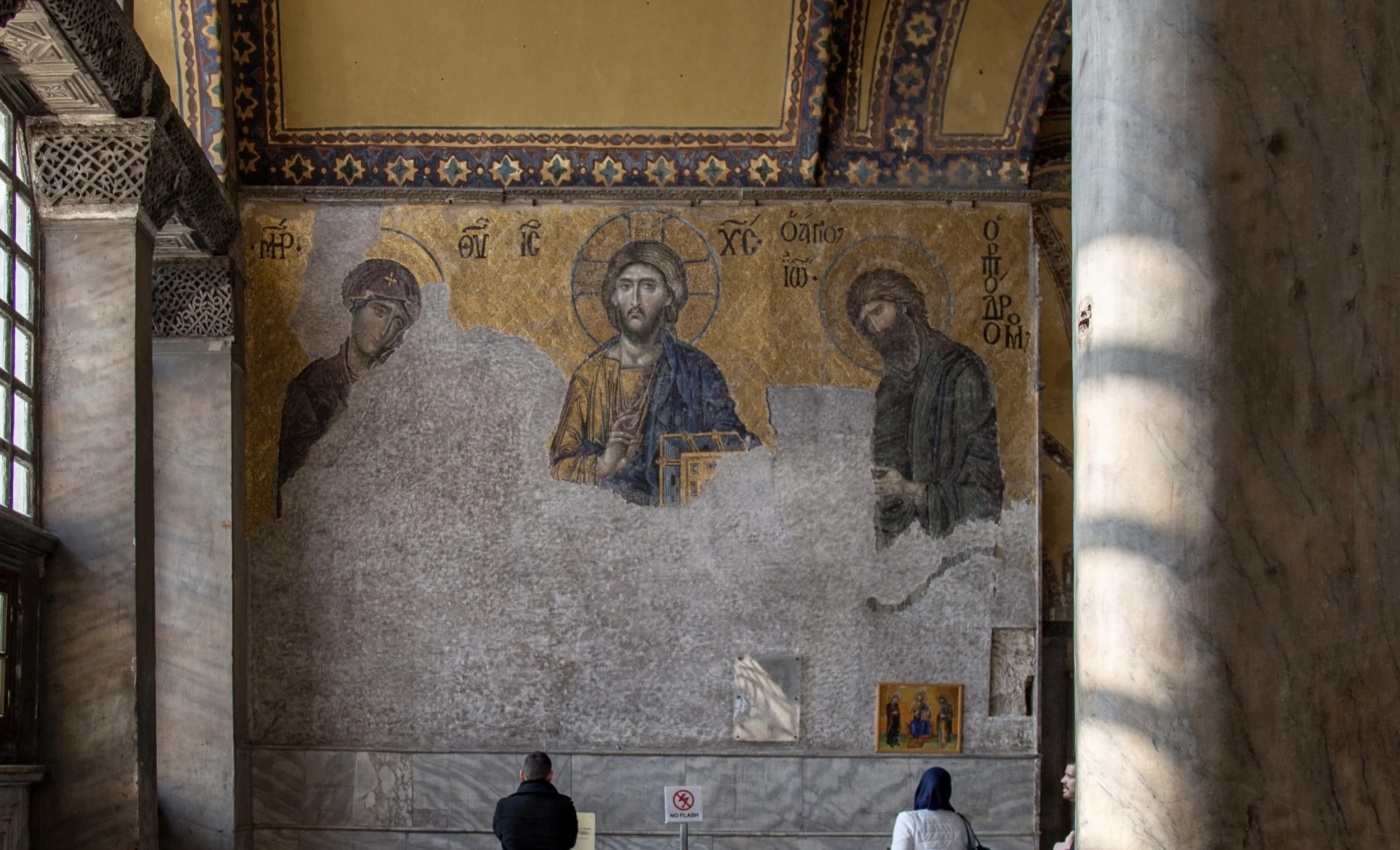
The deēsis (δέησις, ‘prayer' or 'supplication') mosaic of Christ with Virgin Mary and John the Baptist in Hagia Sophia, c. 1261.
On May 29, 1453, the unthinkable happened: Constantinople, the center of Christendom for over a millennia and “the queen of cities”—as her inhabitants called her—fell to the Ottomans, as a 21-year-old Sultan Mehmed II breached the unbreacheable walls (built by Theodosius II) by cannons and conquered the city.
With this cataclysmic event, all significant development in Byzantine Liturgy and theology practically stopped in the east, on one hand, while in the west the churches were soon to become engulfed in the turmoils that the Reformation would ensue, starting with Martin Luther’s (purported) nailing of the 95 theses at Wittenberg Cathedral in 1517, which arguably ushered in the modernity. The Reformation swept through the Europe In less than a century after the fall of Constantinople.
As many did, Henry VIII in England read Martin Luther. In November 1534—only 17 years after Luther’s defiant act against the papacy—the English king broke from the papacy and self-crowned as the head of the Church of England. As part of the new reign, he ordered eradication of all images of St. Thomas Becket (d. 1170). All paintings and statues of the saint were ordered to be destroyed, thus institutionalizing and perpetuating iconoclasm that had already been sparked in 8th- and 9th-centuries in the east. Henry VIII’s iconoclastic edict also emboldened the Reformation movement even further against the Catholic Church.
Thomas Becket instantly became a saint after he was murdered in Canterbury Cathedral on December 29, 1170, for excommunicating the supports of King Henry II and subsequently refusing to annul the excommunication demanded by the king’s supports. Thereafter Canterbury became the third most visited pilgrimage site after Rome and Jerusalem, until Henry VIII’s erasure of the saint’s images in 1534 put a stop to the flow of pilgrims to the city. Sometime between 1387 and 1400 Geoffrey Chaucer memorialized the pilgrimage in his novel The Canterbury Tales.
Henry VIII introduced Protestantism in England in 1532. Under Edward VI (1547-1553) England became fully Protestant. Under Elizabeth I (1558-1603) the country became solidified as a Protestant nation, during which time almost all icons and stained glass windows were destroyed in the country. The King James Bible was first printed in 1611.
Gutenberg Printing Press
Notwithstanding the seismic events taking place in Constantinople and in Europe, there was also a significant technological advancement that also altered the course of history, namely, the invention of the printing press by Johannes Gutenberg sometime between 1440 and 1450.
While the printing press enabled the Protestant Reformation to spread rapidly like a wildfire in the west (especially Martin Luther’s inflammatory writings), on one hand; it however put a stop to any significant development in theology and liturgy in the east, including the text of the Divine Liturgy and, as Gorodenchuk notes, that of the rite of unction.
Halting of theological and liturgical development in the east is understandable, not only because Constantinople had fallen but also, with respect to liturgy, because of the success of the printing press, which hampered any efforts to revise the already widely disseminated texts. In other words, once a text is printed in mass quantity, any changes therein are difficult to implement, because the existing copies must be gathered and replaced by the revised version. In short, the so called textus receptus (‘the received text’) became solidified and authoritative largely because of the success of the printing press that ironically posed the problem of implementing revisions. This appears to be the case with respect to the text of the Divine Liturgy. No significant changes therein took place after the 15th-century, not because of maturity and completion that the text had reached by that time but because of the difficulty of replacing the texts with revised ones.
The Iconoclasm Controversy and the Turn to the Historical
In addition to the fall of Constantine, the Reformation, and the invention of the printing press, another significant development had already occurred by the 16th-century: the rise of historical realism and the concomitant ideological shift toward the individual.
The turn toward historical realism had already occurred a few centuries prior, however, with the Quinisext Council and the ensuing rise of iconoclasm, as we will see shortly. With the turn toward historical realism there occurred the rise of individualism that the Renaissance further promoted. The two ideological strands—historical realism and individualism—enforced each other and solidified into modernity. Paintings, for example, became realistic and individualized. René Descartes (d. 1650), for another example, declared: “I think, therefore, I am”—as if the whole universe rested on what I thought, what I believed, or what I imagined—no matter how universally the ego may do so.
Going back a few centuries, in 692 the Quinisext Council in Trullo (attended mostly by bishops from the eastern churches) issued a canon (Canon 82) that ordained that Christ be portrayed henceforth in human form and not symbolically as the Lamb of God (Taft, 1980/1981: 72). It specifically ordered “that henceforth Christ our God must be represented in his human form instead of the ancient lamb…;” and that “[t]he symbol of Christ… must given place to the face of God incarnate, to the historical person of Christ” (Sendler, 1988: 20). A turn to historical realism is evident in these canons.
Shortly thereafter, circa 730, as iconoclasm was burgeoning, the eastern churches implemented the Proskomidi, the preparatory rite before the Divine Liturgy in which the bread and wine are prepared on the prothesis—a table of offering set aside from the altar in the sanctuary.
Shortly after the Quinisext Council (692)—thirty four years later, to be precise—the iconoclast persecutions broke out (726-787) to be followed by another only 28 years later (815-843). The iconoclasm was soundly defeated in the end, as we will see shortly. But the triumph over iconoclasm had its unanticipated consequences, one of which was the turn toward what Taft calls “incarnational realism” (1981: 59). The triumph over iconoclasm both saved and, I submit, threatened the eastern (Orthodox) Church. It saved the Orthodox Church, as icon veneration began to define her identity and worship. But, ironically, it also turned theological focus to historical realism, while turning away from the Alexandrian/Neo-Platonic idealism of obtaining the vision of God (theōsis), which other church fathers until that point in time had proposed to be the ultimate goal of Christian practice centered around the Divine Liturgy and monastic life. Pseudo-Dionysius, for example, believed that theōsis was the goal and design of the two hierarchies: the angelic or heavenly hierarchy and the ecclesiastical or earthly hierarchy. The union with God (theōsis) thereafter became the union with Christ in his incarnational reality. One no longer sought to be transformed to become divine like God, sharing divinity as embodied in Christ. Rather one sought to identify with Jesus of Nazareth in his life, in his ministry, and in his passion—in short, in his incarnational reality. The shift toward historical realism had significant implication for Christian theology and practice, especially in the understanding of the Eucharist.
After the triumph of Orthodoxy—first celebrated in 843—the focus on achieving the vision (theōria) of God diminished in the east, as already said, on one hand; while in the west, curiously, it gained attraction as it is understood to be a private mysticism (i.e., beatitude), as Pseudo-Dionysius was discovered around that time and was appropriated by Aquinas and Bonaventure in the 13th-century in Paris. This development in the west, however, contributed to the rise of individualism that was later celebrated in the Renaissance and thereafter in modernity.
Furthermore, the 16th-century Reformation solidified in theological thinking the permanent focus on the historical reality of Christ’s salvific work on earth. Accordingly, the Resurrection as a historical fact became an object of belief—as in doubting Thomas (Jn 20)—that determined one’s salvation. With the proliferation of confessional statements of faith (e. g., Zwingli’s Sixty-Seven Articles (1523), the Ten Theses of Berne (1528), Augsburg Confession (1530), the First Confession of Basel (1534), Heidelberg Catechism (1563), Westminster Confession of Faith (1646), etc.), the objects of faith became the propositions believed to be true of Christ and his work in history. In short,, whether one believes or not in the historical reality of Christ’s birth, death, and resurrection became the litmus test for verifying the status of one’s salvation, thereby re-enforcing the private, individual nature of salvation. Everything boils down to one’s belief: Sola Fide. Faith became a firmly held belief, despite the protest against such a reduction by the Reformers.
It must be noted in this connection, the Nicene Creed is referred to by the Orthodox Christians as “the symbol of faith” or as Maximos the Confessor puts it “the intellectual kiss of peace” [νοεροῦ ἀσπασμοῦ, noetic embrace or greeting] (On the Ecclesiastical Mystagogy, 830; 2019: 83). In its nature it is liturgical and public, recited initially at baptism and later as part of the Divine Liturgy prior to receiving the communion, excluded from the catechumens. For the Greeks both baptism and the liturgy are the initiation rites through which the initiate enter into the Mysteries. As an integral part of the sacramental Eucharist, the Creed functions as the initial ‘greeting’ toward or ‘kiss’ or ‘embrace’ of the Divine in union. Maximos describes the union this way:
[God] will deify the whole soul and transform it unalterably into himself, so as ‘to be,’ as the all-holy Dionysius the Areopagite says, ‘an image and manifestation of the unseen light, a mirror, pure, bright, untarnished, unspotted, receiving, if one may so, the whole loveliness of the divine goodness and purely enlightening within itself as far as possible the goodness of silence in the inner sanctuaries.
Mystagogy, 875-882; 2019: 85.
The roots of the Reformation/modernity, then, were already firmly implanted in the churches both in the east and west long before Martin Luther had rebelled against the papal Church—the act of Reformation that further solidified historical realism accompanied and re-enforced by the concomitant rise of individualism.
Accordingly, the Cross became the dominant symbol of all Christian symbols. In fact, the Bread and Wine became the symbols or signs that mainly refer to the passion of Christ, as evinced by the implementation of Proskomidi (circa 730) in the east. See also the Eucharist.
Iconoclasm
The icons were saved in the Orthodox Church by the two Empresses: Irene and Theodora. In his book, The Icon, Image of the Invisible: Elements of Theology, Aesthetics and Technique, Egon Sendler offers one of the best summaries of the two iconoclasm controversies—more precisely, the two bitter persecutions of the iconodule by the iconoclast emperors based on the same controversy over the icon veneration.
The iconoclasm did not arise from Judaism. As Sendler notes, the 6th-century synagogue Beth Alpha had “mosaics of the ark of the covenant, the signs of the zodiac, the sacrifice of Isaac, etc.” (1988: 9). The third-century synagogue of Dura-Europos in Mesopotamia contained images of “the stories of Moses, Elijah, Daniel, and other Biblical persons” that could be, as Sendler surmises, “a precursor of Byzantine art” (1988: 9). But Judaism too had an iconoclastic moment, as Sendler further notes: “The systematic rejection of all images was established at the time of the Maccabees when Judaism felt itself threatened by Hellenism” (1988: 8).
In 692 Justinian II convoked a council (known as Quinisext) in the imperial palace. The council was attended by bishops mostly from the east. In this council the importance of the holy cross and its veneration were declared (Canon 73). Canon 100 in particular prohibited “deceiving paints which being exposed to public view corrupt the intelligence by exciting shameful pleasures…” (Sendler, 1988: 20). Furthermore, Canon 82 declared “that henceforth Christ our God must be represented in his human form instead of the ancient lamb” (Id., 20). It further declared: “The symbol of Christ… must given place to the face of God incarnate, to the historical person of Christ” (Id.). The Quinisext Council thus elevated the abstract sign of the cross as an object of veneration, while “the historical person of Christ” is to be depicted in all Christ-icons, as the symbolic image of the Lamb of God is no longer to be produced.
In 721 the caliph Yazid II (who ruled over Alexandria, Jerusalem, Antioch, and Damascus) imposed “very draconian measures in order to eliminate all images from the sanctuaries and homes of the provinces under his authority” (1988: 22). In 725 three bishops from Asia Minor supported the iconoclastic movement: Theodosius of Ephesus, Thomas of Claudiopolis, and Constantine of Nacolia (Id.).
In 730 an underwater volcanic eruption took place near Santorini, north of Crete. Interpreting this as God’s punishment for the idolatrous veneration of images, Emperor Leo III “ordered the destruction of a greatly venerated icon of Christ above the Bronze Gate in Constantinople” (Sendler, 1988: 23). “Immediately there was a riot,” which was suppressed. But realizing the seriousness of this revolt, Leo III invited Patriarch Germanus (d. 740) to the Senate to try to win him over to his side. But Germanus was not intimidated by Leo III. Rather, he stood up in the Senate, “took off his omophorian (the bishop’s stole), and cried out: ‘I am like Jonah; throw me into the sea. I can have no other faith, Oh Emperor, than that of the ecumenical council.’ He then left and went to his ancestral home where he stayed for the rest of his life” (Sendler, 1988: 23).
In 730 Leo III appointed an iconoclast Anastasius as the patriarch, after Germanus was exiled. As result, Sendler writes:
The images in the churches were replaced by flowers, ornaments, birds, and even scenes of the hunt and of the horse races. What is striking in this type of painting is that it was a return to ancient models. In the final analysis, it was an return to paganism which expressed itself in the liturgy as well; preaching was strengthened along with an increase in religious poetry and all sorts of music.
Sendler, 1988: 23.
The persecution of the iconodules began. Sendler writes:
Every citizen had to bring his icons to a public place so they could be burned. Many of the clerics, monastics, and faithful who resisted were condemned, tortured, or killed; others simply left the capital.
Sendler, 1988: 23, 25.
In 731 the newly elected Pope Gregory III, however, rebutted Leo III’s letters sent to him on the controversy point by point, and convoked a synod in Rome in 731, whereby everyone who “opposed the veneration of the holy images and blasphemed against them, destroyed them, or profaned them” (1988: 25) were excommunicated. In retaliation, Leo III “confiscated the patrimonies of St Peter, increased the taxes in Calabria and Sicily, and finally detached the provinces of Illyricum from Roman jurisdiction and gave them to the patriarchate of Constantinople” (Sendler, 1988: 25).
Thus, the seeds of the eventual Great Schism of 1054 had been planted, although Germanus was later canonized by both Orthodox and Catholic Churches.
St John of Damascus (aka St John of Damascene, who belong to the eminent Mansur family holding high offices in the government of the Ommiad caliphs; d. 749; Sendler, 1988: 25) provided the following eloquent defense for veneration of the icons:
In former times God, who is without form or body, could never be depicted. But now when God is seen is the flesh conversing with men, I make an image of the God whom I see. I do not worship matter; I worship the Creator of matter when became matter for my sake, who willed to take His adobe in matter; who worked out my salvation through matter.
On the Divine Images, “Apology I,” St. Vladimir’s Seminary Press, Crestwood, NY, 1980, p. 23; as cited in Sendler, 1988: 40.
St John continues:
If we made an image of the invisible God, we would certainly be in error… but we do not do anything of the kind; we do not err, in fact, if we make the image of God incarnate who appeared on earth in the flesh, who in his ineffable goodness, lived with men and assumed the nature, the volume, the form, and the color of the flesh.
On the Divine Images, PG 91, col. 1320; St. Vladimir’s Seminary Press, Crestwood, NY, 1980, pp. 52-3; as cited in Sendler, 1988: 25.
In 741 Emperor Leo III died, to be replaced by Constantine V, who ruled between 741 and 775, who was then replaced by Leo IV, who ruled between 775 and 780, who was then replaced by his wife Irene, who became the regent during the childhood of their son Constantine VI between 780 and 790, and who co-ruled with her son between 792 and 797, when she deposed her son (by gouging out his eyes, causing his death shortly thereafter) to become the sole ruler of the empire until 802.
In 754 Leo IV convened the iconoclastic council at Hieria in an imperial palace near Constantinople (Sendler, 1988: 26). The final statement, signed by 388 Byzantine bishops, put forth the following Monophysite argument, as summarized by Sendler:
… if we represent the divinity, we confuse the natures, and we claim to be able to ‘circumscribe’ what cannot be expressed. If we represent the humanity, we divide what must be united in the person of Christ and thus fall into Nestorianism. Through a material image, we would thus deny the hypostatic union which had been defined by the Council of Chalcedon. In addition, matter which is used to make images degrades the original holiness of the model. The only possible icon, instituted by Christ himself, is the eucharist which is the mystical presence of the incarnation. The only permitted representation of the saints is to follow their examples and strive for moral perfection….
In reality, iconoclastic doctrine did not accept the perfect hypostatic union: the union without confusion of divinity and humanity in the person of Christ. It manifested rather a Monophysite foundation: according to the iconoclastic view, the human nature of Christ was practically absorbed by the divinity.
Sendler, 1988: 27.
In short, Christ was too divine to be depicted in a material image.
The council of Hieria condemned “the criminal act of painting” and those who defended images: Germanus, George of Cyprus, and John of Damascus (Sendler, 1988: 27). A new wave of “persecutions, tortures, exiles, spoliations, forced marriages of monks, and executions” ensued (Sendler, 1988: 27). As the monasteries became the centers of resistance, Emperor Constantine V “threw their relics into the sea, transformed monastic buildings into army barracks or stables, and even prohibited the use of the words ‘saint’ and ‘monk” (1988: 27) Sendler writes further:
In 761, some 342 monks were mutilated in various mays and put into the Pretorian prison; others gave their lives for Orthodoxy such as Stephen the Young, Andrew the Cretan, and Paul of Crete… Even the patriarch, Anastasius, was not saved. Although he had been a creature of the emperor, he was later exiled and beheaded.
Sendler, 1988: 27.
In 780 Leo IV died; and his throne was taken over by his wife Irene, as her son (later to be Constantine VI, who became iconoclast unlike his mother) was too young to assume the imperial power. Empress Irene, the first woman to be an empress and who was an iconodule from Athens, appointed Tarsus as Patriarch and convened a council in 786 to be held in Constantinople, which however was intervened by the revolting imperial guard.
About five months later, on September 24, 787, Empress Irene succeeded in convening another council in Nicaea, which came to be known as the second Council of Nicaea, that met in Hagia Sophia (Sendler, 1988: 28). In this ecumenical Council (the seventh and the last), an important distinction was drawn between ‘veneration’ and ‘worship.’ As Sendler summarizes:
Images receive relative or honorific veneration, proskynesis schetike [προσκύνησιςσχετικός], and not worship, latria [λατρεία], which is reserved for God alone. What is more, images are not the ultimate object of veneration because the image only has a reality in relation to the object represented: the image is the reflection of the prototype. Because the veneration of the image is addressed to the prototype, Christ; the veneration is transformed into worship.
Sendler, 1988: 28.
In 794, supported by Charlemagne, the king of the Franks, who was to become the crowned (by Pope Leo III) Emperor of the Holy Roman Empire 6 years later (on Christmas in 800) and who was not informed of the Nicaea II council’s 787 decision, convened the council of Frankfurt in 794. At this council, it was decided that icons should be neither prohibited nor worshipped. (1988: 29).
In 781 Irene arranged a marriage between her son, Constantine VI and Charlemagne’s daughter Rotrude, who was to be given a Greek name, Erythro. Shortly thereafter Irene changed her mind and broke off the engagement, thus angering Charlemagne.
In 803 within 3 years of her difficult reign, Empress Irene died in the lonely island of Lesbos. She was succeeded by her son Constantine VI, who turned from being her young son to being her rival in power, who became iconodule against his mother (whom he exiled), and who in turn was blinded and dethroned by ??? in ???.
In 813 Leo V the Armenian became the emperor. A former general of Anatolia [Turkia] and an iconoclast, Leo V issued an order prohibiting icons. In 815, however, St. Theodore the Studite replaced Patriarch Nicephorus, who was exiled for opposing Leo V. St. Theodore organized a procession for Palm Sunday in which “1000 monks carrying icons took part,” after which he too was exiled, following after Nicephorus (Sendler, 1988: 31).
In 820 Leo V was assassinated by the supporters of Michael the Stammerer, who was proclaimed emperor and convened another council in Paris to reconcile the two opposing parties over the icon veneration controversy. Before the council could be concluded, Emperor Michael died in 825. His son Theophilus became the successor and assumed the throne in 829.
Emperor Theophilus convened a council in 832 with the aim of renewing the iconoclastic decrees. Once again, as against Leo V in 813, monks, especially those of St Abraham’s Monastery, rose up in opposition, which irritated Theophilus and caused him to imprison them along with bishops and iconographers. The second mass persecution of Orthodoxy ensued, though not as severe as the first that occurred in 761 (Sendler, 1988: 27, 32).
In 842 Theophilus died. With his death iconoclasm also died. Theodora and her three year-old son, Michael, assumed the rule and deposed patriarch John the Grammarian while appointing Methodius, a confessor of Orthodoxy and highly respected clergy in Constantinople (Id., 32-33). In 843 Theodora convened a council to affirm for the last time the seventh Council’s defense of the icons as well as the six previous ecumenical Councils’ decisions (Id., 34). The council also determined that on the first Sunday of Great Lent, March 11, 843, the triumph of Orthodoxy would be celebrated. Sendler writes:
There was an impressive procession presided over by Patriarch Methodius; the empress and the whole court led the procession and behind them followed the monks and the faithful. Many of them still carried on their bodies the marks and proofs of their fidelity. The whole group moved to Hagia Sophia to celebrate the feast of Orthodoxy or the definitive triumph of truth.
Sendler, 1988: 34.
The triumph over iconoclasm “was the beginning of a new split between the West and the East, which was to deepen and contributed to the final separation of the great schism of 1054” (Id., 35).
The triumph over iconoclasm also diminished the role of symbols in the life of the Church. While emphasizing the material reality in the veneration of icons, the victory over iconoclasm ushered in a unintended consequence: a turn toward, in Taft’s words, “incarnational realism.” Taft writes in referring to Patriarch Germanus, who in 725 defended icon veneration, as described above, and was exiled as result:
So what we find in Germanus is the encroachment of a more literal tradition upon another, more mystical level of Byzantine interpretation—and this precisely on the eve of Iconoclasm, when shifts in Byzantine piety led to such growth in the cult of images that Orthodoxy soon found itself locked in [in] mortal combat to defend this new expression of radical incarnational realism against the reaction of a more traditional iconoclastic spiritualism.
Tarf, 1980/1981: 58-59.
Liturgically, it was during this time period (circa 730) when the development of the rite of Proskomidi took place—the preparation rite in which the bread and wine is prepared on the prothesis before the Divine Liturgy begins. The text and the symbolism of proskomidi is highly historical and realistic, as they refer to the historical events of Jesus’ crucifixion. The text is mostly cited from the Passion narrative in the Synoptic Gospels. The historical realism, thus, entered into the Divine Liturgy.
Accordingly, a shift occurred in the understanding the Eucharist as well—a shift from the heavenly sacrifice that Christ offers perpetually (as described in Heb 1.13, 4.14, 7.3, 11-25, 8.1-5) to the understanding thereof as a representation of (and representational re-enactment of) the past historical event of Jesus’ crucifixion as described in the synoptic Gospels. In short, the shift occurred from the present reality of Christ’s sacrifice to the past event of Jesus’ crucifixion.
Recovering Jesus’ Relics and the Holy Places in Jerusalem
If the iconoclasm controversy resulted in the turn toward the historical Jesus, there was a prior movement that also propelled the shift toward historical realism that already have taken place in early 4th-century. It was the movement, initiated by Empress Helena (d. 330), to recover the historical sites and relics associated with Jesus’ life and death in Palestine.
More specifically, the Edict of Milan (aka Peace of Constantiana) issued in 313 created a new movement to hallow the holy places associated with historical Jesus, such as the Holy Sepulcher in Jerusalem (326-335) and the Church of Nativity in Bethlehem (326-330). Once Christianity became official, the interest in recovering the sites and relics associated with Jesus became intense. Thus, the seeds to turn towards what Taft calls the “incarnation realism” (1980/1981: 59, 65) had already been planted centuries before the iconoclasm controversy. Accordingly, Christ-Event become real as historical events in theological imaginations—the fact which had been assumed all along but did not assume a decisive role in theological discourses.
Pseudo-Dionysius (b/d. ~500), however, belonged to the time period when historical realism had not yet fully flourished. For this reason, his theology remained symbolic, not historical. Thus, he could be placed in the Alexandrian camp. His emphasis and reliance on the role of sacred Symbols as God’s revelation and presence puts him at adds with the more historical and realistic Antiochene camp, as represented by St Chrysostom.
Another major influence that accounts for historical realism and the rise of individualism is St Anselm’s substitutional theory of atonement that was first proposed in the late 11th-century. See Anselm and Byzantine Synthesis.