

An Introduction to the Orthodox Liturgy |
An Introduction to the Orthodox Liturgy |
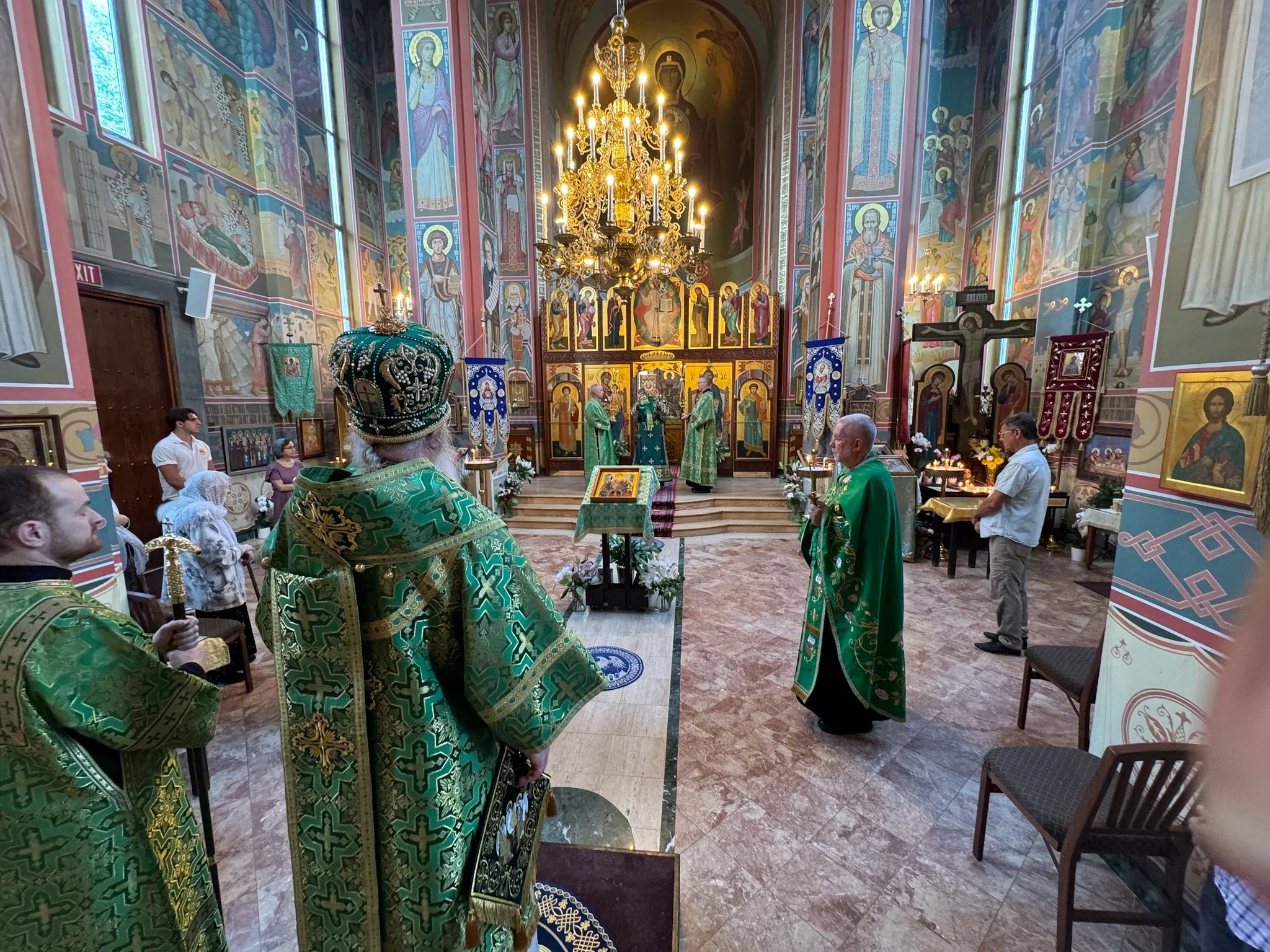
Liturgy, then, is a sanctification of life by turning to God whenever one is able, to do what all liturgy always does—to celebrate and manifest in ritual moments like Lent what is and must be the constant stance of our every moment: our unceasing priestly offering, in Christ, of self, to the praise and glory of the Father in thanks for his saving gift in Christ.
Robert F. Taft, S.J., Liturgy: Model of Prayer—Icon of Life, 2008: 161.
The history of liturgy is the story of a people at prayer, expressing in worship its peculiar cultural incarnation of the common faith.
Taft, The Great Entrance, 2004: vii.
“The Divine Liturgy of Our Father Among the Saints” (Hieratikon Á, 2025: 123) is the proper title to the text of the liturgy celebrated by Orthodox Christians worldwide. The text is attributed to St John Chrysostom (d. 407), a priest from Antioch and archbishop of Constantinople. On special days in Orthodox Church calendar a similar but longer text attributed to St Basil is used.
After Jesus’ death and resurrection, Christianity went underground until it was officially recognized by Emperor Constantine’s Edict of Milan (aka the Edict of Toleration or Pax Constantiniana, 313). Thereafter Christianity went public and adopted the Roman system of administration and pageantry, while preserving the tradition of Jesus’ institution of the Lord’s Supper (Matt 26.26-29, Mark 14.22-25, Luke 22.14-20, I Cor 11.23-26) that began after His resurrection and ascension. The liturgy evolved further and more dramatically, as Christianity became the official religion by Emperor Theodosius’s Edict of Thessalonica in 380.
With the building of Hagia Sophia (537), moreover, the Divine Liturgy became distinctively Byzantine. (“Byzantine” is a 17th-century term.) As Robert F. Taft puts it, “the Byzantine rite is basically the rite of the Great Church” (2004: 33). The Liturgy continued to evolve, however, until becoming more or less solidified by the invention of the printing press in 1440. The subsequent development is minor in nature, largely caused by regional variants, practices, and practical necessities.
As the aforementioned title indicates, the subject of the Liturgy—the actor in it—is God the Father Himself, who performs the liturgy to serve us. In His condescension He redeems and thereby draws us back to Him, as we are thereby lifted up to His image and likeness. In the circular movement of descent and ascent, He gives “his only begotten Son” (Jn 3.16, KJV), and we in turn “offer ourselves and each other, and our whole life, to Christ our God.” We say this prayer and commitment six times during the Divine Liturgy. God’s giving and our offering up to Him are the acts of sacrifice offered to each other in exchange. See Let Us Offer Ourselves. This is an exchange of gifts that occurs as an exchange of sacrifice between God and human: God gives Himself to us in his goodness and mercy/love, and we in turn offer ourselves and each other and the whole creation around us back to Him in consecration.
‘Sacrifice’ means ‘offering’ in the original sense of the Hebrew word (for ‘sacrifice’), קרבן (qorban). The nounmeans ‘cause to come near’ (Moffitt, 2022:163), as in the Greek verb, προσφέρω, which means ‘to present,’ ‘to offer;’ and ἱεραγέω, ‘to carry offerings.’
Ὶερά means: rites, sacrifices. Ὶεράρχης means: president of sacred rites, high-priest.
The Levitical priests did not slaughter the animals. After the animal is killed by non-priests in a location away from the outer altar, the priest brings the offering to God to burn (the suet) and to sprinkle the blood (on top and in front of the Ark and on the horns around the outer altar) (Lev 16.14, 18, 25).
Liturgy, more specifically, is the divine sacrifice/offering of Christ, in which we—along with angels as concelebrants—are joined in cooperation and union with Christ in giving/offering/sacrificing. The aim of the Liturgy is theōsis: divinization in imitation of and union with Christ. We offer “ourselves and each other to Christ our God,” as Christ did/does to the Father in (self) sacrifice at Golgotha and on the altar in the sanctuary.
Just as God once demanded Abraham to sacrifice his “only son Isaac, whom you love” (Gen 22.2), He offers his “only begotten Son” at Bethlehem and Golgotha as well as on the altar of the Eucharist in the Divine Liturgy. This act of sacrifice/giving/offering redeems, reconciles, purifies, nourishes, and divinizes us, so that we too can sacrifice/give/offer ourselves to God, to one another, and to the world. (To love God is to love the neighbor, as Jesus teaches in the parable of the Good Samaritan (Luke 10.25-37).) Our sacrifice to God is a return in recapitulation (ἀνακεφαλαίωσις) of the creation back to its Creator, the Source and Fountain of Life, God the Father.
Just as Christ voluntarily offered himself in sacrifice once and for all (Heb 10.10) in the garden of Gethsemane, He in his risen Body offers Himself on the heavenly altar in perpetual sacrifice in the order of Melchizedek, interceding for us at the right hand of God (Heb 1.13, 4.14, 7.11-25, 8.1-2). The Liturgy symbolizes and actualizes all these polysemic sacrifices Christ offered and is offering.
The Liturgy as a whole is a symbol (raza in Syriac, meaning ‘secrete,’ ‘mystery,’ ‘symbol,’ σύμβολον) of God’s saving work (ἔργον), in which humans join with Him as His coworkers (συνεργόι, I Cor 3.9). Without God’s action (θεουργία), on one hand, the Liturgy becomes an empty ceremony. Without human co-operation, on the other, it cannot take place at all. God’s service/liturgy requires our service/liturgy; His sacrifice our sacrifice. In the mutual and cooperative acts of service, God’s divine initiative in condescension towards humanity is returned in our response to Him as our service/liturgy offered to Him in the movement of our ascension.
The circle of the divine descent and ascent, however, concretely manifests in the Divine Liturgy as processions: the procession of the Word and that of the Gifts. The Little Entrance (the liturgy of the Word) and the Great Entrance (the liturgy of the Eucharist) thus encapsulate the whole of the Divine Liturgy. For, as Pseudo-Dionysius notes, the Liturgy mainly consists of “the sacred words and the [holy works] of the hierarchy [i.e., the sacraments]” (EH 441C, Campbell translation altered).
The Word, which was from the beginning with God, enters the world, as the Gospel Book in the Liturgy enters the church (as in Hagia Sophia) and moves through the nave to be proclaimed at the ambo at the center of the nave, purifying and enlightening the people. In the Little Entrance, the procession of the Word enters the nave symbolizing and thus actualizing in the present the Incarnation of the Word becoming flesh and dwelling among us (John 1.14). In the Great Entrance, Christ, the “King of All,” enters, as He did in Jerusalem, to fulfill the will of God and to die on the cross, thus conquering “death by death,” and thereby rescuing and taking up humanity from death to life.
The wonder of Creation is the fact that in the beginning there was procession, the bestowing, the offering of God to humanity and to the world—a gift endowed in God’s goodness and love.
The miracle of being is not that ‘there is’ rather than ‘there is not’ but that there is giving that grants being. The given, the offered, the consecrated, the sacrificed is more wondrous than that there is being in the beginning by itself on its own, which is admittedly absurd.
The initial movement of God’s offering triggers our responsive movement back toward Him—our rising to God to become divine ourselves—in a measure proportional to our capacity and nature. In the outgoing and returning movement of the liturgical processions, we partake, participate, and have communion with God in His dynamic movements. If the Church is liturgical in essence, as She is, Her Body is sustained by the communion with the Holy Spirit, Who sustains and nourishes Her. Because the Liturgy is God-act (θεουργία), wherein God serves us first, we can draw near to Him in response to His initiative by participating and partaking in His act/work. It becomes our act insofar as we participate in His act.
When Jacob encountered God at Bethel, he exclaimed: “Surely the LORD is in this place…. How awesome is this place!” (Gen 28.16-17). Jacob’s disposition is probably the appropriate one we can have in our encounter with God in the Liturgy that takes place in the House of God. Accordingly, the Liturgy must be splendid and majestic, not because of its music or inspiring sermons (though they would help) but because of God’s presence in His glory that draws us near to Him with reverent fear and awe. The Liturgy is the place in which θέωσις (theōsis, deification, divination)occurs:
While remaining in his soul and body entirely man by nature, he becomes in his soul and body entirely god in grace, by the divine splendor of the beautifying glory which is wholly expedient to him.
Maximus the Confession, Ambigua, 1088c; as quoted in Lossky, 1963: 134.
St Simeon (d. 1022) affirms the same notion involving the transformation of the whole human, mind and body, in theōsis. He writes:
O miracle! Man is united to God spiritually and corporeally, for his soul is in no way separated from the spirit, nor the body from the soul. God enters into union with the whole man.
St Simeon, Sermon 25, ed. of Mount Athos, (Russian), I, p. 228; as quoted in Lossky, 1963: 146.
Liturgy as Public Works
The word ‘liturgy,’ λειτουργία, originally referred to: “A public service.” Liddell and Scott’s Greek-English Lexicon further defines:
At Athens, a burdensome public office or charge, which the richer citizens discharged at their own expense, properly in rotation, but also voluntarily or by appointment.
Private funds are set aside and spent for road- and building-projects, temple constructions or repair, erecting statues and creating art works, and for sponsoring sacrifices and festivals, etc. in ancient Athens. But liturgy as public works entailed running a deficit; it “required … a putting out of funds at a loss” (Levinas, 1996:50). The private treasury got emptied, as funds were outspent. For this reason, liturgy was a ‘burdensome,’ public work.
Likewise, for God to perform the liturgy (for us) is to spend prodigally, like the father in the parable of the prodigal son, who offers a lavish banquet at the homecoming of the lost son, after giving him the ring and the robe (Lk 15). The father’s prodigality in restoration exceeds the son’s prodigality in waste. Excess and outspending seems to be God’s disposition towards humanity in his loving and merciful condescension.
Likewise, in the Liturgy, there is God’s goodness and love (“the lover of mankind”) overflowing towards us in his condescension. Or, to put it differently, God’s abundant Light (Christ) that exceeds and superceeds any other lights, illuminates us, enabling us to glow in His radiance in turn and to become lights ourselves for the world. Thanks to God’s abundant goodness and loving kindness, we can in turn become divine in His image and likeness (Gen 1.26). We can be a light to the world because we receive Christ, the Light of the Father, in Communion with Him.
In John’s Gospel we do not have the narrative of the Last Supper. Instead, we see the Lord bending down and washing the disciples’ feet (Jn 13). If ‘liturgy’ means ‘public service,’ washing someone’s feet—serving the Other—is an act of liturgy. If the climax of the Divine Liturgy is the Eucharist, then Christ’s offering of Himself as the Bread and Wine is equal to His act of service in washing the disciples’ feet. By participating in the Liturgy, we participate in Christ’s act of sacrifice, i.e., His act of service in “the form of a servant” (Phil 2.7; KJV). The way to God is through my neighbor; to become God is to serve my neighbor.
The Hierarchy
The Liturgy presupposes hierarchy, a divine order, which is set up for us to participate in God’s circular movement of descent and ascent. God descends (both in history and in the Liturgy) as an infant, servant, healer, preacher, and ultimately as a sacrifice on the altar. He then ascents back to God the Father in Resurrection and Ascension (again both in history and in the Liturgy). In the Liturgy we participate in this divine movement.
If the Divine Liturgy is an order set by human, the hierarchy (ἱεραρχία, ‘holy order,’ ἱερόςτάξις) is an order set by God. The ecclesiastical hierarchy is set up for the Liturgy; and the Liturgy presupposes the ecclesiastical hierarchy.
The word ‘hierarchy’ was coined by Pseudo-Dionysius (Louth, 1989: 38), who laid out its goal explicitly (though verbose) as follows:
… hierarchy [ὶεραρχἰα] is … a sacred order [τἀξιςὶερὰ], knowledge [ἐπιστἠμη], and energy [ἐνέργεια]—assimilated [ἀφομοιουμένη], as accessible as possible [ἐφικτὸν], to the likeness of God [θεοειδὲς] in proportion to [ἀναλόγως] illuminations [ἐλλάμψεις]—illuminations which are bestowed [ἐνδιδομένας] by God himself—into upliftment [ἀναγομἐνη] toward God-imitation [θεομίμητον].
Pseudo-Dionysius, Celestial Hierarchy, Ch. 3; CH 164D, translation mine; see also EH 393A.
Hierarchy, then, whether angelic or ecclesiastical, has nothing to do with power or authority. Rather, it is the divine order set up for theōsis, divinization.
Accordingly, the ecclesiastical hierarchy is set up in the order of illumination and imitation, starting from the laity, deacons, priests, and to the hierarchs in the greater degree of imitation and illumination.
The Divine Liturgy is designed to achieve the goal of theōsis. This goal is achieved by means of symbols/sacraments, through which we accomplish/celebrate (ἐπιτελεῖν) our communion with, our participation in, and our partaking of God (CH 305C, 308A). In baptism, the Eucharist, and unctions, we participate in and partake of “Christ our God.”
Μετουσία means: participation, partnership, communion all combined. CH 305C, 308A.
Μετάδοσις means: the giving a share, imparting, exchange, distribution (of benefits), communication; transferring (of being by way of participation (in Plotinus).
Μετάληψις means: participation (partake); alternation, succession, taking one thing instead of another, objection, counterplea, translation, rendering, transference; participation in Plotinus.
Μετέχω is the word Plato and other subsequent philosophers use, including Aristotle, to indicate: ‘participate in a universal,’ Arist. Metaph. 990b31, 1037b19. Compare it to μετουσία mentioned above.
Μέθεξις means: participation.
God imparts to us his goodness, love, and light. We in turn partake in them. The Divine Liturgy joins us in these acts/movements of God. The Liturgy is where our union with God occurs by the power of the Holy Spirit and through the work of Christ (in history, in the Liturgy, and in heaven).
Ecclesiastical Hierarchy and the Liturgy
There are only two hierarchies, according to Pseudo-Dionysius: the celestial and the ecclesiastical. Humans belong to the latter, whether kings or servants, male or female. We cannot belong to the celestial hierarchy, because we can never be an angel (a disembodied intelligible being)—no matter how close we get to God in our imitation and illumination. Conversely, it is not required that humans become something like angels in order for us to imitate or have a union with God. We will reach the full and complete union at the eschaton (the end time) with our bodies fully recovered and redeemed. Theōsis, then, does not negate the body, the physical, or the material; just as symbols cannot do away with the physical, the material, or the bodily movements with which we engage with them.
The Divine Liturgy is what the ecclesiastical hierarchy is and does for our divinization and upliftment toward God in our flesh and bone, inasmuch as we are capable of in our own human nature. We do so by participating in and partaking of the ecclesiastical hierarchy and its movements (the Liturgy), outside of which divinization is not possible.
God’s work (θεουργία) happens in orderly fashion—in sacred order (ἱεραρχία). God’s work for humans takes place in the ecclesiastical order, which imitates “the supremely divine operations” (EH 508D-509A).
Analogous to Godhead (Θεαρχία) and the celestial hierarchy, the ecclesiastical hierarchy, for Pseudo-Dionysius, is divided into three ranks: bishops, priests, and deacons (EH 509C). Each of these ranks corresponds to the following degree of divinization: purification, illumination, and perfection.
Bishop administers toward the goal of perfection (τελείωσις, fulfillment, completion); priest toward that of illumination (Φωτισμός); and deacon toward that of purification (κάθαρσις). EH 508C. The three stages of divinization do not form a linear progression, however, as they may occur all at once or gradually one after another. Thus, for example, bath baptism and the Eucharist purify, illuminate, and perfect the initiate into divinization. However, only the hierarchs (including bishops) participate in the preparation rite of myron, which is “concealed from the multitude” (EH 476C); and only they can administer baptism, the Eucharist, and the unction, while the deacons prepare the catechumens prior to baptism and distribute the Communion to the people after the elements are consecrated.
Regardless of ranks, however, the key to divinization is participation in God’s work administered by, in, and through the activities of the ecclesiastical hierarchy, i.e., the Divine Liturgy. Participation in and communion with God (“May the communion of the Holy Spirit be with you…”) through the sacraments of the Divine Liturgy is the only way to be divinized. This is so because, as Dionysius puts it, “the most universal and supremely divine Blessedness proceeds [πρόεισιν] out of His goodness for the communion [κοινωνἰαν] of those who piously [partake in] [μετεχόντων] Him” (EH 429A; Campbell trans. altered).
If the Liturgy works through the hierarchy, on one hand; the hierarchy actualizes itself in the Liturgy, on the other. The sacred rites can only be performed by the ranks, as each fulfills his respective role therein, while each initiate participates:
… the hierarchy … […] distributes the proper share of divine things to each according to his merits and with a view to his salvation, giving these things holily, in measure, proportion, and due time.
EH 432C, Campbell trans.
Liturgy as the Work of Symbols
Liturgy is the work of the holy symbols/sacraments, performed through the ecclesiastical hierarchy, which in turn, as Golitzin puts it aptly, is “the general frame of the σύμβολον [symbol] given in our ‘hierarchy,’ the meeting place of heaven and earth” (2013: 235).
Συμβάλλω means: to throw together, dash together; to throw together; come together, join, unite; collect, contract, make a contract with, contribute, jumble up together.
Συμβολέω means ‘to meet.’
Σύμβολον means: a sign; tally, i.e. each of two halves or corresponding pieces of an ἀστράγαλος or other object, which two ξένοι, or any two contracting parties, broke between them, each party keeping one piece, in order to have proof of the identity of the presenter of the other.
Liturgy is the symbol of God’s work performed by human and, at the same time, that of human work performed by God (through the Holy Spirit). Liturgy as the moving, dynamic symbol of God’s activity (θεουργία) manifest in the ecclesiastical hierarchy, is where the contact occurs between the Infinite and the finite, between God and human, and between God’s work and human work.
Symbol, understood as sacrament and much more, enables this contact and union, despite the seemingly paradoxical and impossible relationship between the finite and the Infinite that the symbol brings together:
… every manifestation and every work of God is sacredly described in the varied composition of the hierarchical symbols.
EH 485B, Campbell trans.
In symbol the ineffable, uncircumscribable, uncontainable God in His action is still expressed, circumscribed, and contained: “The Holy One comes forth on a plate and in a cup,” as Narsai of Nisibi (d. 502) exclaimed. The Eucharist is the chief symbol of Christ’s Incarnation; for it presents the Body of Christ before the faithful.
As we progress toward the climax of the Liturgy (the Eucharist), we, together as one, are to be lifted up to the One and be illuminated in the increasing degree, thereby becoming one with Christ: “the Light of the Father” (CH 121A). We become united with the divine by partaking and participating in the Communion. The remarkable Greek words, μετουσία (participation, partnership, communion), μετέχω (partake of, have a share in), μετάδοσις (giving a share, imparting, transferring of being by way of participation), μετάληψις (participation, transference) —all indicate how the union with the divine is to occur. The sacred Symbols allow us to participate in the Divine.
Now, liturgy consists of the holy rites. A rite (τελετή) by definition is a ceremony by which one enters into an “initiation in the mysteries.” In the Liturgy we as the ecclesiastical group (consisting of ones who are called, elected, and gathered) enter together into the reality/Mystery of God’s Kingdom/Work, whereby His will and His righteousness (δικαιοσύνην, justice,' Matt 6.33) is realized on earth as it is in heaven. As Dionysius puts it,
The [main point] [κεφάλαιον]and the [final goal] [τέλος] [of every rite] is the imparting [μετάδοσις] of the supremely divine mysteries to the one initiated [τελουμένω].
EH 425A; Campbell trans. altered. Campbell’s insertion “of every sacrament” is replaced by “of every rite.” Both are not found in the Greek text, however.
The Greek word μύησις refers to ‘initiation;’ and its derivative μυσταγωγία means ‘initiation into the mysteries.’ Initiation by definition is entering into mystery. In the mystagogy of the Liturgy, then, one enters into the divine (reality of the) Mysteries, into the (new, mystical) reality of the kingdom of God and His righteousness (δικαιοσύνη). Something divine happens in such a way that one’s being or existence is fundamentally changed by participation (μετουσία) into the Mystery. In other words, we become (initiated into being) “a new creation” (2 Cor 5.17, Gal 6.15). Otherwise, epiclesis (invoking the Holy Spirit to come down and to change us and the Gifts) has no meaning. Like the bread and wine, we too must be transformed in our participation in the Divine Mysteries. See also Symbol and Glory.
Christ the Antitype
Referring to baptism, which is a part of the Liturgy, St Cyril of Jerusalem writes:
You became christs when you received the prefiguration [τὸ ἀντίτυπον, antitype] of the Holy Spirit… […] … when you ascended from the pool of the holy waters, you received chrismation [χρἲσμα], the prefiguration [τὸ ἀντίτυπον] of Christ’s chrismation [ἐχρίσθη].”
St Cyril of Jerusalem, 2017: 105; Johnson’s translation altered. The consecrated oil is mixed with the water in the basin before one is submerged into and arisen from it in the rite of baptism.
‘Christ’ means ‘anointed,’ which in turn means ‘chrismated’ or ‘rubbed with chrism’ (“a consecrated oil, usually mixed with balsam or balsam and spices, used by certain churches [in Syro-Palestine] in various rites, as in baptism, confirmation, and the like” (Random House Dictionary at www.dictionary.com). The root Greek word is χρίω meaning “to touch on the surface, to rub.”
To become the prefigured image of Christ one must be entirely enwrapped by Him, as if immersed in the water of baptism, as if shaped by hammer and anvil (ἀντίτυπος means: formation by hammer and anvil).
The Liturgy (τελετή), for example of baptism or of the Eucharist, effectuates divine likeness by imitation and illumination, as we are initiated into the Mysteries, as we partake of the Bread and the Cup. As Dionysius puts it:
The most divine, peaceful, and common participation [μετάδοσις, imparting] of the one and the same bread and chalice imposes on [νομοθετεί, ordains] [us] a divine [sameness] of character [ὸμοτροπἰαν] as well as [sameness] of nourishment [ὸμοτρὀφοις].
EH 428B; Campbell trans. altered.
The Communion (κοινωνία) and our participation therein allow us to partake in the divine character and nourishment, enabling us (by God’s work) to become divine. God provides us with the way and means to come back to Him and to become Him. All we have to do is to turn around, purify ourselves, and join Him and participate in His welcome and embrace, as did the prodigal son (Lk 15).
During the Eucharistic Prayer before Anaphora the priest exhorts us:
Let us lift up our hearts. [And the choir/people respond:] We lift them to the Lord.
Thus, we arise together as the Body of Christ to become partakers of God and to be offered up to Him as sacrifice, as in Christ, as in the lifting up of our hands in evening prayer:
Let my prayer be counted as incense before you and the lifting up of my hands as an evening sacrifice (Ps 141.2).
Becoming Christ, the Self-Sacrifice
What does it mean to imitate or become Christ? Christ offered himself as a sacrifice. He sacrificed himself in a self-sacrifice. But what does it mean to (self) sacrifice, which we should imitate?
To sacrifice is to bring the gift/offering to God or to a person (προσφέρειν). The word ‘sacrifice’ in Hebrew is קרבן (qorban), which means: “cause to come near” (Moffitt, 2022:163). The Septuagint usually translates it as δῶρον (dōron), gift.
In English Bible, however, קרבן (qorban) is usually translated as ‘atonement.’ This is mistranslation. ‘Offering’ would be a correct translation.
‘Atonement’ is one of many English words that a Greek scholar William Tyndale (d. 1536)—who first translated the Bible into English—used to (mis)translate קרבן (qorban). Tyndale in turn was probably influenced by St Anselm of Canterbury (d. 1109), who introduced in Latin the concept of substitution to the work of Christ on the cross explicitly, although the concept was implicit in the Passover ritual and the Levitical sacrifices.
The word ‘atonement’ originates from 1505-15. The associated word, ‘expiate,’ from Latin expiātus (ex + pious, to set aside to make holy) is defined in terms of ‘atonement,’ despite its Latin root.
Similarly, פָסַח, pascha, is usually mistranslated as ‘passover.’ However, it means: ‘protect’ as in Exod 12.13. See Milgrom, 1991: 1081. In Orthodox Christianity, however, the Resurrection is referred to as Pascha. This is a misnomer.
Another Hebrew word that is frequently (mis)translated as ‘atonement’ is כפר, kipper, which refers to “both ransoming and purifying effects” (Moffitt, 2022:109). As referring to ‘purification,’ the word kipper implies ‘repentance.’ Now, if by ‘atonement’ we mean ‘purification,’ we can translate kipper as ‘atonement,’ as in ‘Day of Atonement,’ which should be understood as the Day of Repentance.
In English ‘sacrifice’ usually means ‘substitution,’ as in a ‘sacrifice hit’ in baseball. This is unfortunate, because substitution is not the primary meaning of ‘sacrifice.’ To be sure, the concept of substitution is implied in the primary meaning of ‘sacrifice,’ which is ‘offering’ or ‘giving.’ When God sacrifices His Son for us, he is ‘giving’ his Son to the world (John 3.16). ‘Bestowing’ is a term Rowan Williams likes to use to refer to ‘generative giving,’ as in Creation (both in the capital ‘C’ and the lower case ‘c’). When we sacrifice ourselves to God, we are ‘offering’ ourselves to Him in generative giving, just as God gives us his Son in his generative bestowing. See “Let Us Offer Ourselves.”
The Levitical sacrifice involves two essential aspects: (1) drawing near to God by offering gifts; and (2) cleansing of sin by performing purification rituals with blood (by smearing it in certain manner on the altar and in the Holy of Holies, as prescribed in Lev 16). In the context of the purification ritual, the blood functions as a cleansing agent (חַטָּאָה, hattā’t, ‘the purification offering,’ in Num 29.11: “the purification offering of purification;” or in Exod 30.10: “the blood of the purifying purification offering;” Milgrom, 1991:1062; cf., Rev 7.14).
Moreover, during the night of the Passover (Pascha) in Egypt, the blood of lamb that was smeared on the doorposts and lintel had the protective effects (פָסַח, pascha, ‘protect,’ Exod 12.13; Milgrom, 1991: 1081): the blood protected the Hebrews from the angel of death (Exod 12; cf., Rev 12.11). Blood is apotropaic. Jesus’ blood on the cross can be understood in this way. His death conquered “death by death.” His blood protects us from the sting of death (I Cor 15.55). Note the absence of the notion of substitution here.
Finally, in Isaiah 52-53 a suffering servant is depicted as substituting for sinners (“he was wounded for our transgressions…” 53.5). The suffering of the righteous, as the Israelites understood during the Babylonian Exile, renews the broken covenantal relationship with God, when the covenant with God is broken by the Israelites’ transgression or inequity.
In Christ’s earthly crucifixion, as recorded in the Gospels, all these diverse themes of sacrifice are invoked and combined, historically and symbolically. Moreover, in his heavenly sacrifice, as referenced in the Letter to the Hebrews, Christ offers himself in perpetual sacrifice to intercede for us (Heb 7.25).
Moreover, the sacrificial act of Christ—in all its polysemic fullness as outlined above— is symbolically brought forth and produced in the Divine Liturgy, especially in the eucharistic rite (Anaphora). The (Mystery of) symbolism employed in the Liturgy is such that, like Mary, it contains what cannot be contained: The Mystery of God’s work (θεουργία) in operation effectuated by human cooperation in the ritual (τελετή) celebrated in the Liturgy. See the Great Entrance for more on sacrifice.
Symbol (Raza)
As a symbol (raza), the Liturgy produces or brings forth the divine, ineffable, and mystical reality, and presents it in the visible and tangible things with which and to which we act ritualistically. Rather than being something exotic, primitive, irrational, or magical, the symbols (including the symbolic acts) contain their intrinsic reality. As understood by the Neo-Platonists, symbols are not imitations (μιμητικὴ) (Proclus, Commentary on the Republic, I. 198.14-15); and they (σύνθήματα) “themselves, by themselves perform their appropriate work” (Iamblichus, De Mysteriis, II.11. 96, 13-97, 8, as quoted in Schibille, 2014:209; and 204 for reference to Proclus’ citation).
Symbols, then, have intrinsic power. It is in this sense the Latin transported the Syriac notion of ‘symbol’ into its word, sacramentum, whose origin has nothing to do with what the Syriac word refers to.
‘Sacramentum’ means: “a sum deposited by a party in a civil process, as security for a future judgment, forfeit money, guaranty,” or, “the preliminary engagement entered into by newly-enlisted troops;” whereas, as stated above, raza in Syriac means: ‘secrete,’ ‘mystery,’ ‘symbol’ all combined.
Brock, 1985: 41.
Lastly, “symbol gives rise to thought” (Ricoeur, 1967: 347, 356). Theology is possible because symbolic is its language and power.
I am using the word ‘symbol’ (σύμβολον) in the sense that Pseudo-Dionysius uses to refer to what the Latin Church means by the word sacramentum. But to translate ‘symbol’ as ‘sacrament’ would lose its rich meaning. For by symbol, Dionysius refers to God’s names as well as sacraments. ‘Sacrament’ is a technical term, having strict application in the (Latin) churches only. Symbol, however, includes that as well as its broad meaning in normal settings outside the church. In Syriac we find the appropriate equivalent to Dionysius’ use of the word ‘symbol.’ The Syriac word is raza, meaning ‘secret,’ ‘mystery,’ ‘symbol’ all combined (Brock, 1985: 41). Mystery here implies something that we can never comprehend (see below for another meaning). A divine symbol by definition, then, contains the ineffable, inscrutable reality/mystery of God that exceeds and defies human reason and comprehension. Our reason runs up against the wall of aporia (ἀπορία), as in paradox. Such is the overwhelming, inscrutable reality/mystery of the divine symbols that Dionysius refers to in his discourse on the Divine Liturgy: Ecclesiastical Hierarchy.
Prayer as the Living Sacrifice
Finally, St Paul exhorts us to offer (παραστῆσαι) our bodies as “a living sacrifice” (Rom 12.1). Accordingly, in vespers and in Pre-sanctification Liturgy, we pray, reciting Psalm 141.2:
Let my prayer be set forth before Thee as the incense; and the lifting up of my hands as the evening sacrifice.
To pray is to sacrifice; and to sacrifice is to pray. We literally and figuratively offer ourselves to God when we pray.
Taft writes: “… we know that incense was a symbol [simile] of Christian prayer and virtue anterior to the actual use of incense in Christian ritual (2000: 98).
But to pray, according to Hannah, is to pour out one’s soul (I Sam 1.15), to empty oneself completely and entirely. Likewise, to sacrifice is to completely empty oneself (kenosis, κενόω) and descent to the lowest level of being—even to the point of death (Phil 2.7-8)—offering oneself and making available “to the least of these” (Matt 25: 40, 45).
To sacrifice, in other words, is to be a grain of wheat that falls and dies, thereby bearing much fruit (Jn 12.24). Sacrifice—offering oneself entirely in humility and service—is the logic of divine salvation that Christ shows and effectuates physically, historically, and sacramentally (that is, symbolically, therefore, actually). For this reason, John’s Gospel shows Christ washing the disciples’ feet instead of the scene of the Last Supper. Both crucifixion and foot-washing are the acts of sacrifice, the acts of giving and offering oneself to the others in humility and service.
As we sing: “… the sun was darkened, unable to see humiliated the God before whom all tremble. Wherefore, let us worship him” (10th Antiphon in tone 6, after reading of the Fourth Gospel, Orthros of Holy Friday (The Twelve Passion Gospels)). Or, to put it another way: “The greatness of humility is … in the humiliation of greatness” (Levinas, 1994: 118).
God’s sacrifice, as an act of love, knows of no limits: He gave His “only begotten Son.” Christ, too, gave all of Himself. Love, sacrifice, giving/gift(ing)/offer(ing)—these are all synonymous (either as noun or as verb).
If we are to imitate Christ, we must do as He did: Giving or becoming a sacrifice completely, totally, and wholly, without limits—like a burnt offering whose smoke, like prayer, arises from the altar, like a holocaust (ὁλοκαύτωμα), a burnt offering (Exodus 20.24; 29.18, 25; Lev 1.6, 9; 4.10; Num 10.10; 15.24; 28.11, 13; Deut 12.6; 13.16).
St Basil the Great challenges us:
This is how you pray continually, not by offering prayer in words, but by joining yourself to God through your whole way of life, so your life becomes a continuous and uninterrupted prayer.
A life offered unceasingly is a prayer offered uninterrupted. This must be what St Paul means when he exhorts us to “offer your bodies as a living sacrifice…” (Rom 12.1). Such a sacrifice is what the Liturgy symbolizes and produces materially and visibly here “on earth as it is in heaven.”
The priest prays softly at the epiclesis:
Send down your Holy Spirit upon us, and upon these offered gifts, and make this bread the Precious Body of your Christ, and that which is in this chalice the Precious Blood of your Christ, changing [them] by your Holy Spirit… […] for fullness of [your] kingdom…. (Quoted from Taft, 2008: 105). Amen.
Here, the Holy Spirit is invoked to descend “upon us, and upon these offered gifts.” The Holy Spirit is to transform not only the bread and wine but also us so that we could receive and become the Body of Christ, which that is given and broken for the many.
Is It Possible?
Can we really become Christ? Is it possible to give, as Christ did in self sacrifice, as a whole offering? Giving is not giving up. Sacrifice is not slaughter. It is offering. By the power of the Holy Spirit, we can give and become an offering ourselves. Thanks to God that our imitation of Christ does not depend on our ability. Rather, as Pseudo-Dionysius assures us,
God is the cause of all being of similarity that partake in similarity, and is the creator of auto-similarity; and all similarity is some similarity of a trace of divine similarity and thus completes the union.
πάσι δὲ τοῖς ὃμοιὀτητος μετέχουσι τοῦ ἔίναι ὃμοἰοις ὸ θεός αίτιος γίγνεται καὶ ἒστι καὶ αὐτῆς τῆς αὺτοομοιότητος ὺποστάτης. Καὶ τὸ ἐν πᾶσιν ὃμοιον ἲχνει τινὶ τῆς θείας ὃμοιὀτητος ὃμοιὀν ἐστι καὶ τὴν ἓνωσιν αὐτῶν συμπληροῖ
Divine Names (“DN”) IX 6, 913D-916A; translation mine.
Or, more succinctly put:
In His Kindness, He effected a complete transformation of our nature.
EH 441B; Campbell trans.
God is the source of our imitative power and ability, and the cause of our becoming divine/holy/sacred children of God. This is because we, as His creation, are implanted with a trace of His likeness. The like attracts the like, as the similar likens unto the similar. We are in God’s image; therefore, we can become God. “Because God loved us in this way [εἰ οὕτως],” loving one another as He loves us is possible (I Jn 4.11). Such love is commanded, because love (in the way of Christ) is (made) possible (by God).
As Dionysius puts it, God “wishes all things ever to become near to Himself, and participants of Himself, according to the aptitude of each” (Letter VIII.1; 1085D). Golitzin puts it otherwise:
It is God himself who gives himself, opens himself to participation, enables the same in his creatures, and so leads them back to himself.
Golitzin, 2013: 100.
More succinctly still, Dionysius says: “[Christ] gave us a share [κοινωνίαν, communion] in God and divine things” (EH 436D; cf., 441B). This is literally true, when we receive communion. As we receive a share of God, we participate in Him. We become divine. Participation (μετουσία, μέθεξις, μετάδοσις) in the divine is the key to our imitation of Christ (CH 305C, 308A).
Let us partake of the divine Gifts and commune with Christ our God! As the priest blesses: “May the communion of the Holy Spirit be with you all…”