

Proskomidi - preparation of the Holy Gifts |
Proskomidi - preparation of the Holy Gifts |
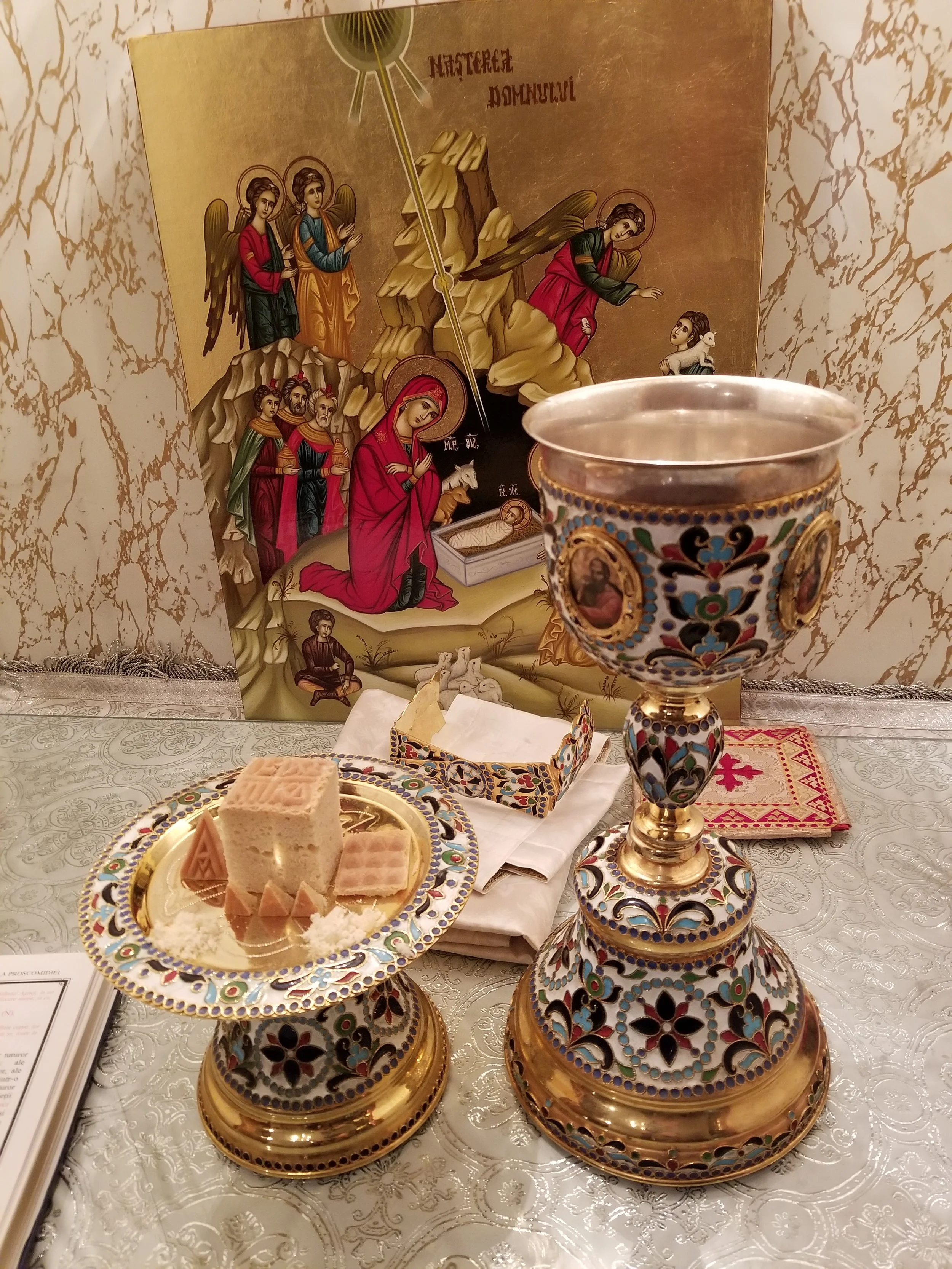
THE PROSKOMIDI
(προσκομιδή, ‘oblation,’ ‘offering’ [Mateos, 2016: 56])
[Also spelled as the Proskomedia, this preparation rite takes place on the prothesis (πρόθεσις, ‘a table of offering,’ aside from the sanctuary), not on the altar in the sanctuary. Therefore, this rite is not the rite of the sacrifice proper, although the bread (prosphora, προσφορά, offering) is referred to as the Lamb during this preparatory ritual. The explicit reference to the slaughter of the Lamb in this rite is a later development circa 730. In Hagia Sophia, for example, the vestments, prosphora, wine, and other implements for the Liturgy were stored in a separate, small rotanda called skeuophylakion (a treasury) located in the north east corner of the church, in which the clergy vested and from which the deacon fetched the prosphora and the wine by exiting the sanctuary from the north east ‘back’ door (of the apse) and returning with them through the nave and transferring them to the bishop at the Royal Entrance (the center doors of iconostasis) awaiting to receive in front of the altar. See Prothesis for more detail; and also the Great Entrance.]
The Text of Proskomidi
The whole text of Proskomidi in PDF.
(The text below is taken from The Liturgikon: The Book of Divine Services for the Priest and Deacon. 1989. 3rd Edition. Grand Rapids, Michigan: Dickinson Press. 240-250.)
As the priest vests, the deacon being fully vested comes to the prothesis and prepares everything necessary for the Proskomedia, and then covers the chalice and diskos with the kalima.
After washing their hands, they stand before the prothesis, with the priest in the center and the deacon to his right, and make three metanias, saying each time:
Priest: O God, be gracious unto me, the sinner.
They reverence the prothesis, and then the priest removes the kalima from the chalice and diskos and lays it aside. As he does so, he may say:
Priest: Make ready, O Bethlehem, for Eden hath been opened for all. Prepare, O Ephratha, for the tree of life hath blossomed forth in the cave from the Virgin; for her womb did appear as a spiritual paradise in which is planted the divine Plant, whereof eating we shall live and not die as Adam. Christ shall be born, raising the image that fell of old.
All now being in readiness, the priest says:
Priest: Thou hast redeemed us from the curse of the Law, by thy precious Blood; nailed to the cross and pierced by the spear, thou hast poured forth immortality upon mankind. O our Saviour, glory to thee.
The deacon raises his orarion and says:
Deacon: Bless, master.
Holding the first loaf of prosphora with both hands, the priest elevates it and makes with it the sign of the cross over the chalice and diskos, as he says:
Priest: Blessed is our God, always, now and ever, and unto ages of ages.
Deacon: Amen. Let us pray to the Lord. Lord, have mercy.
Holding the loaf in his left hand and the spear in his right, the priest makes the sign of the cross three times over the loaf with the spear, saying each time:
Priest: In remembrance of our Lord and God and Saviour Jesus Christ:
The deacon responds each time:
Deacon: Always, now and ever, and unto ages of ages. Amen.
The deacon then says:
Deacon: Let us pray to the Lord. Lord, have mercy.
Cutting with the spear along the right edge of the Lamb (on the priest's left), the priest says:
Priest: As a sheep led to the slaughter, [Isa 53.7-8]
Deacon: Let us pray to the Lord. Lord, have mercy.
Cutting along the left edge of the Lamb, the priest says:
Priest: And as a blameless lamb before its shearer is dumb, so he opened not his mouth'.
Deacon: Let us pray to the Lord. Lord, have mercy.
Cutting along the upper edge of the Lamb, the priest says:
Priest: In his humiliation, justice was denied him.
Deacon: Let us pray to the Lord. Lord, have mercy.
Cutting along the lower edge of the Lamb, the priest says:
Priest: Who can describe his generation;
Deacon: Take up, master.
Piercing the bread at the right corner of the seal and cutting away the bottom crust, the priest removes the Lamb from the loaf, saying:
Priest: For his life is taken up from the earth.
Deacon: Sacrifice, master.
The priest inverts the Lamb on the diskos, placing the face of the seal downward, and makes a deep vertical incision on the back of the Lamb without cutting through it, saying:
Priest: Sacrificed is the Lamb of God, who taketh away the sin of the world, for the life of the world and its salvation.
Deacon: Crucify, master.
The priest makes a: deep horizontal incision, again without cutting through the Lamb, and thus completes a cross-shaped incision, saying:
Priest: At thee crucified, O Christ, tyranny was laid low and the power of the enemy was trampled underfoot. Glory to thee, for neither an angel nor a man, but the Lord himself hath saved us.
The priest then inverts the Lamb again so that the seal is upward.
Deacon: Pierce, master.
Inserting the spear in the right side of the section of the seal marked IC, the priest says:
Priest: One of the soldiers pierced. his side with a spear, and at once there came out blood and water; and he who saw it hath borne witness, and his witness it true. [Jn 19.34-35]
(If additional Lambs are to be consecrated at the Divine Liturgy, they are prepared now, saying and doing for each Lamb the same as was done for the first Lamb, beginning with In remembrance of our Lord and God and Saviour Jesus Christ. When all of the Lambs have been prepared, the Proskomedia continues.)
Taking the cruets of wine and water, the deacon says to the priest:
Deacon: Bless, master, this union.
As the deacon pours the wine and water into the chalice the priest blesses this diaconal action with the sign of the cross, saying:
Priest: Blessed is the union of thy holy things.
Deacon: Always, now and ever, and unto ages of ages. Amen.
Taking up the second loaf, the priest cuts from it a. small triangular particle, saying:
Priest: In honor and memory of oui; most blessed and glorious Lady the Theotokos and ever-virgin Mary, through whose intercessions do thou accept, O Lord, this sacrifice upon thy most heavenly altar.
Lifting this particle with the spear, he places it on the diskos to the right (his left) of the Lamb, saying:
Priest: The queen stood at ,thy right hand, clothed in a robe of gold, adorned in varied colors. [Ps 44.10]
Taking up the third loaf, the priest cuts from it a small particle, which he places on the diskos immediately to the left (his right) of the Lamb, saying:
Priest: In honor and memory of the great angelic leaders Michael and Gabriel and of all the bodiless powers of heaven;
Taking a second particle from under the first, he places it on the diskos under the first, saying:
Priest: Of the honorable, glorious Prophet, Forerunner and Baptist John; of the holy glorious prophets Moses and Aaron, Elias and Elisha, David and Jesse; of the Three Holy Children, Daniel the Prophet and of all the holy prophets;
Taking a third particle from under the second, he places it on the diskos under the second, saying:
Priest: Of the holy glorious and all-laudable apostles Peter and Paul; of the Twelve, the Seventy and all the holy apostles and equals- to-the-apostles;
Taking a fourth particle from next to the first, he places it on the diskos next to the first, saying:
Priest: Of our fathers among the saints, great hierarchs and ecumenical teachers Basil the Great, Gregory the Theologian and John Chrysostom; of Athanasios, Cyril and John the Merciful, patriarchs of Alexandria; of Nicholas of Myra; Spyridon of Trimythous; and Nektarios of Pentapolis; Raphael of Brooklyn; and ·of all the holy hierarchs;
Taking a fifth particle from under the fourth, he places it on the diskos under the fourth, saying:
Priest: Of the holy protomartyr and archdeacon Stephen; of the holy, glorious great martyrs, George the Trophy-bearer, Demetrios the Myrrh-streaming, Theodore the Soldier, Theodore the General; of the hieromartyrs, Polycarp, Ignatios the God-bearer of Antioch, Haralampos and Eleftherios; of the holy women martyrs Thekla, Barbara, Anastasia, Katherine, Kyriaki, Photeini, Marina,.Paraskeva and Irene; and of all the holy hieromartyrs, right-victorious martyrs and confessors;
Taking a sixth particle from under the fifth, he places it on the diskos under the fifth, saying:
Priest: Of our venerable and God-bearing fathers, who shone in the ascetic life, Anthony the Great, Euthymios, Paisios, Sabbas the Sanctified, Theodosios the head of monasteries, Onouphrios, Athanasios and Peter of Athos and of all venerable men and women;
Taking a seventh particle from next to the fourth, he places it on the diskos next to the fourth, saying:
Priest: Of the holy, glorious and wonder-working unmercenaries Cosmas and Damian, Cyros and John, Panteleimon and Hermolaos and of all the holy unmercenary healers;
Taking an eighth particle from under the seventh, he places it on the diskos under the seventh, saying:
Priest: Of the holy and righteous ancestors of God, Joachim and Anna; (of Joseph the Betrothed and Simeon the God-receiver); of N. ( the saint of the day) whose memory we celebrate this day;. of N. ( the patron saint of the church) and of all the saints, at whose supplications, visit us, O God, and grant all of our petitions which are unto salvation and life eternal;
Talking a ninth particle from under the eighth, he places it on the diskos under the eighth, saying:
Priest: Of our father among the saints (John Chrysostom, archbishop of Constantinople or Basil the Great, archbishop of Caesarea).
(If there is to be an hierarchical Divine Liturgy, the priest now covers the diskos and chalice with the aer, and removes the first three loaves of prophora, leaving only the fourth and fifth loaves on the pro thesis for the bishop to complete the Proskomedia.)
Taking up the fourth loaf the priest commemorates the living, taking a particle for each and placing them on the diskos in a row, beneath the letters NI and KA of the Lamb, saying:
Priest: Remember, O Master, Lover of mankind, every bishop of the Orthodox who rightly divideth the word of thy truth; our metropolitan (or archbishop), N., and our bishop, N.; the honorable presbytery, the diaconate in Christ and every priestly and monastic order (and our brethren and concelebrants, priests, NN ., and deacons, NN .); and all our brotherhood whom thou hast called into thy communion, through thy tender compassion, O all-gracious Master.
He then remembers the bishop(s) who ordained him and his sponsors in ordination - if living - his confessor and all others of the living, placing a particle for each one on the diskos and saying for each:
Priest: Remember, O Lord, thy servant, N.
Taking up the fifth loaf the priest commemorates the departed, taking a particle for each and placing them on the diskos in a row, beneath the particle of the living, saying:
Priest: Again we pray for the blessed memory and forgiveness of sins of all Orthodox kings, patriarchs, bishops, priests, deacons, monastics, and every priestly and monastic order; the blessed and ever-memorable founders arid benefactors of this holy house, and the priests and deacons who have served therein; and all our Orthodox fathers and brethren who have fallen asleep in thy communion in the hope of the resurrection unto life eternal, O Lord, Lover of mankind.
He then remembers the bishop(s) who ordained him and his sponsors in ordination - if departed - and all others of the departed, placing a particle for each on the diskos and saying for each:
Priest: Remember, O Lord, thy servant, N.
The deacon may now remember whom he will of the living and the departed, the priest taking a particle for each of the living from the fourth loaf and for each of the departed from the fifth loaf.
The priest then takes again the fourth loaf, removes one particle and places it on the diskos with others of the living, saying:
Priest: Remember, O Lord, my unworthiness, and forgive all my transgressions, both voluntary and involuntary.
The priest then kisses the spear and puts it aside. The deacon puts incense on the burning charcoal and then holds the censer, saying to the priest:
Deacon: Bless, master, the incense. Let us pray to the Lord.
And the priest blesses it, saying:
Priest: Blessed is our God, always, now and ever, and unto ages of ages. Incense we offer unto thee, O Christ our God, as a savour of spiritual sweetness which do thou receive upon thy most heavenly altar and send down upon us in return the grace of thine all-holy Spirit.
Deacon: Amen. Let us pray to the Lord.
The priest holds the star over the incense, kisses it and then places it on the diskos, saying:
Priest: The star came to rest over the place where the young child was.
Deacon: Let us pray to Lord.
The priest holds the diskos veil over the incense, kisses it and then places it over the star, saying:
Priest: The Lord is King, he is clothed with majesty; the Lord is clothed with strength and he hath girt himself. [Ps 92.1] For he established the world which shall not be shaken.
Deacon: Let us pray to the Lord. Cover, master.
The priest holds the chalice veil over the incense, kisses it and then places it over the chalice, saying:
Priest: Thy virtue hath covered the heavens, O Christ, and the earth is full of thy praise. [Hab 3.3]
Deacon: Let us pray to the Lord. Shelter, master.
The priest holds the aer over the incense, kisses it and then places it over the gifts, saying:
Priest: Shelter us, O God,.in the shelter of thy wings; drive away from us every enemy and foe; make our life peaceful; O Lord, have mercy on us and on thy world, and save our souls, for thou art good and lovest mankind, and art a merciful God. [Ps 16.8-9]
Deacon: Bless, master.
'The priest takes the censer and censes the gifts, saying thrice:
Priest: Blessed art thou, O our God, who art thus well pleased. Glory to thee:
The deacon responds each time:
Deacon: Always, now and ever, and unto ages of ages. Amen.
Taking the censer from the priest and kissing his right hand, the deacon says:
Deacon: Upon the holy and sacred setting forth of the precious gifts, let us pray to the Lord.
The priest bows low and says the prayer of blessing of the bread:
Priest: O God, our God, who didst send forth the heavenly Bread, the Food of the whole world, our Lord and God Jesus Christ, our Saviour and Redeemer and Benefactor, blessing and sanctifying us: Do thou thyself bless this oblation, and receive it upon thy most heavenly altar. Remember, as thou art good and lovest mankind, those who brought this offering and those for whom they brought it; preserve us blameless in the celebration of thy divine mysteries, for sanctified and glorified is thine all honorable and majestic name of the Father and of the Son and of the Holy Spirit, now and ever, and unto ages of ages.
Deacon: Amen.
The priest makes three metanias before the prothesis, then kisses the diskos, the chalice, and the cross on the aer, saying:
Priest: Holy God: the unoriginate Father; (the diskos)
Holy Mighty: the co-eternal Son; (the chalice)
Holy Immortal: the all Holy Spirit. (the cross on the aer)
O Holy Trinity: Glory to thee.
The deacon kisses only the lower edge of the aer.
The priest then says the dismissal of the Proskomedia:
Priest: Glory to thee, O Christ our God and our Hope, glory to thee.
Deacon: Glory to the Father and to the Son and to the Holy Spirit, both now and ever, and unto ages of ages. Amen.
Lord, have mercy. (Thrice)
Master, bless.
The Dismissal
Priest: May he who was born in a cave and lay in a manger (insert the appointed characteristic phrase) for our salvation, Christ our true God, through the intercession of his all-immaculate and all-blameless holy Mother; of our father among the saints (John Chrysostom, archbishop of Constantinople or Basil the Great, archbishop of Caesarea) and of all the saints, have mercy on us, and save us, forasmuch as he is good and loveth mankind.
Through the prayers of our holy fathers, Lord Jesus Christ our God, have mercy on us.
Deacon: Amen.
(The curtain is opened.) The following hymns are said by the deacon, or, in some traditions by the priest as he censes the pro thesis, the four sides of the holy table and all the sanctuary. He then exits the sanctuary through the north door and does the great censing of the entire church. If it is a Sunday or any day between Pascha and its Leavetaking, he first says In that we have beheld ... , but on all other days he begins with In the grave with the body ...
In that we have beheld the resurrection of Christ, let us worship the holy Lord Jesus, the only sinless One. Thy cross do we adore, 0 Christ, and thy holy resurrection we praise and glorify: for thou art our God, and we know none other beside thee; we call upon thy name. O come, all ye faithful, let us adore Christ's holy resurrection. For lo, through the cross is joy come into all the world. Ever blessing the, Lord, let us sing his resurrection: for in that he endured the cross for us he hath destroyed death by death.
In the grave with·the body but in hades with the soul as God; in paradise with the thief, and on the throne with the Father and the Spirit wast thou, O Christ, filling all things, thyself uncircumscribed.
Glory to the Father and to the Son and to the Holy Spirit. As life-bearing, as more splendid than paradise and more radiant than any royal chamber, O Christ, is shown forth thy tomb, the fountain of our resurrection.
Both now and ever, and unto ages of ages. Amen.
Rejoice, O thou hallowed, divine abode of the Most High, for through thee, O Theotokos, was joy given unto those who cry aloud to thee: Blessed art thou among women, O all-undefiled Lady.
He continues the great censing, saying Psalm 50: “Have mercy on me, O God ...”
At the conclusion of the censing, the priest and deacon stand at their places before the holy table.
The Divine Liturgy begins….
Continue to Liturgy of the Word