

The Eucharist
in Pseudo-Dionysius, Anselm, Francis, Cabasilas, et al.
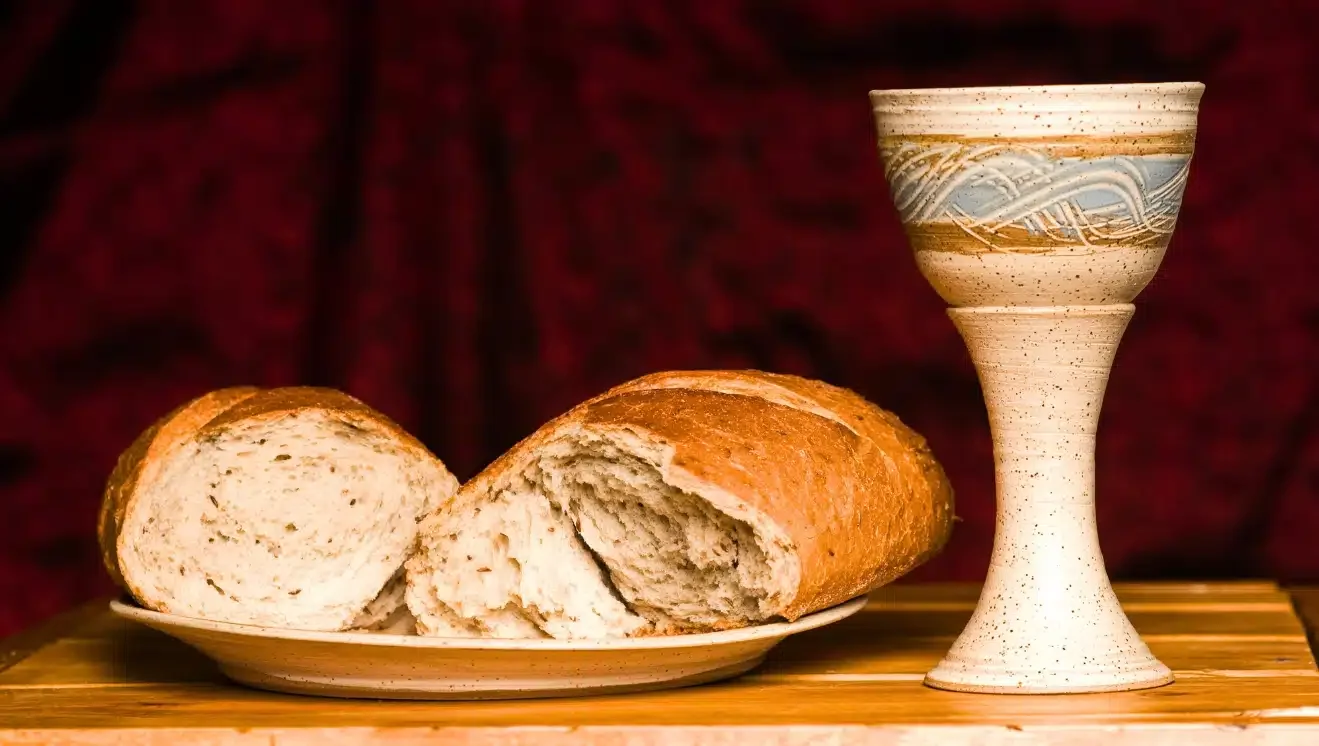
Source: anglicancompass.com

By the look of the broken bread on the table in the picture above, we can see that the elements laid out there are not for the Orthodox or Catholic Eucharist. It might not even be for Anglican or Protestant eucharistic rite either. It might just be an ordinary offering of a meal, a supper or a provision laid out for traveling guests, perhaps. In that precise sense, a table set out for someone is an offering, a sacrifice, a hospitality. To sacrifice is to offer food, lodging, or one’s goods—in short, to offer something in hospitality, a gesture of pure gift without expectation of gain in return. Sacrifice is offering, a pure gift without return or exchange.
To welcome the Other is to set up a table for her, to sacrifice myself for her in substitution. It is to “offer [our] bodies as a living sacrifice” (Rom 12.1) or to pray (Psalm 141.2)—that is to say, to pour out one’s soul to God (I Sam 1.15) and to another person. Because to sacrifice (oneself) to God is to sacrifice (oneself) to my neighbor. To love God is to love my neighbor. One is not possible without the other. We all know the commandment: “you shall love the Lord your God with all your heart and with all your soul and with all your mind and with all your strength. The second is this: You shall love your neighbor as yourself” (Mark 12.30-31). The words “the second is” here need not indicate the order of priority but repetition: ‘that is to say.’ Thus Levinas says after a lifetime of mediation on the Torah: “[God] shows himself only by his trace, as is said in Exodus 33. To go toward Him is not to follow this trace, which is not a sign; it is to go toward the Others who stand in the trace of illeity” (Levinas, 1996: 64). To serve God is to serve my neighbor—that is, to bring about peace in the world, to establish God’s kingdom on earth. There is no other way to God than through my neighbor. To serve Him is to serve the one created in His image.
During the Divine Liturgy the concelebrants gather around the altar, kiss each other, and declare: “Christ is in our midst” (See Taft, 2004: 387-96). To kiss each other in the Mediterranean culture is to offer a greeting of peace with one another. Why is this ritual inserted at the point of breaking bread and mixing it with wine in the Divine Liturgy? Because the Eucharist is for peace, for establishing God kingdom and His righteousness/justice on earth as it is in heaven. Thus, to desire union with God without desiring peace among (any) humans is to desecrate the Eucharist. The question, Who is my neighbor? does not permit us to discriminate. Whether “Jew or Greek,” “slave or free,” or “male or female,” we are all “one in Christ Jesus” (Gal 3.28). We are one in Christ on the altar of sacrifice.
Peace without communion (κοινωνία) is not possible. If there is peace, there is communion. The rite of Communion symbolizes and thus actualizes our communion with God and with one another. If the peace we desire is of God—if it is divine peace—it is realized in the Eucharist. This is so because the Eucharist is essentially an offering—Christ’s offering of Himself to the world; and our offering of ourselves along with Christ to God and to the world. Thus, the deacon exhorts six times during the Divine Liturgy: “Let us offer ourselves and each other to Christ our God.” This exhortation would be meaningless, if we are not willing to offer ourselves, as Christ does. Peace is possible by way of sacrifice; it is impossible without it. Peace is costly, because it prerequisites sacrifice. It requires expenditure that exceeds the reserve or limits, like the love or forgiveness demonstrated by the prodigal son’s father (Luke 15.11-32). It is this costly peace with which we depart the church at the end of the Liturgy to spread in our communities to which we return—the peace that is envisioned like a living water flowing from the altar down to the valleys, rivers, and the seas, as seen in Ezekiel’s and John’s visions.
If the Liturgy aims to produce (perpetual) peace, moreover, it is same as ethics. As Levinas puts it, “liturgy is not to be ranked alongside ‘works’ and ethics. It is ethics itself” (Levinas, 1996: 50). By ‘liturgy’ he means here in its ancient Greek sense: “the exercise of a [public, civic] function which is not only totally gratuitous but requires on the part of him who exercises it a putting out of funds at a loss” (Levinas, 1996: 50). Liturgy—a public, civic work—requires exorbitant sacrifice. It thus symbolizes (and therefore actualizes) God’s offering of his only Son, Christ’s offering of Himself to the world, and our offering of ourselves together with one another “to Christ our God” and thus to the world as He did.
If liturgy is ethics, can ethics be liturgical? Kant offers a clue. See Kant on Baptism.
If the Liturgy is to offer the world to God, it must transcend it. For bringing the world to God requires that we ‘set aside all worldly cares” so that we can dedicate it as a whole to God. But to dedicate the whole world in its totality to God would mean that one can stand under it in support and in one’s offering it up to God. One must bear the weight of it all, as Christ did—not only on the cross but also at his birth, in his ministry, and in his resurrection—so that “God may be all in all (1 Cor 15.28). Like Christ, we must bear the weight of it all in responsibility; we must become the messiah. To be messiah, according to Levinas, is to be ‘me’ in the accusative (Difficult Freedom, 1990: 89). To be an ego is to be ‘me’ first and foremost, in the accusative, before I can think, feel, care, etc, or before I am a being-in-the-world to claim, to own, and ultimately to face death alone as my own most and utmost possibility or, to say the same, to look down at the darkness of the bottomless abyss.
It is not enough, then, that each of us become divine (theōsis) individually and privately; the whole world must become divine as well, as so envisioned by the prophets of old and new. Radical evil within ourselves and without must be domolished. But it all starts with a simple offering of bread and wine on a table like the ones shown above in the picture.
For offer of peace (sacrifice) precedes violence of war (slaughter), as both Cain and Able did. They sacrificed before they went to war against each other and against all. War cannot be the father of all things, as Heraclitus claimed. That is, beings are possible, not because of their active, self giving gesture of ‘be-ing’ in the verbal mode but because of giving, as in for-giving, as they were given “in the beginning…” This is to say that gift precedes being that is said to be on its own, giving itself to be, in self arising justification of itself without the reason why, claiming this place (dasein, ‘being there’) under the sun as my own: the beginning of imperialism of the west. Being in essence is anti-Christ.
The Prayer of the Offering or the Offertory Prayer (that the priest says silently after the Great Entrance has been completed, and while the deacon recites a litany) captures the essence of the Eucharist. It runs with my commentaries added in parentheses:
O Lord God almighty, who alone are holy [transcendent] and receive the sacrifice [offering] of praise from those who call upon you with their whole heart [in prayer], accept the prayer also of us sinners; bring us to your holy altar, enable us to offer your gifts and spiritual sacrifices for our sins and for the people’s transgressions, and deem us worthy to find favor in your sight [make us in your likeness], that our sacrifice [offering] may be pleasing [acceptable] to you, and that the good [Holy] Spirit of your grace may rest upon us, upon these gifts here present, and upon all your people [and transform and divinize them].
As quoted and translated by Mateos, 2016: 56-57; italics added.
As Mateos notes, “us” in the Greek is missing (“bring us to your holy altar). For that reason it is often taken to refer to the prior prayer: “bring it (the prayer) to your holy altar.” But, as Mateos further notes, the Liturgies of St Basil and St Mark “refer the phrase explicitly to the celebrants and not to the prayer” (57; italics his). This interpretation is also supported by the ending of the prayer itself: that the Spirit of grace “may rest upon us [the celebrants], upon these gifts here present, and upon all your people.”
What is asked here? Transformation by the Holy Spirit to divinize “us”—to make us in God’s likeness—the bread and wine, and the faithful who gather in the synaxis to “receive the Body of Christ.” Unless the elements are divinized, they cannot be given; unless we are divinized, we cannot receive the Gifts.
The Eucharist in the Liturgy is the taste of the Resurrection, a realized eschaton, in which offering of oneself for the Other is made possible (by the Holy Spirit) beyond the logic of exchange (Anselm) but in radical substitution of oneself-for-the-Other (Levinas).
In this essay, I will trace the genealogy of the Protestant understanding of the Eucharist that, in my view, has its origin in the early 5th-century Bishop of Mopsuestia, Theodore II (d. 428). The strand that starts from him runs through both the Latin and the Greek (Orthodox) theological traditions thereafter, as it makes itself known in figures such as Patriarch Germanus (d. 740), Anselm of Canterbury (d. 1109), Francis of Assisi (d. 1226), Nicholas Cabasilas (d. 1392), Symeon of Thessalonica (d. 1429), and in the Reformers such as Martin Luther (d. 1546) and John Calvin (d. 1564).
The development that inevitably leads to the Protestant view of the Eucharist was set in motion, I submit, by even an earlier historical fact: the act of Constantine the Great commissioning the Church of the Nativity in Bethlehem in 326 and the Church of the Holy Sepulchre in Jerusalem in 336. Ever since then Jerusalem and Bethleham became the major sites of pilgrimage, as they continue to be to this day—visited by Christians of all denominations with the longing for proximity to the historical and physical Jesus.
The quest for historical Jesus, then, did not begin with Albert Schweitzer and his predecessor, David Strauss, in the early 20th-century. It began rather in the 4th-century, as I said, by Constantine the Great, not to critique or to demythologize Christianity (as Schweitzer and Strauss did) but to experience Christ’s presence closer to one’s heart, historically and physically.
The desire to be close to Jesus physically—whether with respect to a relic or through receiving the sacramental Bread and Wine—inevitably leads to loss or neglect toward ontological union with Christ, i.e., becoming divinized in the image and likeness of Christ. In short, by aiming physical union with Christ one loses sight of the goal of divine union: theōsis. To become divine without losing humanity is precisely the aim of the Incarnation: “… if the Word is made man, it is that men might become gods” (Irenaeus of Lyon, Against Heresies, V pref., col. 1035; as quoted by Lossky, 1963: 42). Theōsis (deification) is the ultimate aim of the Incarnation. This amiable goal is lost when Christians over the centuries sought to be close to Jesus Christ in real, historical and physical sense. There no longer the talk of having a communion with Christ and His Spirit in the eucharistic rite, for example. Rather, the Eucharist becomes a devotional aid, heightened by the sense of Christ’s real and physical presence.
For Protestants, the Eucharist primarily rekindles the memory of historical Jesus and his work on the cross, as Christ’s passion is re-enacted in the eucharistic rite. The assumption here is that the memory rekindled by the ritual would bridge the historical gap between Jesus of history and the faithful who participate in the rite now: “Do this in remembrance of me” (Lk 22.19, I Cor 11.24). Christ, the Head, is joined to His Body, the Church, in the active living memory of Her members, bringing thereby the reality of Jesus of Nazareth to the present consciousness of the Church as a whole. In other words, the Church as His Body lives in the memory of its members, who recalls his birth, ministry, death, and resurrection as historical events of the past that nonetheless live in their present moment of consciousness. The Body of Christ, the Church, lives in the memory, as memory. Christ’s presence, then, is maintained by and in the memory of the believers, by their affirmation and reaffirmation held fast in their memory. Memory and faith—the two moments of consciousness—reproduce the historical Christ-Events of the past into the present moment at the communion table. “Christ is in our midst”—insofar as we remember, believe, and recall. However, is this a real presence, a real communion or a reality filtered through the present moment of consciousness that recalls?
Is the collective memory of the Church that re-enacts and recalls the historical Christ-Event of the past sufficient to accomplish Christ’s ontological presence? Does the Divine Reality rest on human memory or consciousness? Furthermore, if God’s saving work had belonged to history alone, how does it impact the Church in the present? Does the efficacy of Christ’s saving work cease to be now that He had offered himself on the cross “once and for all” (Heb 7.27)?
These questions force us to pose a more fundamental one: What do we mean by salvation or God’s saving work? In church history, there seem to be the following two basic answers to the question: salvation by becoming and returning to God, on one hand; and salvation by being made righteous before God in grace, on the other. I call the former the ontological soteriology, the latter legalistic soteriology.
After the time of Pseudo-Dionysius (b/d. ~500)—whose Alexandrian mystical theology Maximus the Confessor (d. 662) tried to revive (without success, in my view)—the quest for divinization (theōsis) by ontological and visional union (theōria) (to employ pleonasm) seemed to have disappeared in the patristic theology in the east, while in the west Dionysius’s concept of hierarchy was appropriated subjectively in terms of individualistic and private spiritual journey, as in Bonaventure and Aquinas in the 13th-century. Regardless, nowadays hardly anyone talks about theōsis, if the term is understood at all.
The trajectory of turning toward historical realism and away from the (mystical) union/vision with God was set in motion, however—as I said already—when the aforementioned two churches were erected in Bethlehem and Jerusalem as the sites of pilgrimage by Constantine the Great in the 4th-century. But two centuries later in Constantinople Emperor Justinian I (re)built Hagia Sophia from the ashes of its ruins and the other great churches in the city and elsewhere, including Ravenna and the desert of Mt Sinai.
If the aforementioned churches in Palestine built in the 4th-century gave rise to historical realism in patristic theology (that later became labeled as the Antiochene tradition with Chrysostom as its chief representative), the churches in the east built in the 6th-century Constantinople seem to have revived the Alexandrian tradition (where ‘to see’ or ‘to contemplate’ (theōria, θεωρία) is to be transformed to becoming that which is seen/thought (theōsis, θέωσις)). The effects of the effortlessly rising dome above the nave heightens the sense of the immanence of the transcendent God. In this experience of encountering God, enabled by the effects of the architectural structure, the historical event of Jesus Christ recedes in the background. For “Christ is in our midst,” as the concelebrants around the altar beneath the vaulting dome would have said amongst the clergy as they exchanged the kiss of peace in Constantinople.
Why would history matter when “Christ is in our midst”? If the Palestinian churches are partially responsible for the rise of what Taft calls the “incarnational realism” (Taft, 1980/1981: 59, see below), the Byzantinian churches in Constantinople seem to have revived the Alexandrian theology of theōsis that the vaulting domes above the naves re-enforced. See the ancient descriptions of Hagia Sophia in which light plays the vital role in the design of the dome, as the visitors from Kiev attested in the 11th-century.
The term “incarnational realism” is coined by Robert F. Taft, who attributes it to the consequences arising from the triumph over iconoclasm in the 8th- and 9th-century (726-787, 814-842). He writes in referring to Patriarch Germanus, who in 725 defended icon veneration before the iconoclast emperor Leo III the Isaurian (Sendler, 1988: 23):
So what we find in Germanus is the encroachment of a more literal tradition upon another, more mystical level of Byzantine interpretation—and this precisely on the eve of Iconoclasm, when shifts in Byzantine piety led to such growth in the cult of images that Orthodoxy soon found itself locked in [in] mortal combat to defend this new expression of radical incarnational realism against the reaction of a more traditional iconoclastic spiritualism.
Tarf, 1980/1981: 58-59; italics mine.
I have provided selective texts written by Germanus below to show what Taft calls the “radical incarnational realism” found in Germanus’s extravagant allegorical interpretation on the Eucharist and the associated implements, which he had likely used as Patriarch in Hagia Sophia.
In the defense of icons, in short, the Church became more, as Taft puts it, “literal” in the sense that an image must refer to something in biblical history or in theology in at least one-to-one correspondence, so that, as Germanus interprets it, the altar represents the tomb of Christ, laying down (προσφέρειν, τιθέμεν) of the Elements on the altar is reenactment of Christ’s offering and being offered (προσφέρων καὶ προσφερόμενος) as (self) sacrifice (προσφορᾶς, Ecclesiastical History and Mystical Contemplation,” par. 4; P. Meyendorff, 1984: 59), etc. (“The holy table corresponds to the spot in the tomb where Christ was placed [ἐτἐθη].” But it is also “the throne of God” because “He rested in the body.” It is also the physical table where Jesus sat for the Last Supper with the disciples, as well as the altar in the tabernacle where manna, Christ, was placed. Ibid.) One object can have multiple referents, more than one-to-one correspondence. In other cases when the one-to-one correspondence is difficulty, allegorical reference is employed, as we see in Germanus’ interpretation just referenced and will reference more below.
As Sendler notes, after the defeat of iconoclasm, an important shift in iconography occurred: proliferation of biblical scenes. Icons became realistic and illustrative. He writes:
After iconoclasm, Church decoration found form, and these literary forms were fully developed in art. First of all biblical scenes covered the church walls even to the saturation point as we see in Servia, for example, at Decani [a 14th-century monastery in Kasavo]. There we can count more than one thousand scenes. The churches of Romania also manifested this great richness.
Sendler, 1988: 68.
With paintings of biblical scenes, icons became didactic and literal. They also became realistic, as they began to refer to historical reality in one-to-one correspondence (although “patterned after the life of Christ” such that the birth of the Theotokos is modeled after the nativity of Christ, the pattern that is repeated in the icons depicting the birth of St. Nicholas or St. Sergius of Radonezh) (Sendler, 1988: 69).
The turn toward historical realism or incarnational realism occurred not only in the eastern Orthodox Church. It also occurred in the west. As Volker Leppin optly describes of the time of St Francis of Assisi (early 13th-century):
A picture wasn’t simply the work of a painter but played an important role in the execution of a believer’s cultic responsibilities, a medium between God and humankind, a place of presence, a subject of pious performance. In a society where icons of saints were themselves actors in the liturgical drama, of course a crucifix could speak. This wasn’t the result of extravagant imagination or pious deception—it was only to be expected in a God-entranced world. In Francis’s spiritual development, his experience of the divine presence grew more and more intense. The representation of Christ on the cross became a gateway into a closer experience of Christ himself (2025: 45).
According to G. H. Williams, it was the late 11th- and 12th-centuries “when the regal figure of the Romanesque crucifix was beginning to show the lineaments of the Gothic Man of sorrows” (1957: 252).
Neo-Platonism and Iconoclasm
The iconoclastic spiritualism, on the other hand—the movement away from the realistic and material images that the Protestantism embraced—had its roots in Plotinus (d. 270), the father of Neo-Platonism, who is known to despise image making, even his own statue. Following Plato, Plotinus’ model of contemplation (theōria) promotes the elevation of the soul to the Intelligible by setting aside or shedding off the sensible. For him,**
The Neo-Platonic notion of “participation” in the One by imitation thus gives way in this historical trajectory to the Platonic notion of representational function of image in which art thrives, according to Plato, to the detriment and in degradation of ontological reality it (the imaging art) represents and distorts. As consequence, the Syriac notion of symbol (raza)—in which a symbol does not refer to anything other than itself (enclosed in its own mystery, hiddenness, density/opaqueness/depth, i.e., in its aporia)—is lost. Accordingly, the notion of the Eucharist as a divine (sacramental) Symbol is also lost.
Here, I want to trace and document what has been lost in the genealogy of the Eucharist manifesting itself through the authors mentioned above with the hope that it could be retrieved and revived.
Theodore of Mopsuestia (d. 428)
Theodore became the bishop of Mopsuestia in 392 after being a presbyter for a decade at Antioch. In his Mystagogic Catecheses, he provides, for the first time, a description of “anything resembling today’s ritualized transfer of gifts” (Taft, 2004: 35), i.e., the Great Entrance. He is also the first to interpret “the eucharistic liturgy as an anamnesis of the resurrection, and … the procession with the gift as the burial procession of Christ” (Taft, 2004: 37). Theodore, then, was a precursor of the “incarnational realism.” He wrote in his homilies:
It is the deacons who bring out this oblation… which they arrange and place on the awe-inspiring altar, as vision … awe-inspiring even to the onlookers. By means of the symbols we must see Christ who is now being led out and going forth to his passion, and who, in another moment, is laid out for us on the altar… And when the offering that is about to be presented is brought out in the sacred vessels, the patient and chalices, you must think that Christ our Lord is coming out, led to his passion… by the invisible hosts of ministers… who were also present when the passion of salvation was being accomplished… And when they bring it out, they place it on the holy altar to represent fully the passion. Thus we may think of him placed on the altar as if henceforth in a sort of sepulchre, and as having already undergone the passion. That is why the deacons who spread linens on the altar represent by this the figure of the linen cloths of the burial… [And afterwards] they stand on both sides and fan the air [aer] above the holy body so that nothing will fall upon it. They show by this ritual the greatness of the body lying there… which is holy, awe-inspiring, and far from all corruption… a body that will soon rise to an immortal nature… It is evident that there were angels beside the tomb, seated on the stone… and now too shouldn’t one depict as in an image the similitude of this angelic liturgy? … [the deacons] stand around and wave their fans… because the body lying there is truly Lord by its union with the divine nature. It is with great fear that it must be said out, viewed, and guarded. These things take place in complete silence because, although the liturgy has not yet begun, still it is fitting to watch the bringing out and deposing of such a great and wonderful object in recollection and fear and a silent and quiet prayer, without saying anything… and when we see the oblation on the altar as if it were being placed in a kind of sepulchre after death, a great silence falls on those present. Because that which is taking place is awe-inspiring, they must look on it in recollection and fear, since it is suitable that now, by the liturgy… Christ our Lord rise, announcing to all the participation in ineffable benefits. We remember therefore the death of our Lord in the oblation because it makes manifest the resurrection and the ineffable benefits.
Taft, 2004: 35-36; italics added.
Taft notes: “When Theodore says ‘the priest begins the office of the prothesis,’ this should not be understood as referring to a prothesis in the modern Byzantine sense of the term” (2004: 38).
Mateos comments on the above passage by Theodore:
… linking the placing of the gifts on the altar with the deposition of the Body of Christ in the sepulcher is an allegory. Theodore continued his allegorical explanation of the liturgy, connecting the Epiclesis to the Resurrection. In our times, it seems that the symbolical action to signify the Resurrection is the commission of the Body and Blood after the fraction, and that the death is signified by the double consecration. Thus, the old allegory of Theodore tends to create confusion.
[…] [Chrysostom] never indulges in Theodore’s elaborate and forced explanations.
Mateos, 2016: 56.
After all this, Taft notes, the priest greets the people with ‘Peace be to you,’ and the kiss of peace is exchanged, the concelebrant washes his hands, the diptychs are proclaimed, and the anaphora begins (Id., 36-37).
As Taft notes further, by Theodore’s time, “the former simple transfer of gifts has already become a ‘Great’ Entrance” (Id., 37). And, says Taft, “this interpretation was to find its way into the Byzantine liturgical commentaries, and inevitably affected the ritual of the liturgy itself” (Id., 37). Most importantly, Taft notes in Theodore “the burial-cortège symbolism” and “the sacramental realism,” where “the gifts are already the body (dead) of Christ” (2004: 28). As Theodore makes it clear, that only the deacons take part in the procession and that there is no accompanying chant (Id.). Everything takes place in dead silence, as in a funeral procession.
The Eucharist as the symbol of Christ’s passion has taken its root as early as late 4th-century.
Narsai (d. 502)
A century after Theodore of Mopsuestia, in a desert saint Narsai, a contemporary to Pseudo-Dionysius, we find a similar interpretation of the Eucharist. In his Liturgical Homilies, Narsai writes, steeped in symbolism:
Let us put aside … anger and hatred, and look upon Jesus led to death for us. He goes forth to suffer in the paten and chalice, with the deacons… It is the symbol of his death that they carry in their hands, and when they place it on the altar and cover it, they symbolize his burial. The deacons do not represent the Jews, but the watchers who ministered at the passion of the Son. He was served by the angels during his passion, and the deacons accompany his body which is suffering mystically… All the priests in the sanctuary present the apostles who gathered at the sepulchre. The altar is the symbol of the tomb of our Lord… The veil above them [i.e., the bread and wine] presents a symbol, that of the stone sealed with the seal of the priests and guards. The deacons who stand on each side and weave their fans are a symbol of the angels… The sanctuary is the symbol of the garden of Joseph [of Arimathea]…
Taft, 2004: 38-39.
Germanus (d. 740)
St Germanus was Patriarch of Constantinople from 715 to 730. He was a fearless defender of the icon veneration in the eve of the iconoclasm persecution, for which he had to abdicate the patriarchy. His love of icons, however, shifted his theological orientation toward what Taft calls the “incarnational realism” (1981: 59). Germanus’ realism in turn forced him to interpret liturgical symbols in allegorical terms, turning almost everything into a sign referring to some historical object, place, or deed associated with Christ’s passion. The following are some examples of his allegorical interpretations, taken from his Historia Ecclesiastica, a track written largely for the catechumens (the paragraph numbers are preserved):
(3) The apse [behind the altar] corresponds to the cave in Bethlehem where Christ was born, as well as the cave in which he was buried…
(4) The holy table corresponds to the spot in the tomb where Christ was placed. On it lies the true and heavenly bread, the mystical and unbloody sacrifice. Christ sacrifices His flesh and blood and offers it to the faithful as food for eternal life.
The holy table is also the throne of God, on which, borne by the Cherubim, He rested in the body. At that table, at His mystical supper, Christ sat among His disciples and, taking bread and wine, said to His disciples and apostles: “Tate, eat, and drink of it: this is my body and my blood” (cf Mt 26:26-28). This table was prefigured by the table of the Old Law upon which the manna, which was Christ, descended from heaven.
(5) The ciborium [a large canopy over the altar table, consisting of four columns and a roof. At Hagia Sophia, it was made of silver] represents here the place where Christ was crucified; for the place where He was buried was nearby and raised on a base. It is placed in the church in order to represent concisely the crucifixion, burial, and resurrection of Christ…..
(6) The altar corresponds to the holy tomb of Christ. On it Christ brought Himself as a sacrifice to [His] God and Father through the offering of His body as a sacrificial lamb, and as high priest and Son of Man, offering and being offered as a mystical bloodless sacrifice, and appointing for the faithful reasonable worship, through which we have become sharers in eternal and immortal life…
(20) The bread of offering, that is to say, which is purified, signifies the superabundant riches of the goodness of our God, because the Son of God became man and gave Himself as an offering and oblation in ransom [ἀντἰλυτρον] and atonement [ἐξἰλασμα, ‘ransom,’ ‘propitiatory offering’] for the life and salvation of the world.
P. Meyendorff, 1984: 59, 61, 71.
For Germanus, the communion table is the table of Christ’s Last Supper with his disciples, a table where manna was laid, as well as His tomb and His throne. The ciborium made in shining silver in Hagia Sophia is Golgotha where Christ was crucified, buried, and risen from the dead. The table is also the altar where Christ offers himself and is being offered as the bloodless sacrifice as a “ransom and [propitiation] for the life and salvation of the world.” We can already anticipate here Anselm’s substitutional theory of atonement.
Germanus’ polysemic allegorical interpretation is not only confusing, as it contributes toward erosion of the meaning of the liturgy, but also decisively distorts the meaning of the Bread and Wine. The consecrated Bread and Wine are not the signs referring to the Flesh and Blood of Christ on the Cross but the Symbol containing the Uncontainable, the reception by which we become initiated into the divine Reality/Mystery. Once meanings are referred to in one to one correspondence, all mysteries evaporate. Nothing is mystical, in which an ontological transformation is to occur: One becomes divine; one is initiated into the mystery or mystical reality.
Allegory destroys mystical symbolism. In Germanus’ allegorical interpretation of the Divine Liturgy, the rich symbolism therein is destroyed, as symbols are reduced to the role of signs that refer to the historical work of Jesus on the cross in Golgotha. Signs in themselves have no reality. They only serve referential functions. In a few centuries later, Anselm will provide a rational explanation for the historical reality of Christ’s salvific work in terms of a transactional accounting ledger, a quid pro quo.
Anselm of Canterbury
Anselm’s rational explanation for Christ’s unique role as the mediator between God and human within the legal framework of substitutional theory of atonement has already been discussed in another page. Here I want to examine his understanding of the Eucharist.
G. H. Williams notes that Anselm belonged to the time of the late eleventh and twelfth centuries “when the regal figure of the Romanesque crucifix was beginning to show the lineaments of the Gothic Man of sorrows” (1957: 252). Concomitant to this development was the shift toward individual piety and devotional practices, where the Eucharist became the sacrament of penance. For Anselm, more specifically, the Eucharist is the physical means by which the benefits of Christ’s atoning work is subjectively appropriated by the individual believers. The Eucharist serves as an occasion for receiving and digesting the divine food necessary for spiritual sustenance. To be Christ means to take his physical flesh and blood. In Meditatio III redemptionis humanae (1099), Anselm writes:
This let thy heart chew, O man, this let it ruminate, this let it suck, this let it swallow when thy mouth receives (accipit) the Body and Blood of the selfsame, thy Redeemer. Make this in this present life thy daily bread, thy viand and viaticum [‘an article of food’ and ‘a supply of provisions for a journey,’ or ‘the Communion as given to a dying person’], for by means of this and by nothing except this shalt thou at once remain in Christ and Christ in thee….
Meditatio III, p. 89; as quoted by G. H. Williams, 1957: 266; italics Anselm’s.
Here the physical act of chewing, ruminating, and swallowing the consecrated Elements is considered to be the unique way in which one can be united with Christ and reap the benefits of His atonement. If baptism transplants the believer from Adam’s sinful nature to Christ’s perfect and righteous humanity; the Eucharist sustains the believer in the new sacramental life mitigated by Christ’s salvific work. As G. H. Williams notes, for Anselm the eucharist is “the principal means of incorporation into the sinless and potentially universal humanity of the Deus-homo [God-Man], in the merit of the eucharistic repetition of the action on Calvary” (1957: 266).
The metaphor of chewing, ruminating, and swallowing seem to be Anselm’s favored tropes; for he use them to describe how Christ’s atoning work is subjectively appropriated. Anselm opens Meditatio III as follows:
Christian soul, soul raised from somber death, soul redeemed from miserable slavery and set free by the blood of God: arouse thy mind, be mindful of thy resuscitation, ponder thy redemption and liberation, Consider whether the power (virtus) of thy salvation is and what it is… Taste the goodness of thy Redeemer, be inflamed with the love of thy Saviour. Bite the honeycomb of the words, suck the savor better than honey, swallow in loving and rejoicing. Gladden thyself by chewing, exult in sucking, be joyful in swallowing.
Where and what is the power and strength of thy salvation? Surely Christ has resuscitated thee. He, the good Samaritan, has healed thee; he, the good friend, has redeemed thee with his soul and set thee free.
Meditatio III, p. 84; as quoted by G. H. Williams, 1957: 266; italics Anselm’s.
Even if these tropes are applied to Christian soul beyond the eucharistic setting, the teaching is clear: that we are to ruminate, taste, savor the joy of redemption wrought by “the blood of God.” The focus is on contemplation and rumination of the atoning work of Christ and its benefits to be appropriated by intellectual, if not physical (as in the Eucharist), rumination. We can see the shift being made from the historical reality of Christ work to the subjective appropriation of that work, by which God-Man, Christ, is appropriated into one’s life. The rite of the Eucharist repeats this incorporation time and again.
Francis of Assisi
For St Francis the Eucharist is primarily a devotional means of individual piety. Before celebrating the Eucharistic, the priest must prepare his heart (Leppin, 2025: 161; summarizing from Frascis’s 1215 “Letter to All Clerics,” 101). The intention of the celebrants must be “holy and pure;” and they are “to direct their thinking and feeling not toward other human beings but toward God” (Leppin, 2025: 162; summarizing the same Letter).
The individual piety toward God, furthermore, is accentuated especially because the Eucharist is approached as an occasion of Christ’s physical presence in his death and resurrection. The historical context is helpful here to see why Francis understands the Eucharist this way—the emphasis on the realism of Christ’s presence. In November 1215 Pope Innocent III convened the Fourth Lateran Council. Although there is no record of Francis attending the Council, the decision issued by the Council deeply influenced Francis.
His close relationship with the Pope is well known. He met Pope Innocent III in 1209 and received Pope’s recognition of his order (Leppin, 2025: 92). When the Pope died in 1216, a year after the Council, Francis was at his bedside in Perugia (Leppin, 2025: 166, 155).
The Fourth Lateran Council declared that Jesus Christ’s “body and blood are truly contained in the sacrament of the altar under the forms of bread and wine; the bread being changed into the body, the wine being changed into the blood of Christ (‘transsubstantiatis’) by divine power” (as quoted in Leppin, 2025: 169). In declaring changes in the substance, οὐσία, the Council fundamentally deviated from the doctrines formulated by Plato and Aristotle, according to whom substance by definition cannot undergo changes.
In any event, the Council did not raised the issues implicated in its own declaration: that Christ in his substance is actually present in the physical elements consecrated on the altar. In 1059, about two century prior, Berengar had already raised such the issue, for which he was condemned, namely, that the changed bread and wine as Jesus Christ’s body and blood were “not only sacramentally but in truth … taken and broken by the hands of the priests and crushed by the teeth of the faithful” (as quoted in Leppin, 2025: 169, fn 20; it is not clear whether Leppin is citing canon 1 in “The Canons of the Fourth Lateran Council of 1215” or Bradshow and Johnson’s “The Eucharistic Liturgies,” 224). As Leppin puts it, the Fourth Lateran Council “did not finally reflect on the matter beyond coining a new word, transsubstantiare, derived from the word substantia, meaning substance [οὐσία], to obviate the need for further explanation” (Leppin, 2025: 169).
In any event, Francis took the matter further than the Council was willing to go. As Leppin notes, “when we turn to his [Francis’s] view of the Lord’s Supper, we witness something more extreme” (Leppin, 2025: 169). However, the Council’s pronouncement was not “the chief cause of Francis’s understanding and spiritual appreciation of the Lord’s Supper” (Leppin, 2025: 170). Francis radicalized the pronouncement by understanding the Eucharist to be the real presence of Christ in his death and resurrection. In his “Letter to a General Chapter,“ 105, written shortly before his death in 1226, Francis writes, as if the priest at the altar is about to receive the body of Jesus crucified, buried, and risen. Historical realism is palpable in the following passage:
Listen to this, my brothers: If it is right to honour the Blessed Virgin Mary because she bore him in her most holy womb; if St John the Baptist trembled and was afraid even to touch Christ’s sacred head; if the tomb where he lay for only a short time is so venerated; how holy, and virtuous, and worthy should not a priest be; he touches Christ with his own hands, Christ who is to die now no more but enjoy eternal life and glory. . . . A priest receives him into his heart and mouth and offers him to others to be received.
As quoted in Leppin, 2025: 170.
Commenting on the passage, Leppin notes: “the body of Christ that once was on the earth is identical with the body of Christ that now returns to the earth in every Mass” (Leppin, 2025: 171). The eucharistic rite re-enacts and relieves the historical reality of Christ’s death and resurrection. One encounters Christ here and now on the altar—physically, as if to touch his head and his death and risen Body.
Here in this passage, furthermore, we find a strange mixture between allegory and realism: Christ present in the bread enters the priest’s “heart and mouth”—literally into the mouth but metaphorically into the heart. The literal and physical act of receiving the Body in turn heightens the subjective and devotional attitude on the part of the receivers. Thus, Francis writes in the same letter:
Kissing your feet with all the love I am capable of, I beg you to show the greatest possible reverence and honour for the most holy Body and Blood of our Lord Jesus Christ through whom all things, whether on the earth or in the heavens, have been brought to peace and reconciled with Almighty God”
“Letter to a General Chapter,” 104; as quoted in Leppin, 2025: 171.
Again, Francis writes:
Our whole being should be seized with fear, the whole world should tremble and heaven rejoice, when Christ the Son of the Living God is present on the altar in the hands of the priest. What wonderful majesty! What stupendous condescension! O sublime humility! O humble sublimity! That the Lord of the whole universe, God and the Son of God, should humble himself like this and hide under the form of a little bread, for our salvation.
“Letter to a General Chapter,” 105-6; as quoted in Leppin, 2025: 172.
The salvific work of Christ in his physical Body reconciles all things whether on earth or in heavens. In his physical and historical presence that is offered in sacrifice Christ accomplishes peace and reconciliation between God and human. His physical presence effectuates atoning sacrifice. We are to fall down before His presence with “the greatest possible reverence and honor.” Francis does not speak of unity or becoming Christ ourselves. But rather his historical realism heightens the sense of “Christ-focus piety,” leading to one’s subjective awe and trembling fear: “… such warnings [writes Leppin] culminated at the sacrament of the altar in a kind of Christ-focused piety with which Francis approached the meal” (Leppin, 2025: 172).
Such a subjective disposition prescribed by Francis is entirely absent, however, in St Paul’s hymnology in Philippians 2, in which it is God who is said to have “exalted [Christ] even more highly and gave him the name that is above every other name” (Phil 2.9). Christ’s exultation here is ontological first and foremost, rather than subjective and sincerely held by one’s belief. The symbolic language of the hymn that Paul cites in Philippians 2: 6-8 is taken literally and historically in realism in Francis’ interpretation. He thus exemplifies the Zeitgeist of his time, in which “Christ-focus piety” was sought and cultivated in the sacraments, which are increasingly interpreted in the literal and physical sense, while employing allegories when such literalism is impossible to be employed in certain occasions.
The literal and historical understanding of the Eucharist also allowed Francis to adopt the lifestyle of the poor in imitation of Christ. As Leppin puts it, “[t]he sacramental presence of Christ on the altar and following Christ in the peripatetic lifestyle of the first poor apostles were two sides of the same coin” (Leppin, 2025: 173). Christ humility is literally and physically imitated in Francis’ life and his fellow associates’ lives knows as “penitant” monks. As Leppin notes, “It was not the sacramental act of an individual priest before God that was determinative of the community but rather the corporate [or corporeal] encounter with Jesus Christ in the Eucharistic celebration” (Leppins, 2025: 172-73). Jesus Christ is literally and physically encountered—in His ‘flesh and bone’ as it were—on the altar. The power of their penance and their commitment to poverty came from the sacramental encounter with Christ, whose poverty and humility was interpreted in material and literal sense. As Leppin puts it in reference to St Francis’s commitment to poverty, “[t]he cross was also a symbol and expression of an ascetic lifestyle, for living under the sign of the cross meant rejection of a life of luxury, and for this son of a rich merchant there was now no turning back” (2025: 66).
Nicholas Cabasilas
For Nicholas Cabasilas, the Eucharist is a representational symbol. It is a means of recalling the atoning work of Christ for edification of our souls.
Here we have already departed from the Syriac notion of raza, which means ‘symbol,’ ‘mystery,’ ‘secret’—all at once (Brock, 1985: 41). As in Greek, its plural form, raze, refers to the Eucharist, the ‘Mysteries”—the divine Reality thot exceeds human understanding and transcends human reality. And yet, still, it is something that we can touch, see, consume, and become one with in union; because it is something physical; because it is a Symbol.
For the ancient Syro-Palestinians, a symbol has the intrinsic reality in itself, though hidden and invisible. A symbol carries within it a secret reality in itself that defies human intelligibility. Symbol is something inherently unknowable, irreducible, and incomprehensible. For in symbol there is the Infinite in the finite, the Uncontainable in the contained, like the paradoxical symbolism of Mary’s womb, like the Incarnation itself.
The rich or ‘heavy’ notion of the meaning of ‘symbol’ in Syriac (raza) I just described, however, gets reduced in Greek, as it mutates into the function of a sign. A symbol (σύμβολον, a sign or token) is where the two different or incongruous realities are put together or thrown together (βάλλω) into something visible and tangible. The two divergent things are arbitrarily put together into a single thing. The visible refers and defers to the invisible, like a crown, for example, that stands for the royal power and authority. In itself it is merely a head gear or a ring of jewels, no matter how luxurious or magnificent it is. The seal, scepter, cloak, etc.—they all represent the royalty that they stand in for as tokens, as symbols. They are the token signs of the king’s or queen’s power and authority. A totem pole functions much the same way.
In modern linguistics, language is a system of signs that refer and defer to other signs to make up a meaning: a signification signifying the signified. A sign differentiates itself from the signified or the referent that may never (come to) be present, as Jacque Derrida argued.
Understood this way, the Eucharist is often interpreted as a sign that signifies the historical event of Christ’s crucifixion. The bread and wine stand in for the Body of Christ as signs of His presence immolated and crucified. The Eucharist recalls the Christ-Event narrated by the synoptic Gospels. Such is often the understanding of the function of the Eucharist in particular and of the Sacraments in general, or even of the Divine Liturgy in modern time.
But already such an understanding dominates Nicholas Cabasilas in the 14th-century, as it did in Anselm in the late 11th-century and even in Theodore of Mopsuestia in the early 5th-century, who said in one of his catechetical homilies in reference to the Eucharist:
We must see Christ now as He is led away in His passion, and again later when He is stretched out on the altar to be immolated for us. This is why some of the deacons spread cloths on the altar which remind us of winding sheets while others stand on either side and fan the air above the sacred body…
Theodore of Mopsuestia, Holimy 15, Synopsis; as quoted in Paul Meyerdorff, 1984: 29.
The symbolism invoked here almost borders on allegory, while its realism in referring to Christ in history is palpable. No other explanation can be more historical and realistic than this. For Theodore the Eucharist symbolically refers to Christ’s “immolation;” the cloth upon which the bread and the cup lay (the antimension is a late 12th-century invention) symbolize the winding sheets that wrapped the crucified body of Christ; and the fans perhaps refer to the mourning angels or cooling of the air above the dead body. For Theodore sacrifice means above all immolation; and the Eucharist recalls Christ’s body “immolated for us.”
But where is “Christ among us,” the Risen Lord who seeks to commune with us at the table? How does the Communion unite us with Christ and transforms us to follow and become Him?
Is our memory of Christ in the past history—no matter how firmly held in our belief—enough to save us? Christ among us, God with us, the indwelling and work of the Holy Spirit in us and on us—the trinitarian Reality of the God-head must occur. For this is the reality of the Eucharist that we invoke at the epiclesis, when the priest prays that the Holy Spirit descend “upon us and upon these gifts.” To seek the change of the bread and wine to become Christ without the concomitant change of us to become His image is to seek a magical phenomenon to be awed and mystified by it in the ritual, where we remain spectators. The Eucharist is not a magic to behold; just as the Incarnation is not a miracle to recall. They are the divine reality of God’s work and energy (θεουργία) in physical and human forms (Symbols, raze).
Symeon of Thessalonica
Martin Luther
John Calvin
Pseudo-Dionysius