

The Little Entrance
The Diataxis of Philopheos (14th-century) is the first document that uses the label “Little Entrance” (Mateos, 2016: 156).
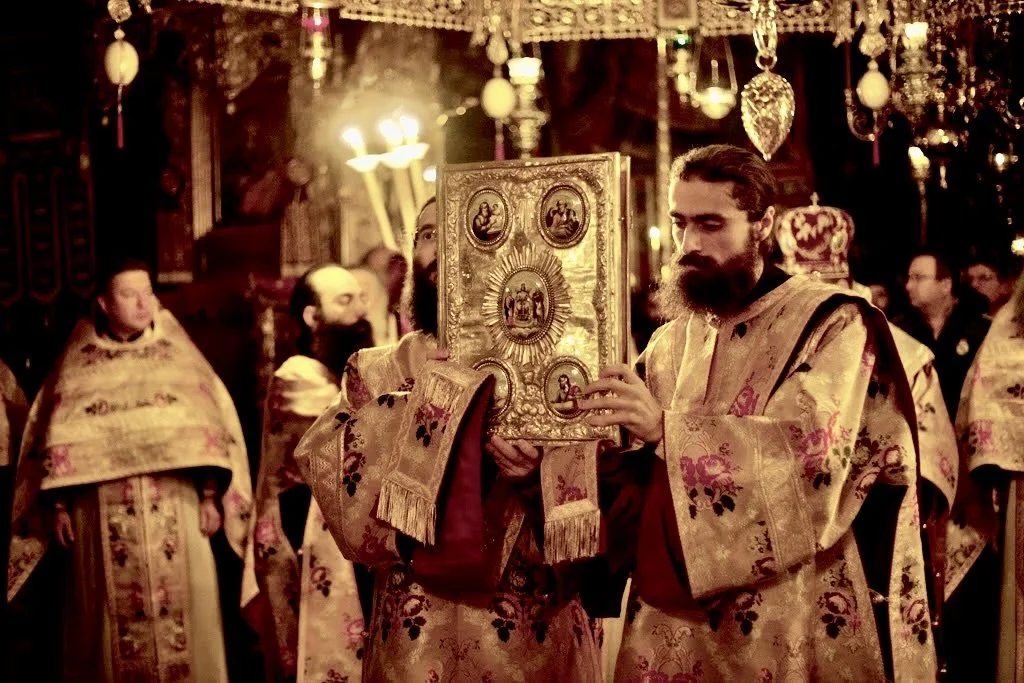
Currently, during the Little Entrance the deacon or priest holds up the Gospel book, carrying it out of the sanctuary to read and, after reading, returns it back to the sanctuary and places it on the altar.
The Word is sacrificed on the altar, as the Bread and Wine will be in the same way at the conclusion of the Great Entrance.
Mateos explains the Little Entrance of ancient times as follows:
[T]he entrance into the church began the Liturgy of the Word, whereas the approach to the altar began the Liturgy of the Eucharist. […]
The first procession stopped in the nave; the second procession ascended from the nave to the sanctuary. Let us note well that formerly the second procession did not include the transfer of the gifts—which had been done previously and without solemnity by the deacons—but only the approach of the bishop and the priests to the altar.
Mateos, 2016: 156. Note: Writing in 1971 or prior, Mateos did not know about skeuophylakion (a treasury) from which the procession of the gifts started. See Editor’s note (most likely Taft’s) in footnote 104 in Mateos, 2016: 125. Still the procession of bishop and patriarch without the gift must have took place so that, when the deacon brings the gifts to the sanctuary during the Great Entrance, they would receive the gifts before they set them down on the altar to begin the liturgy of the Eucharist.
Before the 12th-century, the “little” procession of the Gospel began from outside the church, because the ornately decorated Gospel (sometimes with jewels mounted on the front cover) was kept in and brought into the church from the patriarch’s or bishop’s residence near the church.
The symbolism of the Little Entrance was obvious: The Word enters the world (i.e., the nave, where the people are gathered, where the floor and the surrounding walls and columns are decorated with marbles quarried from all over the world, as in Hagia Sophia).
The patriarch or bishop enters the church during the chanting of the third antiphon. Upon entry, he says, “Peace to all.” And the people who are already there inside the church respond: “And with your spirit.”
St John Chrysostom (d. 407), a bishop and later the patriarch, describes this moment as follows:
The church is the common home of all, and you [the faithful] precede us when we enter there… This is why upon entering we immediately wish peace to all in general, according to that law. […]
For this reason, receive us then with love, when we enter towards you, and, when I say, “Peace to you,” answer, “And to your spirit.”
Mateos, 2016: 103.
Currently, the priest says to the people before the Epistle reading: “Peace be with you all.” After the reading, he says: “Peace be to you, reader.”
In the ancient time, as stated above, the readings began immediately after the bishop’s peace greeting is made to the people as he enters the church, as Chrysostom states above.
Until the 8th-century, the readings included the Prophet in addition to the Epistle, to be followed by the Gospel (Mateos, 2016: 218).
In Hagia Sophia the elevated ambo, upon which the deacon read the Scriptures, was located near the center of the nave. Here, as Mateos puts it, “the community as a whole [was] listening to the Word of God…” Thus, the assembly therein “helped to create a unity between clergy and the faithful…. [where] there is no remarkable differences between bishop, priest and laity. Everyone needs to hear the Word of God and be purified by it” (Mateos, 2016: 61-62).
On Holy Thursday, according to the Typkon of the Great Church, the washing of feet took place in the narthex, then the Entrance Prayer is said at the door of the church. And the patriarch enters the church with the Gospel book without incense or candlesticks, and goes to the synthronon (the throne in the apse). On the evening of Holy Saturday, as usual, the candles and incense accompany the Gospel books (Mateos, 2016: 163).
According to the Pyromalos Manuscript (12th-century), the following three Psalms in abridged forms constituted the three antiphons:
Psalm 91 (“It is good to give thanks to the Lord…”).
Psalm 92 (“The Lord reigns, clothed in majesty…”).
Psalm 94 (“Come, let us shout joyfully to the Lord…” followed by “Save us, o Son of God, risen from the dead. Alleluia”).
Mateos, 2016: 119.
The Manuscript says: “Then the patriarch’s entrance into the sanctuary takes place and the recitation of the Great Synaptê [the Great Litany]” (Mateos, 2016: 119).
Currently, there are three antiphons that the choir sings inside the church. They are completely different from the above.
Currently, during the third antiphony, the Little Entrance takes place: The Gospel is brought out from the sanctuary, exiting through the north door, paraded through the nave or across the ambo, and, after the reading, is returned to the sanctuary through the Royal (center) door to be placed on the altar.
The following three antiphons are typically sung currently:
THE FIRST ANTIPHON: Glory be to the Father, and to the Son, and to the Holy Spirit. Now, and forever, and throughout all ages. Amen.
Bless the Lord, O my soul, and all that is within me, bless his holy name! Blessed are you, O Lord.
THE SECOND ANTIPHON: Glory be to the Father, and to the Son, and to the Holy Spirit. Now, and forever, and throughout all ages. Amen.
Only-begotten Son and Word of God, You that are immortal, yet deigned for our salvation to be incarnate of the holy Theotokos, Mother of God and ever-virgin Mary; and so without change became man, and was crucified; who by death trampled down death, You that are glorified as One in the holy Trinity, together with the Father and the Holy Spirit: O Christ our God, save us!
THE THIRD ANTIPHON: O Lord; remember us when You come into your kingdom.
Blessed are the poor in spirit, for theirs is the kingdom of heaven.
Blessed are those who mourn, for they shall be comforted.
Blessed are the meek, for they shall inherit the earth.
Blessed are those who hunger and thirst after righteousness, for they shall be filled.
Blessed are the merciful, for they shall obtain mercy.
Blessed are the pure in heart, for they shall see God.
Blessed are the peacemakers, for they shall be called the children of God.
Blessed are those who are persecuted for righteousness sake, for theirs is the kingdom of heaven.
Blessed are you when men revile you and persecute you, and speak all manner of evil against you falsely for my sake.
Rejoice, and be glad, for great is your reward inheaven.
Each of the three antiphons are preceded by a prayer. The three prayers before antiphons are considered “much more ancient” but were later added to precede each antiphon in 7th or 8th centuries (Mateos, 2016: 139, 142).
The Prayer before the Second Antiphon resembles the Prayer behind the Ambo said at the end of the Divine Liturgy:
Prayer of the Second Antiphon: O Lord our God, save your people and bless your inheritance (Ps 27.9). Guard in peace the fullness of your Church. Sanctify those who love the beauty of your house (Ps 25.8); glorify them in return by your divine power, and do not abandon us who hope in you (Ps. 16.7)….
Prayer behind the Ambo: (Blessing whose who bless you, O Lord, and sanctifying those who trust in you,) save your people and bless your inheritance….
Mateos, 2016: 140.
“So [says Mateos] we have an ancient prayer of blessing in the Prayer of the Second Antiphon, which became a prayer to precede the chant of an antiphon” (2016: 141).
Currently, during the Third Antiphon, as the Gospel book enters the sanctuary, the priest says silently the following Prayer of the Entrance:
O Lord our God and Master, who ordained in heaven ranks and companies of angels and archangels for the service of your glory: grant that, as we enter in, there may enter with us your holy angels, to serve with us and glorify your goodness: for to You belong all glory, honour and adoration; to the Father, to the Son, and to the Holy Spirit, now and forever, and throughout all ages. Amen. [italics added.]
According to Mateos, this prayer is attributed to St Basil the Great (d. 379). Mateos translates the italicized part as follows: “make this our entrance to be an entrance of holy angels concelebrating with us…” (2016: 164).
The priest’s entrance to the sanctuary with the Gospel book along with the deacon represents the entrance of Christ with holy angels, who will serve the liturgy as concelebrants. It is Pseudo-Dionysius (b/d. 500)who also referred to the angels as “concelebrants” or literally “co-liturgists” (συλλειτουργός, CH 124A).
If the choir imitates Cherubim during the procession of the Great Entrance (of the Incarnate Christ into the sanctuary), the clergy accompany the angels during the procession of the Little Entrance (of the Word into the world). The Little Entrance symbolizes Christ’s descent into the world; the Great Entrance symbolizes His ascent to the altar, offering Himself to God the Father.
Mateos notes, moreover, that in the oldest Italo-Greek manuscripts, the above cited Entrance Prayer for the Liturgy of St John Chrysostom have different prayer, which runs:
Benefactor and Maker of all creation, receive the Church coming forward, accomplish that which is proper to each one, bring us all to perfection, and make us worthy of your kingdom, by the grace, mercy, and love-of-humanity of your only-begotten Son, with whom you are blessed…
Mateos, 2016: 164; italics added.
The Greek word, τελείωσις, meaning ‘perfection’ also means ‘fulfillment’ or, according to Lampe, ‘consummation.’ Maximus the Confessor refers to this moment as the “Church coming forward” (as quoted in Mateos, 2016: 164). The birth of the Church, then, is the fulfillment (τέλος) of Christ’s Incarnation, which the Liturgy accomplishes symbolically/sacramentally.
In other words, becoming the collective and risen Body of Christ is the final aim that the Divine Liturgy presents to us to achieve together as God’s people. The Church as the Kingdom of God is the collective aim of the liturgists who participate in the Liturgy with the angels as concelebrants. The Church in this sense, then, is the “inheritance” that is to be blessed, as said in the Prayer of the Second Antiphon and in the Prayer before the Ambo.
The Stational Nature of the Antiphons
St Maximus (d. 662) makes no mention of the antiphons in his Mystagogue (628-630). St Germanus (d. 740) mentions them for the first time as part of the liturgy (Mateos, 2016: 122, 123).
There were many liturgical processions occurring through the streets of Constantinople, as Mateos writes:
[T]he commemoration of a saint or of an event was not celebrated in all the city’s churches; it took place in one or more churches… […]
The synaxis [the gathering for the Eucharist] was at other times celebrated in the church dedicated to the saints [for example]: 22 October, [at] Saints Anna, Elizabeth, Theodora, and Glyceria…
Sometimes the synaxes [the communions] were celebrated in several churches dedicated to the same saint… […]
On days of a certain solemnity, one went in procession to the stational church. The procession set out from another church, and, during the journey, a troparion was chanted….[…]
The procession often stopped at the Forum [before the church entry], where supplicatory prayers were recited…
The procession can also stop at an intermediate church to celebrate a service of three antiphons….
On other occasions, the service of three antiphons was chanted in the Forum…
Mateos, 2016: 110-113.
Around 950 the antiphons “were not yet considered as an integral part of the liturgy” (Mateos, 2016: 122). They were chanted on certain days “at an intermediary station [i.e., stop] of the procession” (122).
On certain other days “when the liturgy was not stational, the antiphons were always chanted” (122). And the patriarch entered the church during the chanting of the third antiphon (122).
Mateos summarizes his findings as follows:
… in the tenth century there still existed some days without antiphons and other days when the antiphons were chanted outside of the liturgy, during a procession that was a rather penitential. On days without antiphons, they nevertheless had a processional troparion [Ps 94. 2, 6] which served as the entrance troparion to the church [“Let us go before him with thanksgiving…. Come, let us worship…”]. This troparion also existed independently of the antiphons on days when the antiphons were chanted in the Forum or elsewhere.
Mateos, 2016: 123. ‘Troparion’ is a short hymn with one stanza.
According to the Pyromalos Manuscript (12th-century), no mention is made of the initial blessing (that currently starts the Liturgy: “Blessed be the kingdom of the Father, of the Son, and of the Holy Spirit…”); and the three antiphons are chanted outside the sanctuary (Mateos, 2016: 119). As Mateos describes:
The priests and deacons stood on the solea [the pathway from the ambo in the nave to the Royal Door of the sanctuary], before the chancel doors. [See the Great Entrance for a diagram of Hagia Sophia’s interior]. The psalmists were on the ambo, and the deacon was on the steps of the ambo. Since the initial blessing did not exist and since the Prayer of the First Antiphon was said quietly, including the ekphônêsis, without a diaconal invitation, it was the chanting of Psalm 91 [“It is good to give thanks to the Lord…”] which opened the service. The psalms were very abridged, and the [antiphonal] service itself was very brief.
Mateos, 2016: 120.
Prokeimenon (προκεἰμενον, ‘[verse] placed before’) refers to the psalm set before another psalm (2016: 82, 86).
ekphonēsis refers to “the doxological exclamation at the end of prayers” (Mateos, 2016: 166).
Mateos argues further:
… the third antiphon was simply the old processional entrance hymn before the first two antiphons were added.
Mateos, 2016: 133.
Occasions when the Antiphons were Excluded
Here are some special occasions when the antiphons were excluded, as Mateos writes based on Synaxarion of Evergetis (12th-certury):
To begin with, the formulary of Christmas was extended to 2 February and to 25 March, days which, at the Great Church [Hagia Sophia] did not have antiphons at the liturgy because the liturgy was preceded by a procession. Later special formularies for 14 September and 6 August appeared. At the Great Church 14 September did not have antiphons because the liturgy was preceded by the ceremony of the Exaltation and Adoration of the Cross. Palm Sunday did not have its own formulary at Evergetis because the Typika were chanted instead of the antiphons. In the Great Church, the procession of Palms before the liturgy was celebrated, and antiphons were not chanted.
Mateos, 2016: 138.
Various troparia were inserted to mark the special occasions, as Mateos writes:
… the variable insertions of the feasts developed through the centuries. In the beginning, the variants seem to respect the number of syllables and, as much as possible, the assonance of the oldest refrain, which is undoubtedly that of Christmas, “who was born of the Virgin” for 25 December. Similar inserts are the following: “who was baptized in the Jordan” for 6 January, “who for us was crucified” for 14 September, “who in glory was taken up” for Ascension, “who in glory was transfigured” for 6 August, and “risen from the dead” for Easter. [Later, supplemental words were added, such that]… for Epiphany, “who in the Jordan by John was baptized,” and for the Ascension, “who in glory was taken up from us into the heavens.”
Mateos, 2016: 139.
The Little Entrance thus originated from the stational procession, where “on certain days an office of readings was celebrated at an intermediary station” and some other special days the Gospel book was carried, depending on the calendar (Mateos, 2016: 174-75). During these processions, the Cross was also carried, symbolizing the risen Christ (174).
THE EVOLUTION OF THE ENTRANCE RITE
(THE LITTLE ENTRANCE)
Mateos summarizes the evolution of the Little Entrance, the Trisagion, the antiphons, and the troparion in the following way:
Entrance without chanting (4th century).
The Trisagion, the antiphon of a psalm, the hymn of rogation [supplication] processions and so the entrance hymn into church on rogation days (5th century).
The Trisagion, the ancient entrance hymn, retained as the chant for the entrance of the clergy, even on days without a procession (6th century).
A psalm with a troparion (new entrance hymn) used in the non-penitential processions. The Trisagion was chanted after the troparion. On days without a procession, the psalm with a troparion accompanied the entrance of the clergy, and two elements formerly belonging to the beginning of the procession—the synaptê [the Great Litany] and the Prayer of the Trisagion—were inserted between the entrance troparion and the Trisagion (6th-7th century).
The transfer of the preparation of the gifts to the beginning of the liturgy called for the introduction of new elements to occupy the faithful during this time. Two other psalms with antiphons were then placed before the entrance hymn, thus forming a group of three antiphonal psalms, in imitation of those that were chanted at the intermediate stations of the processions. The bishop continued to make his entrance during the entrance hymn, now called the third antiphon. On days with a procession, the two first antiphonal psalms were omitted, the entrance hymn was chanted during the procession. Upon arrival into church, the liturgy began with the Trisagion (7th-10th centuries).
The synaptê [the Great Litany] was transferred to the beginning of the liturgy before the first antiphon; the initial blessing proper to the hours of the office was placed before the synaptê; the preparation of the gifts, which had been done until this time during the chanting of the antiphons, was placed before the beginning of the liturgy, as an independent office [Proskomidi]; the Prayer of the Trisagion was often said during the chanting of the hymn; the doxology of this prayer became detached to become the introduction to the Trisagion (11th-13th centuries).
Mateos, 2016: 212.
Thus, by the 13th century the Divine Liturgy came to take the form we currently have for the most part.