



Ever since 313 CE, when Constantine the Great issued the Edict of Milan (Pax Constantiniana) that declared tolerance of all religions, including Christianity; the churches no longer had to hide underground. They came out in public and celebrated the liturgies in the open for the first time. Shortly thereafter, “deliberate symbolism entered Christian worship” (Taft, 2004: 52).
By the fifth century the Great Entrance became “the moment of the greatest ritual splendor in the whole rite and remains so still among the Byzantines” (Taft, 2004: 37, citing Gregory Dix, The Shape of the Liturgy, London, 1945, 288-89).
In the imperial era the streets of Constantinople, the center of Byzantium Christianity, were dotted with churches; and the public chantings that later became the three antiphons and troparia in the Liturgy accompanied the processions of the clergy and the faithful. They would stop at various stations for prayers and Psalms before they proceed to arrive at the final destination: the designated church. Mateos writes:
… the celebration of the liturgy… had a stational character. So the commemoration of a saint or of an event was not celebrated in all the city’s churches; it took place in one or more churches; for example, in the one which preserved the saint’s relics…
Mateos, 2016: 110.
At Hagia Sophia the first part of the Liturgies we now call the Liturgy of the Word began out in the open on the streets to be concluded with the readings of the Epistles and the Gospel inside at the ambo. The reading from the Old Testament was dropped in the 8th-century (Mateos, 2016: 47).
The Little Entrance was mainly the procession of the Gospel book entering the church after the procession having undergone the prior stational prayers performed out in the open at different stations or churches on the way to the final destination.
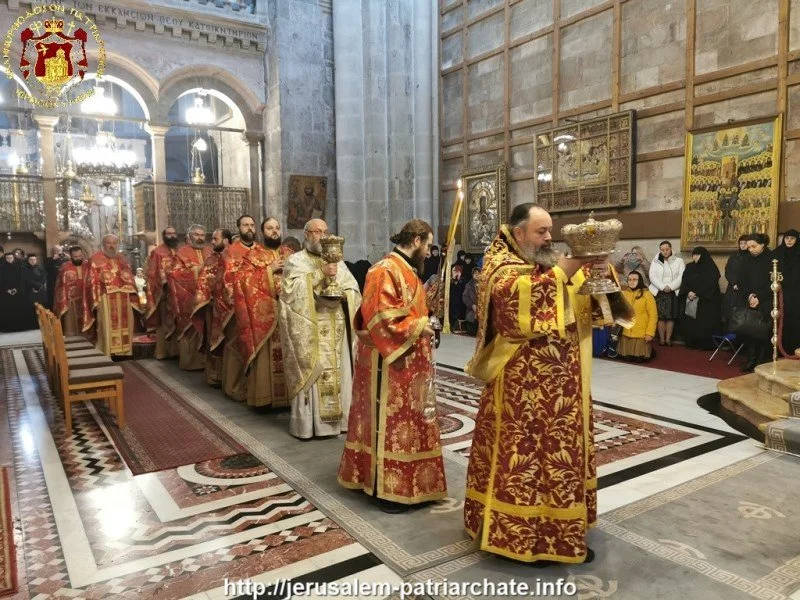
The Great Entrance carries the same spirit and style of the procession. Although performed inside the church, it belongs to the genre of public exhibitions and pageantry, accentuated especially by royal processions (when the emperor is in attendance). In fact, one of the medieval frescoes depicts the “Great Entrance” as the Divine Liturgy itself (Taft, 2004: 11).
The Divine Liturgy, then, is processional in nature, comprising of the Little Entrance and the Great Entrance. In both processions, Christ, the Word and the risen Lord on the plate and in the cup, is the main actor who enters as “the King of all,” as the Cherubic Hymn describes. The Word of God enters the world; and, after being embodied, enters Jerusalem as a sacrifice to give the Life of the new Jerusalem: the Church.
The historical reality of the Risen Body of Christ (the Church) receives its cosmic description in the Book of Revelation, in which the New Jerusalem descends from heaven after all iniquity and corruption of mankind have been purged and destroyed, so that the heavenly liturgy may truly begin on earth in the realized Kingdom of God, wherein God dwells among the peoples as His, wherein God’s justice is fully and finally realized, as foretold by the Prophets.
The great procession takes place in anticipation of this eschaton, as the choir sings the Cherubic Hymn—the most elaborate and length hymn in the present Liturgy dating back to Justin II in 573-574 (Taft, 1980/81: 54):
Let us who in a mystery represent [μυστικῶςεἰκονίζοντες, mystically iconize/’mould into [the] form’ [of]] the cherubim, and who sing then thrice-holy hymn to the life-creating Trinity, now lay aside [ἀποθώμεθα] all earthly cares…
While the Cherubic hymn is sung, the priest and the deacon perform the tasks described below, followed by a litany of prayers, after which, as the Gifts are received by the awaiting bishop (if available) in the sanctuary, the choir concludes the hymn:
That we may receive [ὺποδεξόμενοι] the King of all invisibly escorted by the angelic rank. Alleluia.
[Ὺποδεξόμενοι refers to “the reception of Christ in communion” (Taft, 2004: 64).]]
The bishop receives the Gifts (the bread and wine) on behalf of all gathered there, symbolically and literally. Thereupon, the Anaphora begins and the Holy Spirit is invoked to transform the bread and wine (together with us) into the Body and Blood of Christ (see the Liturgy of the Faithful). Not only the Elements but also we, the faithful, are made into the Body of Christ, the Church, by the grace/the work of the Holy Spirit.
The Bread is mixed with the Wine in the chalice to symbolize the conception of Jesus in Mary’s womb. This is the holy moment of the Conception, of the Word becoming flesh (Jn 1.14).
The Bread and Wine is then shared in communion with the clergy in the sanctuary, before they are brought out to the nave (synaxis) outside the sanctuary to the faithful to be distributed among them. This is the holy moment of Christ entering the world, the moment when the Body of Christ, the Church, is born, nourished, and regenerated in the world—all this after having been empowered by the descent of the Holy Spirit on the altar (epiclesis) and in Jerusalem (historically) on the day of Pentecost (Acts 2.1-4). The symbolism (and thus reality) cannot go deeper than this.
The Cherubic Hymn was added in 573-574 to the pre-existing antiphon comprised of Psalm 24.7-10. The Psalm was then “suppressed” sometime before the 8th century, as the procession became shorter in distance (Taft, 2004: 83, 116, 115, 426).
Hagia Sophia was re-dedicated in 563 after the 558 earthquakes.
According to Taft, the Prayer of Cherubic Hymn is not “an original part of the liturgy of the Great Church (2004: 121). It appears in the 10th century Constantinopolitan euchalogy for the first time (122).
Hagia Sophia had only a small nucleus of psalmists to assist the people in singing the responses and chants. According to Justinian’s code, in the 6-7th century the number of psalmists serving in rotation the three patriarchal churches, Hagia Sophia, Hagia Eileen, and the Chalkoprateia, did not exceed twenty-five (Taft, 2004: 80). But the interior acoustics with the high vaulted dome must have more than made up for the relatively small size of the choir.
John Chrysostom (d. 407) makes no mention of a procession with the gifts (Taft, 2004: 42). Pseudo-Dionysius (b/d. ~500) does not either (EH Ch 3; 425B-428A). Neither does Maximus the Confessor (d. 662) in his Mystagogy (2019: 722-27, 916-18, 968-73).
Initially, the “Great Entrance” was a simple act of bringing the gifts to the altar. “There was but one Christian offering,” writes Taft, “the sacrifice of Christ; and one prayer of blessing over the gifts, one ‘offertory prayer’ (ἀναφορά, [anaphora]): the eucharistic prayer itself.
Justin Martyr (died c. 165), the first Christian apologist, describes the procedure as follows:
After finishing the prayer [of the faithful], we greet one another with a kiss. Then bread and a cup of water and mixed wine are brought to the one presiding over the brethren. He takes it, gives praise and glory to the Father of all in the name of the Son and Holy Ghost, and gives thanks at length for the gifts that we were worthy to receive from him.
Justin, Apol. I, 65; as cited in Taft, 2004: 12.
Before the formation of the Great Entrance performed by the clergy, as we know it, there were procession of the faithful bringing gifts of donation or bread and wine. Taft summarizes:
[T]he people bring to the priest their prosphora with a list of the living and dead for whom they wish him to pray, whenever they happen to arrive in church. These gifts remain in the skeuophysakion or prothesis until after the Liturgy of the Word, when they are then transferred to the altar in the Great Entrance.
Taft, 2004: 34.
[T]he Great Entrance [however] represents something ‘new’ in the liturgy, something ‘introduced’ at a certain point in its evolution, and that its origin is linked in some way to the disappearance of (or at least a change in) the offering of gifts by the faithful.
Taft, 2004: 16.
While the choir sings the Cherubic Hymn, the priest offers the Prayer of Cherubic Hymn [unnecessarily repeating what the choir is singing, according to Mateos, 2016: 55], then, censes around the altar, the throne (behind the altar), and the icon of Christ and of Mary on both sides of the iconostasis.
Then, [at the prothesis, ‘a table of offering’] “[t]he priest, lifting the aēr up from on top of the gifts and placing it upon the deacon’s shoulders and recites Psalm 133.2 (“Lift up your hands toward the holies and bless ye the Lord”).
Then, the priest takes up the veiled diskos, kisses it and hands it to the deacon who in turn kisses the priest’s hand. The deacon holds the diskos with all attentiveness and care and holds it at least to the level of his forehead. The priest himself takes up only the veiled chalice, and they set out on the procession. […]
[T]he procession sets forth through the north [left] door with lamps and censer. As the procession passes through the nave, the deacon exclaims aloud: ‘All of you, May the Lord God remember in his kingdom, always, now and ever, and unto ages of ages.’ [The choir or people respond: “Amen.”]
[…] When the procession reaches the solea [the passage to the sanctuary], the deacon immediately enters the sanctuary through the holy [Royal/center] doors and takes his stand at the southwest corner of the holy table, still holding the diskos and facing west. The priest, facing east, lifts up the chalice and commemorates, first, the hierarch and then whomever he wishes among the living and the departed. After this, the priest enters the altar through the open holy doors while the choir concludes the cherubic hymn. The priest places the chalice on the antimēnsion (to the right) then receives the diskos from the deacon, and places it on the left side of the chalice.
Hieratikon Á, Najim, 2025: 152-154.
Thus the Great Entrance leads to the Holy Anaphora (ἀναφορά,, ᾽rising of a sign’). In fact, the procession should be considered a part of Anaphora (Golitzin, 2013: 141, as quoted below).
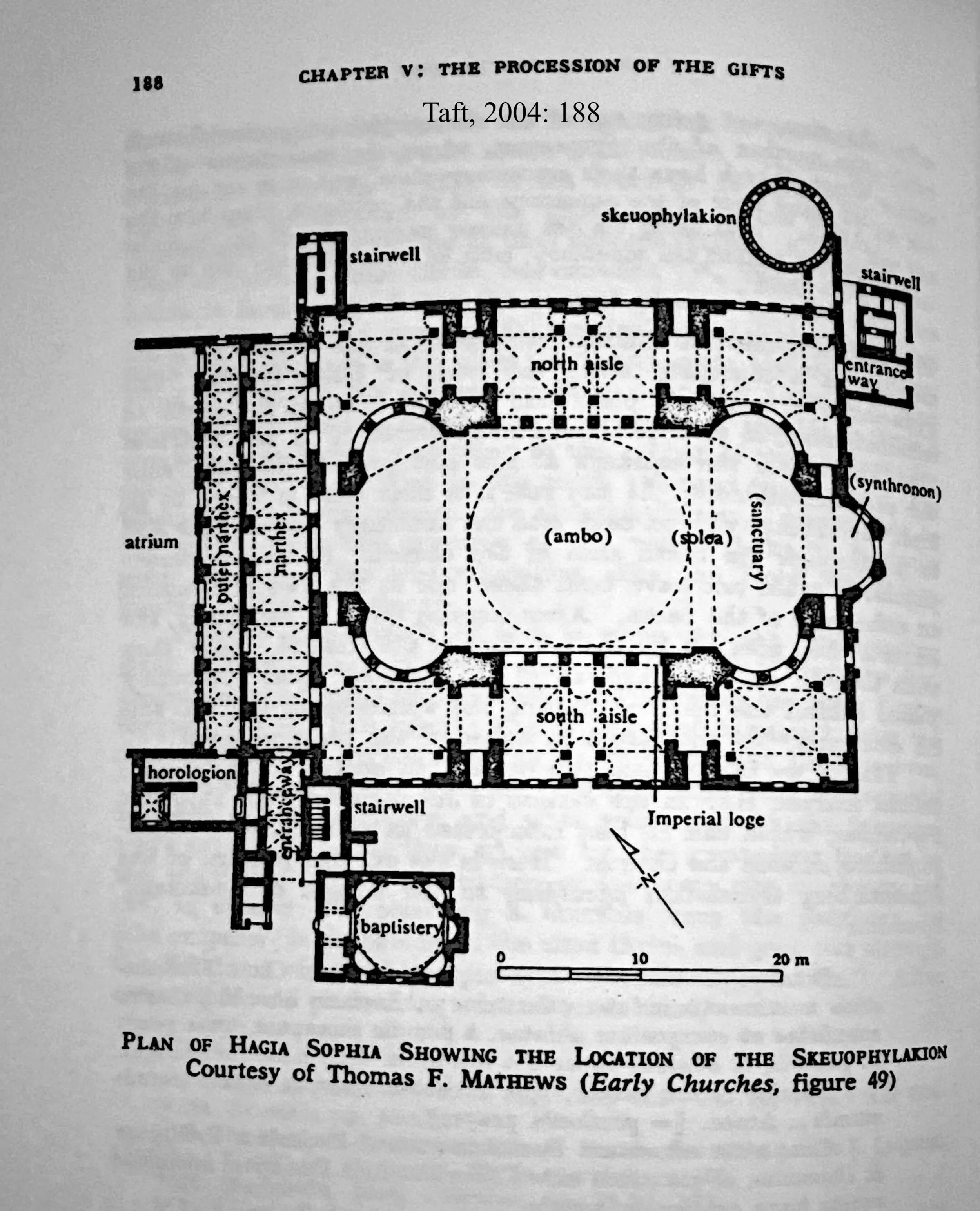
In Hagia Sophia, however, the not yet fully developed Great Entrance started from skeuophylakion (a treasury - σκευάζω ‘make ready’) outside, entered the church through the north east door, moved through the nave, went around the elevated ambo, to be joined by the emperor (if attending), moved on through the solea (a short passage) before reaching the Royal Doors where the Gifts were handed over to the awaiting patriarch or bishop, who in turn set them out (προτιθεῖ) on the altar in the sanctuary.
προτίθημι means: set before, set out (esp. of meals); set up, institute (esp. of contests); lay out (a dead body).
πρόθεσις (translated as ‘a table of offering’) means: placing in public; laying out (of a corpse); offering; (the loaves) laid before, shew-bread. See Prothesis.
The above two words share the same root τίθημι, meaning: set, put, place, set for oneself, lay down; lay in the grave, bury; set up (of the prizes in games); set up (in a temple), dedicate; lay down or give (a law); establish, institute.
These words are rich and polysemic, referring to a meal, burial, and institution (of the Lord’s Supper, for example). In the Divine Liturgy (especially in the Holy Anaphora) all these notions seem to apply.
Consider also θέσις and how Heidegger subverts it for his own purposes in “The Origin of the Work of Art,” Off the Beaten Track, 2002: 53. Even if θέσις (‘being’ in its active sense) precedes τίθημι (‘offering’) in language, in reality sacrifice (‘offering’) precedes being—being that is said to father all things as war (Gen 4; Heraclitus fragment 53; Heid. Introduction, 47 in German).
The main purpose of the procession is simply to bring the holy gifts to the sanctuary and to place them on the altar to be offered as sacrifice in the Eucharistic rite (Anaphora).
Robert F. Taft reconstructs the Great Entrance of Hagia Sophia in its simpler form as follows:
After the intercessions have been completed, the deacons in the cortège herald their arrival [from steuophylakion-see below] with the gifts by intoning the Cherubicon, which is then taken up by the psalmists, who have left their customary place in the chamber beneath the ambo and lined up on both sides of the solea to form an honor guard through which the procession of the gifts, accompanied by numerous candles and the fragrance of smoking thuribles, now passes.
[…]
The splendor of this procession is as legendary as the building in which it took place. Indeed, it came to symbolize, by a sort of ritual synecdoche, the entire Byzantine Divine Liturgy.
Taft, 1980/81: 53.
St Germanus (d. 730) allegorically interprets the Great Entrance as follows:
By means of the procession of the deacons and the representation (ὶστορία) of the ripidia bearing an image of the seraphim, the Cherubic Hymn shows the entrance of the saints and all the just, entering together before the cherubic powers and angelic hosts, invisibly going before Christ the great king proceeding to the mystical sacrifice…
As translated and quoted by Taft, 1980/81: 54. See how this historical interpretation conflicts with St Maximus’s eschatological interpretation of the Eucharist, as noted in Taft’s footnote 59.
In the 10th century the following Prayer of the Cherubic Hymn (that the priest says in soft voice) was introduced. This prayer perhaps best captures the meaning of the procession: as the procession toward the communion:
Holy Master … make us worthy of the reception (τῆς ὺποδοχῆς, [this word refers to the receiving of the Body of Christ, Taft, 2004: 64]) of your only-begotten Son and our God, the King of Glory. For behold His immaculate body and life-giving blood entering at the present moment to be placed on this mystical altar, invisibly escorted by a multitude of the heavenly host. Grant us communion in them without condemnation, so that with the eyes of our understanding enlightened by them, we may become sons of the light and the day.
Taft, 2004: 68; translation his.
In the Great Entrance, then, we along with the heavenly hosts are proceeding toward the communion with Christ in his sacrifice.
What does it mean to commune with Christ in His sacrifice, so that we may become “illuminated [and]… become [children] of the light and the day,” as the prayer says?
Christ is “the Light of the Father,” according to Pseudo-Dionysius (CH 121A). To receive Him is to become light like Him: to be illuminated by and to illuminate “the Light of the Father.”
How did Christ become the Light for the World (Jn 8.12)? By becoming flesh and by being lifted up on the cross, thereby exhibiting “the glory as of the father’s only son” (Jn 1.14, 12.23). The way to divine glory is through sacrifice, by offering and being offered as sacrifice to God and to the world. To offer oneself to God is precisely to offer oneself to my neighbor (Matt 22. 36-40).
To sacrifice is to be illuminated; and to illuminate is to offer in sacrifice. The chiasm reflects the paradox of the logic of sacrifice: “the last will be first, and the first will be last” (Matt 20.16).
What, then, does it mean to sacrifice—to offer ourselves to God in sacrifice, as we join Christ on the altar of the Eucharist?
Leviticus and the Letter to the Hebrews have a lot to say about the sacrifice—the earthly sacrifice performed by the Israelites and the perpetual sacrifice offered by Christ in his Risen Body at the right hand of God.
The Levitical Sacrifice and Christ’s Perpetual Sacrifice in the Letter to the Hebrews
The Byzantine Eucharistic sacrifice resembles the Levitical sacrifice, which in turn is depicted in the Letter to the Hebrews, where the risen Christ is described as performing the perpetual sacrifice in the order of Melchizedek at the right hand of God (Heb 7.3).
The Levitical sacrifice involves the movement of bringing the offering(s) from the outer altar, through the altar of incense in the shrine in the middle of the Tabernacle, and finally to the Holy of Holies (Adytum), where the ark is located behind the curtain (Lev 14 and 16; Moffitt 2022: 164). See Milgrom’s Figure 1 in Prothesis.
In the Letter to the Hebrews, the similar movement that Christ makes is depicted in the curious expression, “through heavens” (note the plural): “… we have a great high priest who has passed through the heavens…” (Heb 4.14, 8.1-5). According to David M. Moffitt, Christ, the High Priest, passing “through heavens” symbolically indicates the movement of the Levitical high priest proceeding from the outer altar to the inner shrine and on to the Holy of Holies to offer the sacrifice on the Day of Purification/Atonement (Moffitt 2022: 36). In the transference of the sacrifice, slaughter belongs to the preparatory procedure and not to the essence of sacrifice.
Sacrifice thus means offering, bringing the offering (προσφέρω). Slaughter is not the essential part of sacrifice, as it is in Ancient Greek religion (see below). In the Levitical sacrifice, in contrast, slaughter took place away from the outer alter. On the Day of Purification/Atonement (Yom Kipper), furthermore, one of the two goats (usually mistranslated as ‘scapegoat’) is release to the wilderness (“to Azazel,” the wilderness of the demon), bearing the sins of Israel (Lev 16.6-10).
See Moffitt, 2022: 169 (“… the slaughter was not an act that occurred upon any of the altars”) and Milgrom, 1991: 1044 (“… the live goat has nothing to do with the sanctuary’s impurities but, as the text [Lev 16.10, 22] emphatically and unambiguously states, it deals with … ‘iniquities’ [of the people]—the cause of the sanctuary’s impurities, all of Israel’s sins, ritual and moral alike, of priests and laity alike”).
In short, for the sins of Israel, including that of the priests, the goat was sent away alive after their sins were transferred onto the goat by Aaron’s laying of hand (Lev 16.10). Only then, the High Priest can perform the purgation of “the adytum, the Tent of Meeting, and the altar,” as prescribed in Lev. 16.14-20, by sprinkling the blood on the appropriate places.
Here, the blood functions as the cleansing agent. It has apotropaic effects, as in Exodus 12. The remains of the animal slaughtered to draw blood were not sacrificed on the altar but discarded “outside the camp” to be burnt by the High Priest’s assistants (Lev 16.27). See Jacob Milgrom’s new translation of Lev 16.1-34.
In contrast, in ancient Greek sacrifices, the animal is slaughtered on the altar, blood is extracted, and the meat is flayed and cooked for feasting in celebration. For the Greeks, the sacrifice was part of the festive banquet.
Walter Burkert describes the Greek sacrifice as follows:
The animal chosen is to be perfect, and it too is adorned, entwined with ribbons, with its horns gilded. A procession escorts the animal to the altar. Everyone hopes as a rule that the animal will go to the sacrifice complaisantly, or rather voluntarily; edifying legends tell how animals crossed forward to the sacrifice on their own initiative when the time had come. A blameless maiden at the front of the procession carries on her head the sacrificial basket in which the knife for sacrifice lies concealed beneath grains of barley or cakes. A vessel containing water is also borne along, and often an incense burner; accompanying the procession is one or several musicians, normally a male or female flute-player. The goal is the stone altar or pile of ashes laid down or erected of old. Only there may and must blood be shed.
Once the procession has arrived at the sacred spot, a circle is marked out which includes the site of sacrifice, the animal, and the participants: as the sacrificial basket and water vessel are borne around in a circle, the sacred is delimited from the profane. All stand around the altar. As a first communal action water is poured from the jug over the hands of each participant in turn: this is to begin, archesthai [ἄρχεσθαί, make a beginning]. The animal too is sprinkled with water, causing it to jerk its head, which is interpreted as the animal nodding its assent. The god at Delphi pronounced through the oracle: ‘That which willingly nods at the washing of hands I say you may justly sacrifice.’ A bull is given water to drink: so he too bows his head.
The participants each take a handful of barley groats … from the sacrificial basket. Silence descends. Ceremonially and resoundingly, and with arms raised to the sky, the sacrificer recites a prayer, invocation, ish, and vow. Then, as if in confirmation, all hurl their barley groats forward into the altar and the sacrificial animal; in some rituals stones are thrown. This, together with the washing of hands, is also called a beginning, Katarchesthai [κατάρχεσθαι, ‘to make beginning of’].
The sacrificial knife in the basket is now uncovered. The sacrificer grasps the knife and, concealing the weapon, strides up to the victim: he cuts some hairs from its forehead and throws them on the fire. This hair sacrifice is once more and for the last time a beginning, aparchesthai [ἀπάρχεσθαι, ‘to make a beginning’]. No blood has flowed, but the victim is no longer inviolate.
The slaughter now follows. Smaller animals are raised above the altar and the throat is cut. Anox is felled by a blow with an axe and then the artery in the neck is opened. The blood is collected in a basin and sprayed over the altar and against the sides: to stain the altar with blood is a pious duty. As the fatal blow falls, the women must cry out in high, shrill tones: the Greek custom of the sacrificial cry marks the emotional climax. Life screams over death.
Burkert, 1985: 56.
No such scene of slaughter, followed by a celebratory banquet, is remotely implied in the Levitical sacrifices or in the Eucharistic rite.
Moreover, Milgrom comments: “the biblical rite [Lev 16.6-10] has naught to do with the notions of offering or substitution…” (1991: 1074; cf., 1076, 1078). The passage (Lev 16.6-10) prescribes how the high priest is to make the purification offering on the Day of Purification/Atonement. Again, slaughter is not part of the purification ritual (of sprinkling blood), nor is it part of the burnt offerings made on the outer altar (because immolation takes place away from the altar). In the Holy of holies, there was no altar but the Ark.
The word ‘atonement’ is one of the unfortunate English words that William Tyndale (d. 1536) invented (1505-15) when he translated the Bible into English. It is an ambiguous and all encompassing word to translate the Hebrew קרבן (qorban, ‘offering’) (Moffitt, 2022: 163) or כפר (kipper, which refers to ‘both ransoming and purifying effects’) (Mofgfitt, 2022: 109). Shakespeare (d. 1616) followed suit in similar fashion to invent more English words for his plays.
The term ‘atonement’ is useful, however, only in one instance: to refer to ‘purification’ or, by inference, ‘repentance.’
The term ‘expiate’ (c. 1585) derives its meaning from ‘atonement’—as ‘to atone for.’
The idea of sacrifice as ‘substitution’ (as in Anselm) however, appears in the description of the Suffering Servant in Isaiah 52-53:
Surely he hath borne our briefs, and carried our sorrows…. But he was wounded for our transgressions, … bruised for our iniquities: the chastisement of our peace was upon him; and with his stripes we are healed.
Isaiah 53:4-5, also 52.14, KJV.
But, as Moffitt notes, since the Levitical sacrifice must be “without defect” and must have “no blemish” (Num 19.2), the Suffering Servant, the righteous, cannot meet the qualification of being a sacrifice, the offering; because he is said to be “bruised” and “marred” (Moffitt, 2022: 51-52).
The idea of the righteous who suffers as a substitution for the sins of the people and that his substitutional suffering would repair the broken covenantal relationship with God, is a later concept originating from the period of Babylonian Exile (the time when Isaiah 52 and 53 are written). This idea of substitution as a means of redemption is, however, carried forward into the Second Temple period, into the intertestamental time, and well into the time of the New Testament. It became dominant in soteriology after Anselm (see Anselm and the Byzantine Synthesis); and it is live and well even today even outside Christianity, as in, for example, baseball: a “sacrifice hit.”
The sprinkling of the blood that is required as “a purification offering”—Lev 16.11, 14; 17.11; the word כפר (kippēr) should be translated as “purification” and not as “atonement”—does not refer to slaughter but to cleansing by smearing the blood (as in χρῖσμα, ‘anything smeared on’).
As already stated, blood acted as a cleansing agent. It had apotropaic (ἀποτροπία) effects, as in Exod 12.13. See Milgrom on hattā’t (purgation offering), 1991: 264 (“… Hebrew kipper [is] the exclusive term for ‘purge’” and “to expunge impurity” (1991: 1033)).
To purge, you need to offer a purification offering (hattā’t). See Lev 16.6 (““Aaron shall offer the bull as a purification offering [חַטָּאָה, hahatā’t] for himself and shall make atonement [כָּפַר, kipper] for himself and for his house“ (NRSV).
Milgrom translates the same verse as follows: “Aaron shall bring forward his own bull of purification offering to effect purgation for himself and for his household.” This is a clearer translation than to use “atonement” as in NRSV. See his new translation of Lev 16.1-34.
The idea of the substitutional atonement, however, was solidified by St Anselm of Canterbury (d. 1109)—before it was carried further on by the Reformers (Martin Luther and John Calvin)—to become nowadays the dominant notion in Christian soteriology. It has its roots, however, in the New Testament passages such as I Cor. 15.3 and 1 Peter 2.24.
Drawing near God to offer the sacrifice (i.e., bringing and offering the gifts) after having daubbed the blood in a certain prescribed manner for purgation is the central motif in the Levitical sacrifice, in which slaughter is not a part but a necessary prerequisite. In ancient Greek, in contrast, slaughter was the essential part of the sacrificial ritual leading to a celebratory banquet.
In the manner of Leviticus 16, Christ is depicted in Letter to the Hebrews as one who offers himself as the perpetual (self) sacrifice (Heb 1.13, 4.14, 7.11-25, 8.1-2). See Introduction for more on Levitical sacrifice and Christ’s sacrifice.
Likewise, in the Divine Liturgy, the offerings (the bread and wine) are prepared on the prothesis, exit through the north door of the iconostasis, pass through the nave, and are brought to the sanctuary through the central (Royal) door, laid on the alter to be offered during the Eucharistic rite (Anaphora) that includes the Great Entrance.
As if to refer to Christ in his heavenly sacrifice, the priest prays softly (as the choir chants Cherubic Hymn) and says in reference to the Gifts: “For it is You that offer and are offered, who receive and are received…”
As in the Levitical codes, in the Byzantine Liturgy, the “slaughter” (of the prosphora by a lance) takes place during Proskomidi, before the Liturgy begins, and apart from the actual sacrifice of the Eucharist performed on the altar. Only after the prosphora and the cup are prepared during Proskomidi, carried through the nave, and entered into the sanctuary during the Great Entrance, the rite of the Eucharist properly begins.
The Physical Features of Hagia Sophia
The Great Entrance cannot be understood without knowing the physical features and furnishing of Hagia Sophia.
Taft describes the interior as follows:
The central nave of Hagia Sophia is flanked along its full length by a colonnaded side aisle on two sides, north and south. Each of these side aisles is surmounted by a similarly colonnaded gallery to from a double or two-story aisle on each side.
Taft, 1998: 35.
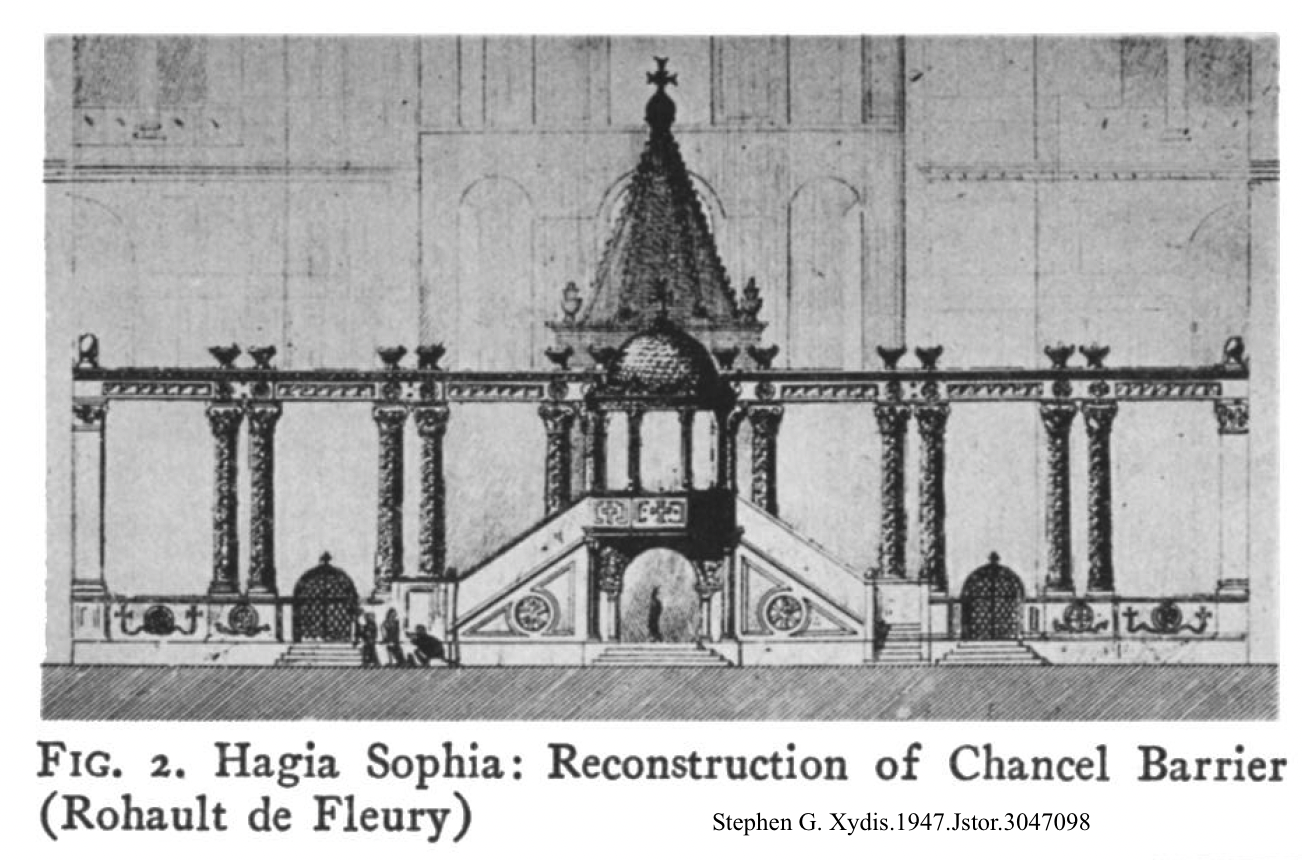
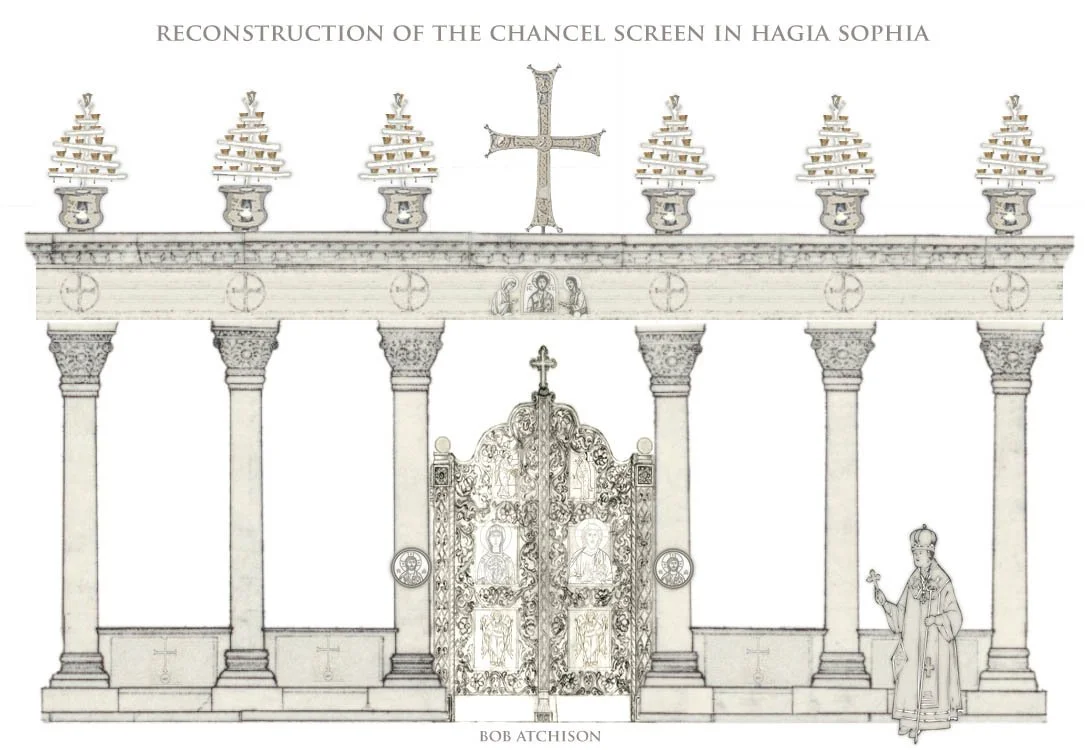
[T]he sanctuary of Hagia Sophia was separated from the nave by a Π-shaped, three-sided templon or chancel barrier jutting into the nave with doors on all three sides: in front ([toward] west), the central or ‘Holy Doors,’ and side doors right (south) and left (north) as one faces the altar [toward the east].
Taft, 1998: 65.
Taft lists the following furnishings of Constantinopolitan churches, which are distinct from the churches in Greece or Italy:
Extraordinary openness of design (numerous entrances, easy communication between various parts of the church).
The presence of an atrium and narthex.
No postophoria or auxiliary chambers anywhere.
An outside skeuophylakion [a treasury].
Galleries, accessible via outside entrances and stairways, that surrounded the nave on three sides (N-S-W).
A centrally located ambo [a raised platform from which sermon was delivered].
No barriers between central nave and side naves; the central nave was also occupied by the laity during services.
The apse [behind the altar] was filled by a very high synthronon [thrones] of many steps; apart from this there were no other seats for the clergy.
The altar was not located in the apse, but before it.
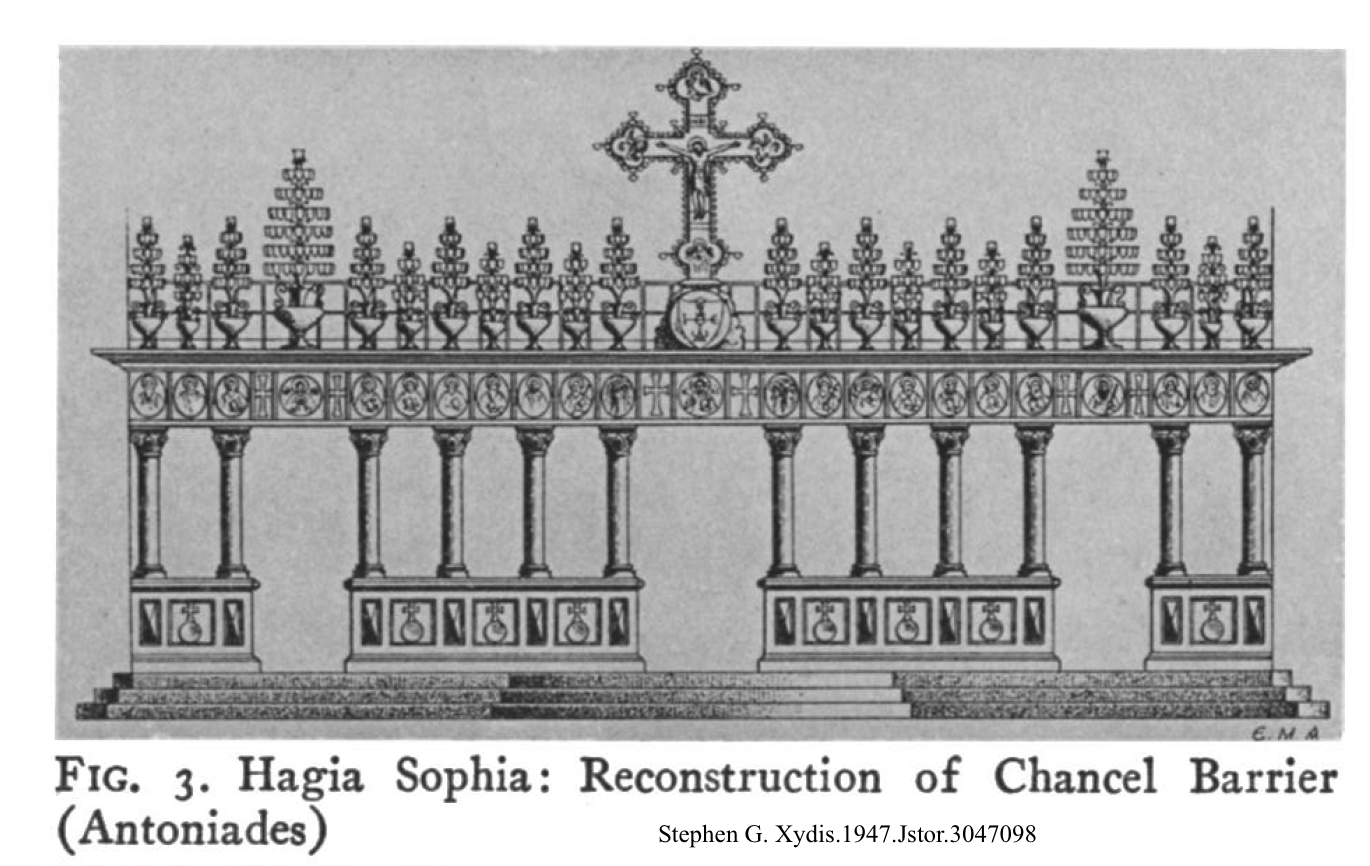
The sanctuary was enclosed by a π-shaped chancel-barrier, originally low, later surmounted by [12] collonettes and an architrave; it did not block-off the sanctuary from the view of the congregation.
In some churches, the ambo was connected to the sanctuary by a solea or pathway similar to the Syrian bēt-ǎqāqōna.
Taft, 2004: 179-80.
Additionally, Hagia Sophia and Hagia Eirene had two monumental ‘back doors’ or ‘service entrances’ on both sides of the single apse. These doors were used as “among the principal entrances of the church” (Taft, 2004: 181). There were a total of 6 doors to enter the church, including the two stairwells leading to the upper galleries.
The southeast (“back”) door of the apse seems to have been used for “the imperial ceremonial for Holy Saturday and Annunciation,” as Taft describes as follows:
At the third hour the emperor begins his progress toward Hagia Sophia. Going first to the Holy Well located near or in the porch south of the apse at the east end of the church, he enters and is greeted by the patriarch. Then both enter the basilica, doubtless by the door leading into the south aisle at the east end of the church, and go into the sanctuary via the central or Holy Doors of the chancel. After incensing the sanctuary, the emperor and the patriarch go off to the skeuophylakion, where they continue their devotions. The account continues [in the 10th century De ceremonies I, 44 (35)]:
Then the emperor rises, and going out of the skeuophylakion, he passes through the narthex of the gynaeceum [“the easternmost bay of the north aisle”] where the deaconesses of the Great Church have their customary place, and goes out by the left door of the sanctuary and the patriarch gives him the eulogia. And going via the narrow passageway of St. Nicholas located behind the sanctuary, both of them go off to the Holy Well.
Taft, 1998: 65, 69.
Even though the emperor is a layman, he received a special treatment by the patriarch, as he was allowed in the sanctuary. Note also the reference to the deaconesses. They were ordained and had active role in the Byzantine Liturgy. See Women in Hagia Sophia.
In 563 Paul the Silentiary [the keeper of silence] notes the three doors cut among the 12 colonnettes set atop the chancel barrier:
And by three doors doth the whole enclosure [i.e., the sanctuary] open to the ministrants; for on each side smaller doors were cut through by a labor-loving hand.
Xydis, 1947: 1.
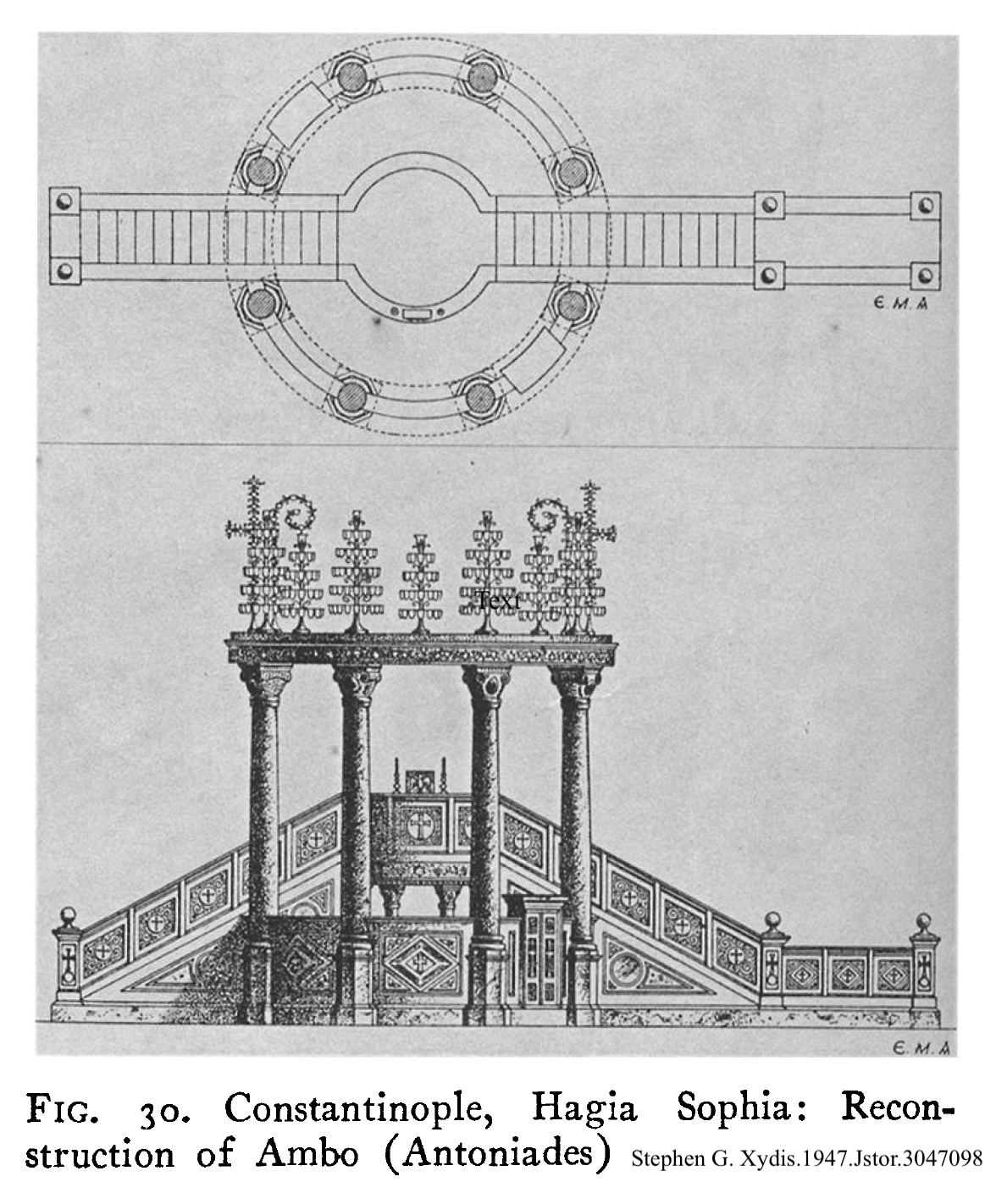
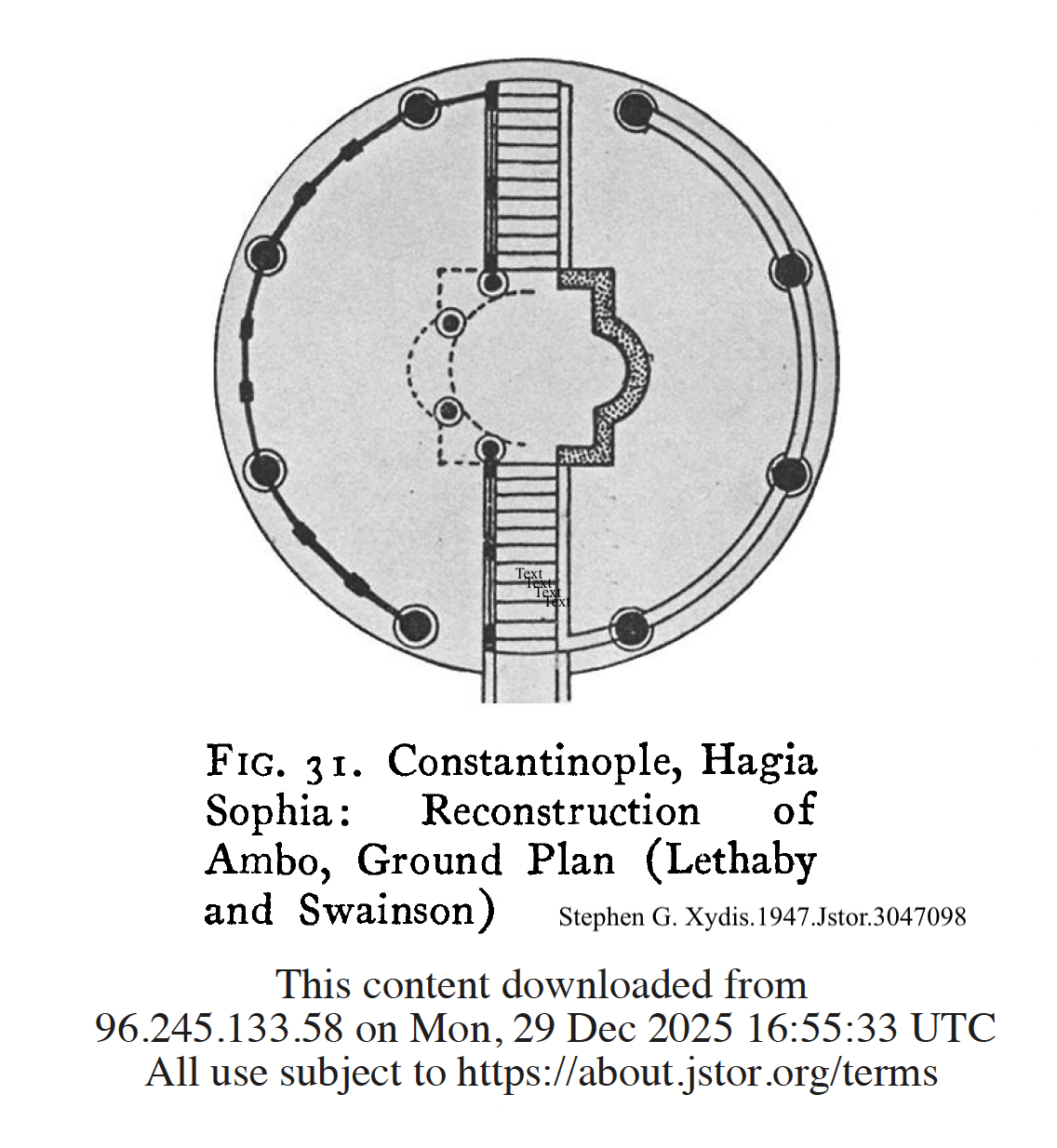
In his Description of the Ambo of Hagia Sophia, Paul the Silentiary also describes the solea as follows:
[247-59] Here the priest who brings the good tidings [i.e., the reading of the Gospel and sermon] passes along on his return from the ambo, holding aloft the golden book; and while the crowd strives in honor of the immaculate God to touch the sacred book with their lips and hands, the countless waves of the surging people break around. Thus like an isthmus beaten by waves on either side, does this space stretch out, and it leads the priest who descends from the lofty crags of this vantage point [i.e., the raised ambo] to the shrine of the holy table [the altar in the sanctuary]. This entire path is fenced on both sides with fresh green stone of Thessaly [the area of the plains and mountains of northern Greece].
As quoted in Mango, Art, 95-96, as in turn quoted by Taft, 1998: 30-31.
The current iconostasis that blocks the view of the sanctuary with multiple levels of icon-display is of the 14th century invention (Taft, 2004: 413). Grand Duke Ivan III (the Great) commissioned one of the earliest, full-length iconostasis for the Annunciation Cathedral in the Moscow Kremlin in 1405. See Templon on Wikipedia.
Early on, a low barrier separating the sanctuary and the nave existed to guard the priestly activities from being interrupted by the gathering crowd in the nave. St Basil is known to have raised the chancel barrier, when a deacon was cited as eyeing a women across the low barrier in the nave during the Anaphora.
As Taft’s list of physical features shown above indicates, there was “a π-shaped chancel-barrier” in Hagia Sophia that started low in height. By the time Emperor Justinian I rededicated the Church in 563, twelve colonnettes set atop the barrier. They were “approximately 4.94 m [16.5 ft] from base to top of capital,” according to Xydis (1947: 7). The height of the barrier itself was estimated by Paul the Silentiary as “as high up as the belt of a man standing by them” (Xydis, 1947: 15).
The location of ambo and solea have changed through the centuries. Taft writes:
Earlier rubrics have the deacon mount the ambo in the center of the nave [in Hagia Sophia and other patriarch churches] to chant the suffrages from there, doubtless facing eastward toward the sanctuary and clergy, in accordance with the ancient custom of orientation in prayer. When the ambo fell into disuse, or evolved into an off-center pulpit as in later Greek and Romanian churches, both the name and function of the ambo were transferred to the semicircle of the sanctuary platform, now called the solea, that juts into the nave before the Holy Doors of the iconostasis in most Byzantine-rite churches today.
Taft, 2000: 75.
Taft summarizes the evolution of iconostasis as follows:
… it is well known that the pre-iconoclast Byzantine chancel was a barrier that impeded access, not visibility, just as in the West. During the Middle Ages, after the definitive victory over iconoclasm, more and more icons were added to the chancel, but the solid iconostasis barrier [like a wall] does not appeal until the 14th century.
Taft, 2004: 413.
The defeat of iconoclasm (843 CE) seems to have resulted in proliferation of icons and the mutation of the chancel barrier into a full-length ‘icon stand’ or iconostasis that conceals the sanctuary from view taken from nave.
Drawing a curtain across the Royal doors during Anaphora (when the Bread is mixed with the Wine) is also a later development. Taft traces it back to the 11th century monastic practice. He writes:
In the Great Church… the sanctuary was not hidden by a chancel curtain during the anaphora…
… in the Great Church the mysteries are said to be ‘hidden’ not because they are invisible, but because they are performed in silence. Hence to hide the altar from the people by means of a solid sanctuary barrier and curtains, popularly considered to be ‘typical’ of the Byzantine rite, appears to be a medieval monastic practice unheard of before the 11th century.
Taft, 2004, 412-413.
Did the chancel barrier or iconostasis originate from the Greek templon or from the Torah screen in Jewish synagogue of the 2nd and 3rd centuries, which in turn was derived from a typical Syrian pagan temple? See Templon in Wikipedia.
The Great Entrance as the Royal Procession
The emperor’s attendance in the Liturgy in Hagia Sophia was rare. One record indicates about 20 occasions in a year when he is recorded as having attended (Taft, 2004: 196).
Based on a 10th century book on the ceremony, De caerimoniis, Taft describes the emperor’s participation in the Great Entrance as follows:
The imperial procession crosses from the right (i.e., south) side of the church to the ambo in the center to meet the gifts, and it seems… that the deacons bearing the gifts and vessels came from the opposite side, i.e., the north side where the skeuophysakion [a treasury] is located [outside], crossing the nave to a point in the center of the church just behind the ambo, where they were met by the emperor and his entourage. Then the procession, accompanied by the sovereigns, passed along the solea to the central doors of the chancel, where the patriarch was waiting to receive the gifts [in the sanctuary in front of the altar] (Taft, 2004: 196).
De caerimoniis records in particular the emperor’s entourage:
the sovereigns with lamps in hand march in front of the gifts, with the senators and chamberlains. The scepters and other accoutrements stand in their proper order and the sovereigns, going via the solea, stand outside the holy doors,…. The holy things, having arrived on the solea, pause, and the archdeacon comes and incenses the sovereigns, then the patriarch, and after him, the holy table. And thus all the holy things enter, and after all have entered, the sovereigns greet the patriarch and then go via the right side of the bema outside [the sanctuary barrier] and enter the metatorion [a room reserved for him in Hagia Sophia].
As quoted in Taft, 2004: 195.
Here the “King of Glory” (Ps 24.7-10) comes “on the plate and in the cup,” as Narsai of Nisibi (d. 502) described. The plate and the cup containing the Gifts are carried by the deacons, preceded by the emperor and his entourage holding lamps, and followed by the priests, and other bearers of the liturgical implements before the Gifts are handed over to the receiving bishop or patriarch in the sanctuary in front of the altar.
The Holy One comes forth on the plate and in the cup.
Narsai of Nisibi (d. 502), a Syro-Chaldean dessert saint, as quoted in Instruction For Applying the Liturgical Prescriptions of the Code of the Eastern Churches, a reproduction of the official English translation, Congregation for the Eastern Churches, (The Vatican: Libreria Editrice Vaticana, 1996), 56.
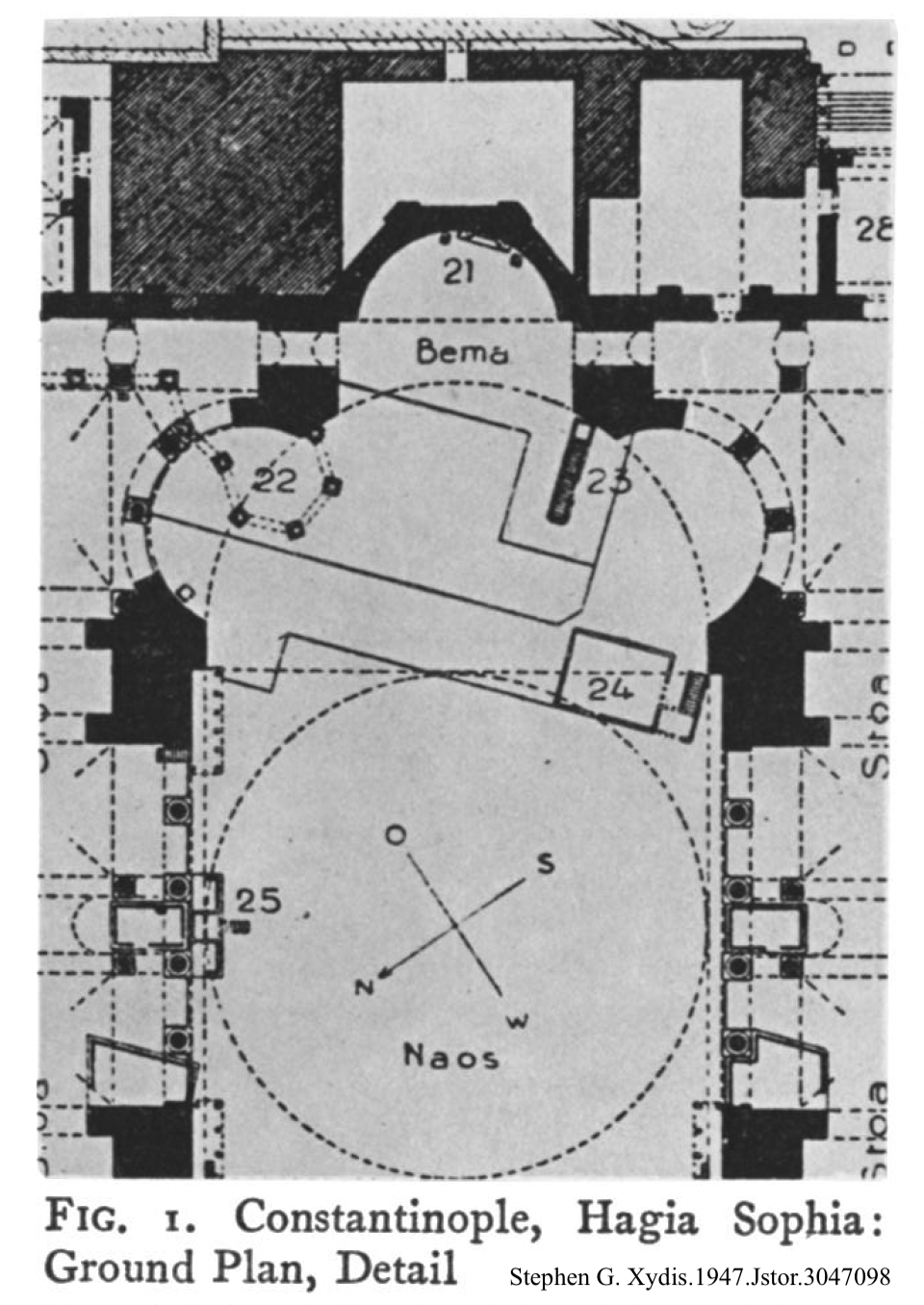
Based on Paul the Silentiary’s ‘observations’ and the comparative archeological studies of other ancient churches, Stephen G. Xydis concluded that there were two side doors beneath the elevated ambo through which (on the south side) the emperor may have entered the solea to join the deacons carrying the Gifts, which were thereafter carried through the Royal Doors and transferred to the awaiting bishop or patriarch in the sanctuary. Then, the emperor may have stayed there in the sanctuary and took part in the communion before exiting the sanctuary through the southern side door attached to the chancel barrier and to proceed to his reserved metatorion.
See below Xydis’ reconstruction (Figures 32 and 33, 1947: 23) of the ground plan, the chancel barrier viewed from the north side, the solea with a opening before reaching the chancel barrier, and the elevated ambo with another opening on the northern side of the ambo. The second side door of the ambo on the southern side, through which the emperor entered the solea, is not shown in the diagram, as the view is from the northern side. Xydis writes of the emperor’s entry through the southern side door below the elevated ambo as follows:
It is through this intermediary space that the Emperor probably passed, advancing to the sanctuary through the solea, after having entered first through the (right) side door of the ambo.
Xydis, 1947:23.
Robert F. Taft in his 1998 essay provides more updated account of the emperor’s participation in the communion. He writes:
So in Constantinople the emperor used to remain in the sanctuary from the moment he offered his gifts at the altar until communion, that is, during the entire liturgy. For in the rite of the Great Church the emperor offered his gifts at the altar during the Introit at the beginning of the service.
Taft, 1998: 81.
Although the emperor was allowed to enter the sanctuary and remain there after he offered his gifts and until he received communion along with the clergy, the practice of remaining in the sanctuary ceased in Constantinople after Emperor Theodosius I (379-395) was rebuked by St Ambrose (d. 397), bishop of Milan, for doing so in Milan. This rebuke took place during “the liturgy of Theodosius’ restoration to communion [which in turn took place] after Ambrose had excommunicated the emperor and forced him to do penance for massacring thousands of Thessalonians in 390 (Taft, 1998: 81).
In any event, the visual effects of the Great Entrance in Hagia Sophia must have been stunning. The procession moved under the hovering golden dome vaulting above the nave “suspended from heaven” (as Procopius describes). The open space was illuminated by the sunlights beaming through multiple windows and bouncing off the 12 silver colonnettes set atop the chancel barrier, embellished with silver disc-icons affixed on the architrave connecting the colonnettes (see diagrams). (The silver disc-icons were about 1 meter in diameter, according to Stephen G. Xydis, 1947: 7, 9).
One could only imagine how the gleamers of the silver at the chancel area would have blended with the colors beaming from the golden dome “suspended from heaven,” and how all the rays of lights bouncing off the mosaics, transennae, and the multicolored marbles on the floor and walls. The sight must have been truly divine.
The Great Entrance, which occasionally became an imperial procession at the height of the glory days of Hagia Sophia, however, later diminished in its imperial glory, as the prothesis was moved into a corner of the sanctuary (in other churches) and as the procession became shorter as result.
Now that we have a certain physical image of the Great Entrance in Hagia Sophia, tow are we to understand this “great” procession in terms of its symbolism?
Psalm 24 (“Lift up your heads, O gates!… that the King of glory may come in…”) was originally chanted during the procession. It was then followed by Cherubic Hymn (which was introduced in mid or late 6-century). Thereafter, the Psalm was eventually dropped off, as the procession became shorter. But the displaced Psalm clearly suggests that the procession should be understood as a royal entry.
Furthermore, the Cherubic Hymn that is still chanted today also supports the view that the procession is for the coming of “the King of all” (… “that we may receive the King of all invisibly escorted by the angelic rank”). The bishop or patriarch receives the King “in the plate and in the cup.” As the lyric says, the choir “represent[s]” or “iconiz[es]” the Cherubim that escort “the King of all.” Both the consacrated humans (the clergy) and angels join to make this procession.
According to Pseudo-Dionysius, the angelic ranks are closer to God than our (human) ecclesiastical ranks in divine imitation and illumination. In fact, angels are “concelebrants” in the Liturgy with us (CH 124A). Therefore, it is fitting that the choir that imitates Cherubim should surround—as Narsai of Nisibi (a contemporary to Pseudo-Dionysius) put it—“the Holy One that comes forth on the plate and in the cup,” as it did along the solea in Hagia Sophia.
By the time Hagia Sophia was first dedicated in 537 Pseudo-Dionysius had probably reposed. Thus, he would not have participated in the Liturgy of the Justinian Hagia Sophia. Even if he had participated in the Justinian Liturgy of Hagia Sophia, by remote chance, the mid to late 6th century Cherubic Hymn would not have been sung as yet. But had he witnessed the procession with the singing of Cherubim Hymn, he would have welcomed it as well fitting. After all, he was the first to produce a full length treatise on the angelic hierarchy, even inventing the term ‘hierarchy’ in the process. It is plausible to argue that Pseudo-Dionysius, who, according to Golitzin, was well respected by his contemporaries and subsequent theologians both in the East and West, might have influenced the design and the structural idea of Hagia Sophia when it was commissioned by Justinian the Great.
As noted already, the emperor occasionally joining the Great Entrance in all the brilliance of the regalia under the streaming sunlight, must have created the aura of a royal procession.
What Archbishop Alexander Golitzin says of the Eucharist, however, best describes the Great Entrance as well:
It is thus during the Eucharist—existing the altar to cense the entire temple, reentering the altar, and, later, inviting believers to partake of the Gifts—that the bishop provides us with an icon of the divine procession and Providence.
Golitzin, 2013: 141.
What can the “icon of the divine procession and Providence” that the bishop provides be other than the procession (πρόοδος, emanation) of the Great Entrance: the Gifts leaving the sanctuary, moving through the nave, and returning to the altar? This is the Dionysian circular movement of the divine descent and ascent/return in which we as God’s creation participate.
If so, the Great Entrance is an “icon” of God’s providential work we participate in cooperation with Christ as God’s “co-workers” (Θεοῦ συνέργοι; I Cor 3.9; CH 165C)—a ritual icon that not only represents the divine providence in which we participate but also that which actualizes it literally and symbolically in the rite. To be symbolic is to actualize visibly that which cannot be made visible: the divine work of God, His providence bestowed upon us with the grace/working of the Holy Spirit.
Furthermore, the procession is circular, as Golitzin notes above, marked by the movement of God’s providential energy (προνοητικῶν ἐνεργειῶν) that gushes forth (ἐκβλυζομένη, CH 177C) toward us and the world, joined by our participation (μετουσίας, partnership, communion) therein in response and in our return (ἐπιστροφή) back to Him—the Source and the Cause of all existence (CH 308A). God’s Gifts gush forth from Him, emanate forth down through the hierarchy, and move upward back to Him in return. lifting up all of his creation, as in prayer, as in sweet aroma of the incense that arises high, as in the burnt offering.
In the Liturgy, then, we are beholding and participating in God’s work of salvation: “Look, now is the day of salvation!” (2 Cor 6.2).
During the Holy Week, however, the Great Entrance becomes a funeral procession for Christ’s burial. See the Funeral Cortège.
Skeuophylakion
Skeuophylakion, a treasury, is “a small rotunda that still stands by the northeast corner of the present church [Hagia Sophia]” (Taft, 2004: 185). It survived the fire in 404, when the church was completely burned down.
Skeuophylakion is the building “where the liturgy begins and ends” (189). Taft further writes:
It was there that ministers vested and prepared the gifts received from the people. The prothesis prayer in the early codices is entitled ‘Prayer that the priest says in the skeuophylakion after putting the bread on the discos.’ It was there, too, that the Great-Entrance procession began; it was there that the final prayer of the liturgy, the ‘Prayer said in the skeuophysakion’ was recited following the exit procession at the end of mass.
Taft, 2004: 189.
The simple tasks of vesting and preparing the bread and wine in skeuophylakion or at the prothesis evolved into a full-blown, mini liturgy in its own right as Proskomidi, which takes place before the Liturgy properly begins.