

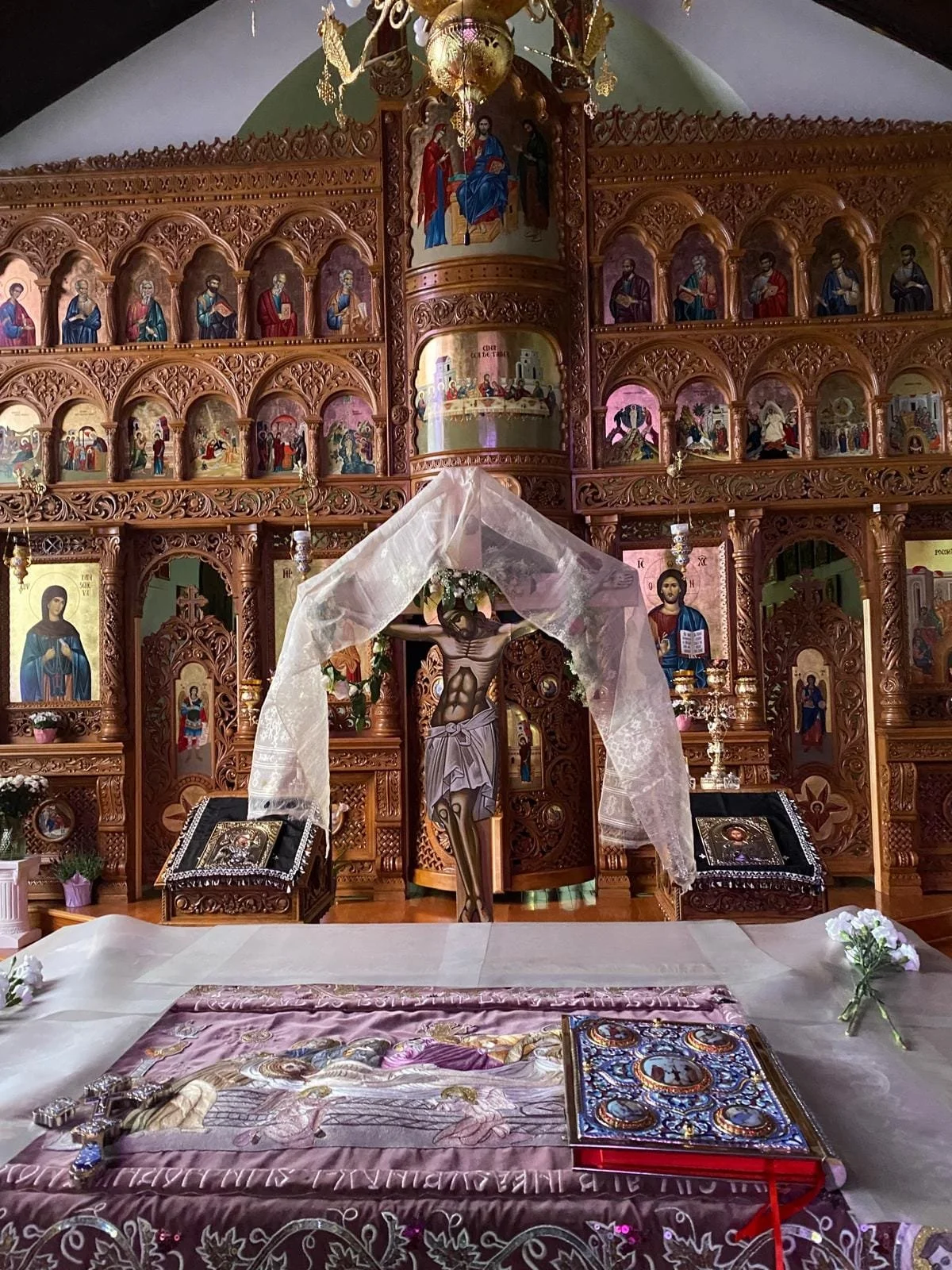
The Great Entrance as the Procession of the ‘Burial of Christ’
The liturgy described by Theodore of Mopsuestia (d. 428), who interpreted the Great Entrance in any occasions “as the funeral cortège,” has the procession occurring in dead silence (Taft, 2004: 36, 53, 63).
The procession evolved to become an imperial procession (when joined by the emperor) and later in the Middle Ages as a procession of the ‘Burial of Christ’ and, as such, became “an important ceremony only in the 14th century” (Taft, 2004: 217; 1980/81: 53). Taft adds: “There is no evidence for any such rite in the Byzantine tradition before the Middle Ages” (217).
Currently, during the Holy Week, the Great Entrance clearly functions as a burial procession. The Cherubic Hymn is modified and replaced by different hymns, although still the references to the King and Cherubim are still preserved.
During the first three days of the Holy Week (Monday through Wednesday), the Divine Liturgy is celebrated with the Gifts already consecrated during the previous Liturgy. Since they are already consecrated, the Liturgy is called the Liturgy of the Presanctified Gifts, during which the Cherubic Hymn is replaced by the following chants during the Great Entrance:
Now the powers of heaven worship with us unseen, for behold the King of Glory enters, behold the mystical sacrifice, already accomplished, comes escorted. In faith and love let us approach in order to become sharers in eternal life. Alleluia.
(Taft, 2004: 55)
As the choir sings, the priest says:
Now the powers of heaven invisibly with us do serve, Lo, the King of glory enters in. Lo, the mystical sacrifice is upborne, fulfilled.
The deacon responds:
Behold, the completed mystical sacrifice is escorted in. Let us with faith and longing draw near and become partakers of life everlasting. Alleluia.”
The Services of Great and Holy Week and Pascha, Rahal ed., 2012: 69, 160, 249-50.
At Vesperal Divine Liturgy of St Basil, which is celebrated on Holy Thursday morning, the Cherubic Hymn is replaced by the hymn below during the Great Entrance procession:
At your mystical supper, Son of God, receive me today as a partaker, for I will not betray the sacrament to your enemies, nor give you a kiss like Judas, but like the thief I confess you: remember me Lord in your kingdom.
Taft, 2004: 54; italics added; Rahal, 2012: 349.
At Vesperal Divine Liturgy of St Basil on Holy Saturday morning, the following hymn replaces the Cherubim Hymn during the Great Entrance procession:
Let all mortal flesh be silent, and stand in fear and trembling, and harbor no earthly thoughts, for the King of Kings and Lord of Lords comes forth to be slain and given as food to the faithful. The choirs of archangels go before him, with all the principalities and powers, the many-eyed Cherubim and the sex-winged Seraphim, faces covered, and proclaiming the hymn: Alleluia, Alleluia, Alleluia!
Taft, 2004: 55; Rahal, 2012: 620.
The hymn of the Liturgy of the Presanctified Gifts refers to the Gifts as “the mystical sacrifice, … accomplished [and]… escorted,” as they have been already consecrated in the previous Sunday Liturgy and are now in procession in the Holy Week before the Easter/Pascha. The Body is that of the crucified Christ—not yet risen.
The hymn for Holy Thursday recalls the night when Jesus was betrayed, as referred to by the prayer of St. Chrysostom recited before the Eucharistic Prayer throughout the year: “I believe … and I acknowledge, that You are the Christ….”
The Holy Saturday hymn gives the meaning to the procession: “the King of Kings and Lord of Lords comes forth to be slain and given as food to the faithful.” It is sung during in the procession of the Great Entrance, as the deacons carry the epitaphios—an elaborately embroilered icon of the “undefiled” body of Christ that had been lowered from the cross. Again, the Easter is yet to come. Thus, the procession as a funeral cortège is unavoidable.
The procession with the epitaphs, according to Mateos, is “a recent development” (Mateos, 2016: 220).
Nicholas Cabasilas, in the 14th century, interpreted the Great Entrance with historical realism in his Commentary on the Divine Liturgy. He wrote:
… this ceremony signifies the last manifestation of Christ, which aroused the hatred of the Jews, when he embarked on the journey from his native country to Jerusalem, where he was to be sacrificed; then he rode into the Holy City on the back of an ass, escorted by a cheering crowd.
Cabasilas, 1977: 65.
The rubrics and the silent prayer offered by the priest as the Gifts are laid on the altar following the Great Entrance (the troparion ‘Noble Joseph’ which was introduced in 14-century (Taft, 2004:246)) also points to the commemoration of Christ’s death, as follows:
The priest and deacon place the paten and the chalice on the altar, and the priest says quietly:
Priest: The noble Joseph, when he had taken your most pure body from the tree, wrapped it in fine linen with spices, and sorrowing laid it in a new tomb.
In the grave bodily, in hell in the spirit, as God in paradise withthe thief, yet on the throne of heaven with the Father and the Holy Spirit were You, O Christ, the Unbounded, filling all things.
Your life-bearing grave, O Christ, more beautiful than paradise, more radiant than any royal chamber, is the fountain of our resurrection.
The priest takes the aer, the large veil, from the deacon's shoulders, he censes it and then covers the gifts with it, saying three times the last verse of Psalm 50 (51)…
The troparion ‘Noble Joseph’ already made its way to St Germanus’ time (d. 740), who interpreted the procession and deposition of the Gifts similarly, even figuratively referring to the altar as Christ’s tomb:
It is also in imitation of the burial of Christ, just as Joseph took down the body from the cross and wrapped it in a clean shroud, and after anointing it with spices and myrrh, carried it with Nicodemus and buried it in a new monument cut from rock. The altar and depository is the antitype of the holy sepulcher, that is, the holy table on which is placed the immaculate and all-holy body.
As quoted and translated by Taft, 1980/81: 55.
Even though the traporion ‘Noble Joseph’ was not introduced to the Great Entrance procession until the 14th century, according to Taft (2004:246), it has its origin in Good-Friday vespers in Jerusalem as early as 381, as Egeria attests (2004: 245). A prayer said at the preparation of the gifts in the Ethiopian liturgy has the following (as the priest wraps the bread in the māchfad):
Just as Joseph and Nicodemus wrapped you in linen cloth and spices and you were well pleased with them, in like manner be well pleased with us.
Taft, 2004: 245.
Thus, the Good-Friday vespers prayer stemming from Ethiopia and Jerusalem in the 4th century was introduced into the Great Entrance of Hagia Sophia in the 14th century “as a retro-influence of the Holy Week ritual of the burial procession of Christ to which this troparion is proper” (Taft, 2004:246).
Given the nature of the processions held during the Holy Week and the post-iconoclasm emphasis on the historic Jesus and his Passion (i.e., the turn to Christ’s Flesh and history), the Great Entrance evolved into a funeral procession even for seasons other than Holy Week. Such a historical interpretation for example forces the altar to be understood as the tomb of Christ, from which He is risen. Hence, the Eucharist rite becomes, for another example, a commemorative function of remembering the historical event of Christ’s Passion and Resurrection. As Taft concludes:
But in the struggle with Iconoclasm what we see is actually the victory of a more literalist popular and monastic piety, precisely in favor of a less abstractly symbolic and more representational, figurative religious art.
Taft, 1980/81, 72.
What is the implication of such a historical interpretation of the Liturgy? The loss of our participation in the very reality of God’s work (His service for us) here and now—in the eschaton—in which we are jointed with Christ in the offering of ourselves as sacrifice in His sacrifice, in communion with Him. For six times, the deacon exhorts the faithful: “Let us [offer side by side with Christ, παραθώμεθα, from παρατίθημι, ‘put side by side’] ourselves and each other, and our whole life, to Christ our God.” We can do so only if and when we “lay aside [ἀποθώμεθα] all earthly cares,” as the choir sings during the Great Entrance. To save the world one must relinquish the world.
The turn to historiography that was accentuated by the struggle against iconoclasm invariably and regrettably lead to reduction of symbolism. One must now be historical, and the liturgical symbols begin to serve as means of remembering Christ’s life, passion, and resurrection. The Pauline focus on believing and living “in Christ” then evolves into the propositional beliefs about historical events surrounding Jesus. Salvation thus becomes a matter of belief, knowledge, and affirmation regarding certain propositions about Christ. In such a scheme, symbols have hardly any efficacy or usefulness, other than for providing illustrations, as demonstrated in Theodore of Mopsuestia’s (d. 428) allegorical interpretation of symbols. For example, the cutting of the bread as Christ’s immolation, the aēr as winding sheets, the altar as the site of burial, the apse as the cave of the sepulcher, etc.—all these liturgical acts, as Taft puts it, “as a dramatic reenactment of the historical economy” (Taft, 1980/81: 63, 64, 66). The Eucharist becomes, to put it crudely, an audio-visual aide and nothing more, as most protestant churches nowadays understands it to be. Preaching also as primarily explanations, rather than as a verbal icon, becomes in vogue. Reformation inevitably ensues with rise of multiple confessional statements as creeds. But, Reformation arguably has its roots in the turn to the historical that the iconoclasm forced upon the Church.
In any event, setting aside the focus on histography, the interpretation of the Great Entrance as Christ’s burial procession should not surprise us, because death is prerequisite to resurrection, just as humility is to glorification (Phil 2.7-9). The logic of sacrifice is at work here in the Great Entrance either in the Holy Week or at any other time: “unless a grain of wheat falls into the earth and dies, it remains just a single grain, but if it dies it bears much fruit.” (Jn 12.24). Even for Christ, death seems to be the prerequisite to his divine glory, the Glory of “the Holy One [who] comes forth on the plate and in the cup,” to repeat Narsai of Nisibi, a Syro-Chaldean dessert saint (d. 502).
The glory we see in the Liturgy is the glory of the meek and of ‘the least of these’ (Matt 25.40,45), the glory of the offerer that comes the offering itself, the glory of self-sacrifice:
For it is You that offer and are offered.
Prayer of the Cherubic Hymn.