

“Let Us Attend”
(Πρόσχωμεν, Proskōmen)
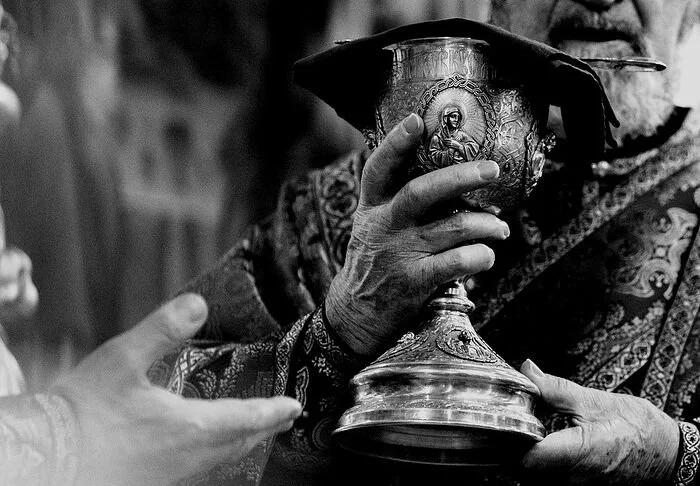
Six times during the Divine Liturgy we are exhorted: “Let us attend.” Once before the chanting of Psalm (Prokeimenon), once before the chanting of the Epistle, once before the chanting of the Gospel, once before reciting the Creed, once during the Eucharistic Prayer (“Let us stand aright. Let us stand with fear. Let us attend, that we may offer the holy eucharist in peace”), and for the last time before the mixing of the Bread and Wine, as “the priest takes up the holy Bread in both hands, elevates it above the altar.”
Προσοχή (prosokhē) means: “attention,” “soberness.” Like the German, Achtung, it means: “(your) attention please!” but also, as in German, “give (someone) the respect due to him/her.” In the military, “Attention” demands “instantly adopting a rigid, silent, and motionless posture upon command. It is a fundamental display of discipline, respect, and maximum readiness to receive orders” (Google search, 4/4/26).
Porphyry
It is Porphyry of Tyre (d. 305, a disciple of Plotinus) who first used the word, prosokhē, to describe the moment of being awake from slumber in one’s contemplation of the existence/being. The passage in which the word is found reads:
Just as insomniacs, desiring to sleep, lie in wait for sleep, and drive sleep away, and do not sleep until, by turning back within, they completely forget about lying in wait for sleeping, so, for the soul, which is a cognitive activity, it is impossible to obtain release from the sensible unless it turns toward the existence itself and keeps its attention (prosokhē) there intently.
Translated and quoted by Michael Chase, 2019: 1. The passage is found no where else except in the writing by a Byzantine scholar Michael Psellos (c. 1017-1078) and, according to Chase, is “unattested elsewhere in surviving Greek literature.” Id.
Keeping the soul attentive means, for Porphyry—who was a Neoplatonic atheist—turning inward introspectively by releasing one’s attention from the sensible things outside the body. Turning inward and thereby releasing the sensible from one’s thought mutually enforce each other. For the sensible—what we perceive, feel, desire, imagine, etc.—come from outside the body as they are filtered through the five senses. Having turned inward, then, the Neoplatonists believed that the soul can turn its focus on pure existence or being itself devoid of the sensible. Turning inward and releasing the soul from the sensible is the state of ‘being attentive.’
In the passage cited above, as the soul is attentive to being itself, it forgets all bodily things, even the fact that (as Porphyry says) the body is lying in wait trying to sleep. What the body is doing is not essential for the soul, in fact distracting, and thus must be set aside or, as the Cherubic Hymn sung during the Liturgy puts it: “lay aside [ἀποθὠμεθα] all earthly cares.” Once all earthly cares are set aside, one can focus on the essentials of life: God the Creator or, as the Eucharistic Hymn puts it, “the Fountain of Life” that we receive as the Body of Christ.
A similar idea can be seen in the desert monk and a follower of Origen, Evagrius of Pontus (c. 345), who influenced Pseudo-Dionysius, Maximus the Confessor, Palamas, among others, and who sought to achieve “the ideal of contemplative life outlined by Origen” (Lossky (d. 1958), 1963: 104). Like Origen, Evagrius believed that theology (θεολογία) lies at the summit of contemplation (θεωρία), more specifically, at the contemplation of the Trinity. In order to arrive at this state, however, one must first exercise and arrive at ἀπάθεια, “impassibility or, the state in which one is no longer disturbed by passions” (Lossky, 1963: 106). “Let us attend,” then, calls forth this kind of a state of mind (Stimmung).
Evagrius along with Origen was condemned at the Fifth Ecumenical Council (the second Council of Constantinople) in 553 for supporting Origen’s subordination theory of Christ. This was after Emperor Justinian had already condemned Evagrius in 543, following St Jerome’s first condemnation in around 414.
Lossky, 1963: 105.
Plato
For Plato (d. 348 BC), however—who gave rise to Neoplatonism—separating one’s attention from the bodily concerns implies purification of the soul. He writes, for example:
Doesn’t purification [κάθαρσις, a cleansing] then, as the ancient would have it, turn out to be the separation of the soul as far as possible from the body…withdrawn from all parts of the body…. released, as it were, from the chain of the body?
Phaedo, 67c.
‘Release’ (Gelassenheit) or ‘setting aside all earthly cares’ is the necessary condition for soul’s purification. Purification involves, according to Plato, releasing the soul from “the chain of the body” (as illustrated by the allegory of the cave, Republic, VII, 514a-517a) as much as possible, in order to be able to ‘pay attention’ to what is true, beautiful, and permanent—i.e., the forms (εἶδος, ideas), which are illuminated clearly and brightly under the sun outside the cave. As the allegory illustrates, the soul must be freed from the distracting and fluctuating images the chained prisoners are forced (without knowing) to see from birth in front of them at the bottom of the cave. Once liberated (from the chain and from the darkness of the cave), the soul can be attentive to the reality and be able to finally behold the good, which lies “beyond being in dignity and power” (Republic, VI, 509b). Church Fathers often equated the Good to the Creator God.
Plotinus
Plotinus (d. 270), the father of Neoplatonism, extended Plato’s thought further and described the soul’s journey in terms of the upward and downward movements:
For every soul possesses an element which inclines downwards towards body, and another which inclines upwards towards Intellect [νοῦς, mind, reason].
Enneads, 4.8.8.
The soul cannot arise, Plotinus further argues, if “the sensible world becomes dominant” in the soul and if the soul is “subject to disturbance,” because in such a state the soul is distracted and preoccupied from discovering “that of which the upper part of the soul is in contemplation” [ὦν θεᾶται] (Id.).
The word θεωρία, theoria, for ‘contemplation’ is the same word used by many Church Fathers to refer to ‘looking up’ toward the divine things (of God). To be in contemplation is to be attentive to the things that are divine above and beyond the sensible.
Moreover, the upper part of the soul (Intellect, nous) in contemplation, according to Plotinus, is said to be “in stillness” [ὴσυχῆ, hēsykhē] (Enn. 5.5.8). It is fixed on “that which is beautiful, inclining and giving itself over completely to what is in the intelligible world…” (Enn. 5.5.8). Furthermore, as Plotinus continues, the soul “collect[s] itself into its interior” (Enn. 5.5.7) and remains “itself by itself alone and pure” (Enn. 5.5.8).
The soul in contemplation, then, is marked by stillness, devoid of sounds and distracting images, while being attentive or attuned to the reality. The Greek word for ‘stillness’ is ὴσυχῆ from which Hesychasm (ἡσυχία) comes from.
St Palamas
Hesychasm was officially recognized and accepted by Orthodox councils in mid-14th century. One of the proponents was St Palamas (d. 1359), who defined hesychasm as
[S]tillness, in which the mind [νοῦς] and the world stand still (cf., Ps.46:10).
Homily 53, par. 52, The Homilies, Rev. Ed. and trans. by Christopher Veniamin, (Mount Thabor Publishing: Dalton PA, 2016), 437.
Palamas elaborates the conditions that are necessary to reach the state of stillness as follows::
It is absolutely impossible to truly encounter God unless, in addition to being cleansed, we go outside, or rather, beyond ourselves, leaving behind everything perceptible to our senses, together with our ability to perceive, and being lifted up above thoughts (λογισμῶν), reason (συλλογισμῶν) and every kind of knowledge (γνώσεως πάσης), even above the mind itself (διανοίας αὐτῆς) and wholly given over to the energy of noetic (νοεράν) perception, which Solomon calls divine awareness (cf. Prov. 2:3-5 LXX), we attain to that unknowing which lies beyond knowledge, that is to say, above every kind of much vaunted philosophy, even though the purpose of the most excellent part of philosophy is knowledge.
Homily 53, par. 51; translation altered by H. Ian Attila; Greek from Ibid., footnote 869, p. 624.
The conditions by which the soul may encounter God in stillness are: (1) purification; (2) going outside beyond ourselves, beyond the senses; (3) being lifted up above thoughts, reason, and all knowledge—”even above the mind itself;” and (4) being given over to noetic energy, to the power of divine perception (as in Solomon), and thereby reaching the state of “unknowing.”
To have the mind and the world stand still is to ‘set aside all earthly cares’ and to attend to the things divine, unknowing everything one knows and one can know.
Palamas was not inventing new terms or ideas here. Rather, he was drawing from the vocabulary of the Church Fathers, who in turn drew from the intellectual climate of their times—but not slavishly but with radical transformation of the concepts they borrowed with strong christological applications in mind. More than anything, the Scriptures were the guiding principles by which the contemporary philosophical terms were freely adopted and employed.
Mystical Theology of Pseudo-Dionysius
For example, the word “unknowing” is the same word Pseudo-Dionysius (b/d. ~500) uses to designate the condition for achieving a mystical encounter with God. In the invocation prayer at the beginning of The Mystical Theology, he prays:
Guide us to that topmost height of mystic lore which exceedeth light and more than exceedeth knowledge, where the simple, absolute, and unchangeable mysteries of heavenly Truth lie hidden in the dazzling obscurity of the secret Silence, outshining all brilliance with the intensity of their darkness, and surcharging our blinded intellects with the utterly impalpable and invisible fairness of glories which exceed all beauty!
The Mystical Theology (MT), 997a-b; trans. C. E. Rolt, 1920: 191.
The “secret Silence” Dionysius speaks of is precisely the “stillness” that Palamas refers to in his description of Solomon’s divine awareness attuned and given over to noetic energy, as he says in the passage quoted above.
What corresponds to the soul’s stillness is “the Ray of that divine Darkness which exceedeth all existence” (MT, 1000a). In Dionysius’ reading, Moses had “plunge[d] into the Darkness where truly dwells… that One Which is beyond all things” (MT, 1000c). Dionysius makes it clear that Moses “meets not with God Himself, yet he beholds … the place wherein He dwells” (MT, 1000d).
The following is Dionysius’ description of “the place wherein He dwells:”
[The place] breaks froth [from all descriptions expressed in “the symbolic language” of the Scripture, i.e., Exodus], … and plunges the true initiate into the Darkness of Unknowing wherein he [Moses] renounces all the apprehensions of his understanding and is enwrapped in that which is wholly intangible and invisible, belonging wholly to Him that is beyond all things …, and being through the passive stillness of all his reasoning powers united by his highest faculty to Him that is wholly Unknowable…
MT, 1001a; Rolt trans.
The “symbolic language” Dionysius had in mind is the passages that describe Moses’ encounter with God.
Moses Atop Mt Sinai
In Exodus 19 it says that Moses went up to Mt Sinai in the midst of thunder, lightening, and passing through a thick cloud, as the trumpet blasted aloud, where “Moses would speak and God would answer him in thunder” (19.19). Then, God “summoned Moses to the top of the mountain, and Moses went up” (19.20). There, God spoke (19.21) and gave out the commandments (Exodus 21-23; Jews believe that there are 613 commandments). In Exodus 20.21 Moses’ ascent is summarized succinctly: “Then the people stood at a distance, while Moses drew near to the thick darkness where God was.” The thick darkness is nothing other than “the Darkness of Unknowing” that he must undergo (MT, 1001a).
In Exodus 24, furthermore, we see Moses going up the mountain with Aaron, Nadab, Abide, and with the 70 elders (20.1). There, in chapter 24, it says that they stood on “a pavement of sapphire stone” (24.10), “beheld God, and ate and drank” (24.11). But Moses went up further this time “alone” (20.2) and received God’s commandments (20.3).
There, alone, at the pinnacle of Mt Sinai, “Moses entered the cloud” (24.18), as the mountain shook violently (19.18), and “the appearance of the glory of the LORD was [shown] like a devouring fire on the top of the mountain in the sight of the Israelites” (24.17). No account is given as to what Moses saw and heard once he had “entered the cloud,” into the darkness of unknowing. But the effects of his encounter was seen by the Israelites from a distance at the foot of the mountain.
The story does not end there. Early in the next morning Moses “set up twelve pillars” at the foot of the mountain and offered sacrifices for each of the twelve tribes (20.4-5). We read: “Moses took the blood and dashed it on the people, and said ‘Here is the blood of the covenant that the LORD has made with you in accordance with all these words” (20.8).
Moses receives God’s commandments, when he encountered God at the top of the mountain. The Law and theōsis coincide. To see God is to do His Law, and vice versa.
Let us note: At the foot of the mountain sacrifice follows immediately after the Israelites received the Law. Moses receives the Law at the top of the mountain; the people at the foot of the mountain.
“We will do and we will hear”
The people at the foot of the mountain responded when they received the Law, saying: “All that the LORD has spoken we will do, and we will be obedient” (24.7; 24.3; 19.8; נַעֲשֶׂ֥ה וְנִשְׁמָֽע). This is a good translation. The phrase literally says: “we will do and we will hear.” It is important to note the “inversion of the normal order” (Levinas, 1990: 42) where doing precedes hearing.
Although the Hebrew phrase is grammatically simple and clear (containing “a lucidity without tentativeness,” Levinas, 1990:48), Levinas finds it significant to comment extensively. Martin Buber explains the phrase by translating: “We will do in order to understand” (as quoted in Levinas, 1990: 42). Levinas finds this translation inadequate. Because for him “and” (expressed by a single letter vav in Hebrew, which could also mean ‘then’) is vital, as if to mean: ‘doing’ and ‘hearing’ amounts to be the same or, as already stated—based on the order of appearance—doing precedes hearing. The word order implies that the Israelites would do first even before hearing what the Law says: “They do before hearing” (45).
This “paradoxical order” (45) in which the normal order of hearing the law before doing it, indicates for Levinas the ethical condition that precedes reason or choice: “To hear a voice speaking to you is ipso facto to accept obligation toward the one speaking” (1990: 48). One’s obligation to the speaker precedes what he or she had said. This means for Levinas responsibility (to the Other) precedes freedom of choice I exercise based on my understanding and judgment. In other words, in this inverted order of things—which Levinas calls “the order of angelic existence” (45) based on Ps 103.20 (“Bless the Lord, Oh, His angels… who do His word, hearkening to the voice of His word” (31)) and based on Rabbi Eleazar’s saying in the Tractate Shabbath, p. 88b (“When the Israelites committed to doing before hearing, a voice from heaven cried out: Who has revealed to my children this secret the angels make use of” (31)).
Angels, who are said to be closer to God than humans, do the law before hearing it, according to Rabbi Eleazar. This angelic order makes sense, if we consider the phrase: ‘paying attention.’ One attends to the speaker in order to hear. This is precisely the sense in which the deacon exhorts: “Let us attend.” Paying attention is the prerequisite to hearing. Another example is the word ‘respect.’ Like attention, one must respect someone before a genuine assistance can be provided, as in the case of the Good Samaritan (Luke 10). Respect toward a person precedes the judgment about that person (to help or not to help). For Levinas, ethics precedes judgment, calculation, politics, etc.; because ethics takes place at the level of ‘paying attention’ or paying respect to someone. Only in that sense, the angelic order of doing before hearing makes sense, according to which Exodus 24.7 is read.
Respect is to be given to a person no matter what. No reason is required to pay respect to humanity in a person, as Kant said. To this Levinas entirely agrees. To respect a person, in Levinas vocabulary, is to face the person. The face of the Other commands my respect no matter what.
This “paradoxical order” (45), argues Levinas further, indicates the fate of Israel’s election—being chosen before one can choose (to become 'the chosen)—the fate of the commandments being accepted prior to and before one can have time to consider and choose. This means that the responsibility to be good to the Others precedes one’s ability to be oneself in freedom (Seinkönnen) and the ability to exert oneself in the world as a sovereign ego before one decides to help the Others or not. One is responsible before one is free. One is under God’s commandments before one can become an ego that builds the surrounding world. This is the situation—that of the difficult freedom—in which the people of Israel found themselves, according to Levinas (50). Israel is called to be the light of the world, not to dominate but to serve it.
The mystical encounter with God at the top of Mt Sinai for Moses and at the foot of the mountain for his people immediately leads to a formation of a nation founded on God’s law; and the beginning of a society starting with sacrifices—the sacrifices that the Law prescribes in large part.
To see God, then, is not to abandon one’s obligation to other human beings or to forget the world but to do God’s will on earth as it is in heaven: to seek first the Kingdom of God and his justice/righteousness here on earth. To see God is to do his commandments. Only thereafter, hearing, understanding, reasoning, and politics follow—the worldly concerns that are not forbidden or contradicted by the commandments that precede them. We set them aside in rap attention to the divine things so that we can properly attend to them fully and properly. The angelic order is necessary for the normal order of things to be properly attended to in the world. We “lay aside all earthly cares,” as we “represent the cherubim…”
Pseudo-Dionysius on Paying Attention
Christ is absent in Neoplatonism. But for Orthodox He is essential for any upward movement of the soul. Without Christ we cannot arise to God.
For Pseudo-Dionysius the movement of descent and ascent belongs not only to the soul but also to Christ. If the soul’s descent is toward the sinful, Christ’s descent toward the evil bears all things evil except His own sinfulness. He participates in our infirmity so that our infirmity can be uplifted up to become godly.
The analogous movement of Christ descent and ascent and our soul corresponding descent and ascent take place in the Divine Liturgy. More precisely, because of Christ’s descent to us, we can ascent with Him to God in communion. The Eucharist is the Communion. By partaking in the symbols/sacraments we are in communion with Christ in his descent and ascent. As Dionysius writes:
Immediately after human nature had fallen insanely from the good things of God, it was seized by a life vexed by many passions and terminated by destructive death… […] But the infinite love for man of the supremely divine Goodness benevolently did not withdraw from us its self-efficacious Providence, but truly became a sharer [μεθέζει] in our whole nature except for sin. Having made itself one with our infirmity, keeping all the attributes of its own nature without confusion or alteration, as members of the same family it gave us communion [κοινωνίαν] with itself and proclaims us shares [μετόχοθς] in its own proper beauty.
EH, 440c, 441a-b; Campbell trans.
In partaking our fallen nature without sinning Christ “made [Himself] one with our infirmity” and enable us to commune with Him. Immediately after receiving the communion, we sing: “We have seen the true Light…,” as if we had the same encounter that Moses had at the top of the mountain.
I order to encounter Christ, according to Dionysius, we must ‘pay close attention’ to “His most divine life in the flesh” and imitate his holiness as much as we are capable of, as Dionysius writes:
For if we aspire to commune [κοινωνἰας] with Him, we must fix our regard on [ἀποσκοπεῦσαι, ‘look directly or intently,’ ‘pay close attention’] His most divine life in the flesh, and in imitation of His holy impeccability, we must tend toward [ἀναδραμεῖν, ‘run back,’ ‘revert,’ ‘return’ to] His blameless and godlike state.
EH, 444b; Campbell trans.
Attending and imitating toward Christ’s perfect and godly life must be part of any communion with Christ. But our paying attention to Him, for Dionysius, amounts to our partaking of Him “in the flesh”— i.e., in His Word and Deed as revealed in and chanted from the Scriptures and as reenacted in the administration of baptism, the Eucharist, and unctions. In other words, we must receive the sacraments in full attentiveness and in purity of our soul, setting aside all early cares. We must be attentive.
Most importantly, however, when we attend to the divine things in the Liturgy, we do not contemplate by abstracting from the sensible—this places Dionysius far apart from Neoplatonism. Rather, we attend to the sacraments in their full sensibility, in their materiality. We set aside the earthly cares, but not the sensibility of the sacred Symbols. Christ comes “on the plate and in the cup.” We commune with Him in the baptismal water. We wear Him by being anointed with holy oil (myron). Christ is in the flesh: “The Word became flesh” (Jn 1.14).
The Divine is the Symbols Themselves. The Symbols do not refer to something else outside. They are in Themselves the sacred, the Divine Reality itself: the Bread and Wine consecrated.
Thus, when we are attentive to them, we are attentive to them as they are in themselves, in their full sensibility. Our sensibility is heightened, however—not set aside—to see the Divine, when we approach the Bread and the Cup “in fear of God, and in faith and love.”
Without the sensible Symbols we cannot be attentive to the Divine, because the Divine is the Symbol. For Dionysius, then, it is the sensible and the material that allow us to rise above from them to the Divine or to the spiritual. As He writes:
[W]e are raised up to divine contemplations through sensible images as much as we can be.
EH, 373b; Campbell trans.
Or, a page later, he says that our nature is such that we:
need[..] material things for our more divine elevation [to rise] from them to the spiritual.
EH, 377a; Campbell trans.
Unless we are raised above from the sensible images, from the Symbols—which are handed down to us through the ecclesiastical hierarchy—we cannot arise above to God (“the first leaders of our hierarchy transmitted to us the supracelestial in sensible figures in accordance with the sacred ordinances” (EH, 376d)).
To be attentive, in sum, means to set aside all worldly cares, while being attentive to the sacred Symbols. For only from the sensible can we arise to the Divine.
“Let us attend” to the Symbols of Christ, to the incarnate risen Lord, to the Lamb of God who was given over to the world for its redemption back to God .
“Here I am”
We have said that to encounter God and to commune with Him is to be attentive to Him. Let us consider some passages where such encounters occur.
When God called Abram, he responded first and foremost: “Here I am” (הִנֵּֽנִי, hinnēni, a Hebrew idiom; Gen 22.1, 11). When the angel of God appeared to Jacob, he responded: “Here I am” (Gen 31.11; also 46.2). At the burning bush, Moses responded to God’s call: “Here I am” (Ex 3.4). When God called Samuel, he replied: “Here I am” (I Sam 3.4). When God called Isaiah in the Temple, he responded: “Here I am” (Is 6.8). When Mary was visited by angel Gabriel, she answered: “Here I am” (ἰδού, ‘behold,’ ‘lo,’ ‘see,’ ‘look;’ Luke 1.38). The same Greek word, ἰδού, is used in Septuagint to translate the Hebrew idiom, הִנֵּֽנִי, hinnēni.
The Hebrew idiom, in fact, is untranslatable, because it does not refer to a location (‘here’) or time (‘now’) or to a state of affairs (‘I am standing here, ready to listen’). It does not designate anything other than the inexpressible fact that the subject is attentive to the one who calls. ‘Lo’ or ‘Behold’ is as good a translation as it gets (KJV, Gen 22.1; Luke 1.38). It designates the inaudible attentiveness to the call of God or of His messenger.
The military use of the command, ‘attention,’ is instructive here in that regard. When an officer commands: “Attention,” you do not respond in words (like “Yes, Sir”) but in posture and readiness. The Google definition given above for “attention” in the military usage is helpful. I quote again: “instantly adopting a rigid, silent, and motionless posture upon command. It is a fundamental display of discipline, respect, and maximum readiness to receive orders.”
Analogously, one’s ‘paying attention’ is a response one takes beyond any words before saying anything in response. It is unlike any other state of affairs that can be expressed in language. It is beyond and before language. It is, as Levinas puts it, facing or saying. Or, to say it otherwise, it is: ‘Here I am,’ ‘me voici’—the inaudible, inexpressible readiness to receive an order. It is precisely the ethical condition spoken of above-the condition of the Israelites who responded to God’s Law by saying: “we will do and we will hear.”
Immanuel Kant
Like the military command, “Attention,” the German word, Achtung, is another good example of “being attentive.” In imperative mood it means: ‘Pay respect.’ As a noun it refers to ‘respect’ [Achtung] that, according to Kant, “is always directed only to persons, never to things” (KpV, 5:77, 78). He further writes to clarify:
[B]efore a humble common man in whom I perceive uprightness of character in a higher degree than I am aware of in myself my spirit bows, whether I want it or not… […] This respect [Achtung], then, which we show to such a person … is not merely admiration [Bewunderung]… (KpV, 5:77, 78).
Respect for a person is not due to any character trait, rank, or possession but to one’s humanity (Menschheit), which, Kant argues, must be treated as an end (and not merely as a means) (KpV, 5:87) and as having absolute dignity (Würde, KpV, 5:88) that defies all comparisons. Human dignity must be respected for its own sake no matter what, under any conditions. For that reason humanity (within the person) cannot be merely used, abused, or ignored, but must always be treated as an end itself in itself on its own.
As Christ says: “… just as you did it to one of the least of these…, you did it to me” (Matt 25.40). “The least of these” is the bare humanity in a person stripped of all traits, ranks, and possessions. But a person in his or her bare humanity commands respect unconditionally and absolutely, because humanity in the person has absolute dignity, incomparable and above all other values. Upon this principle Kant’s ethics rests.
‘Paying attention,’ then, means paying respect to someone or something for his/her/its absolute dignity beyond any worldly values and cares. St Dumitru Staniloae says:
[The saints] ascribe an infinite value to the humblest of men, because the Son of God himself, in becoming incarnate, has given this infinite value to every man.
Prayer and Holiness, 1982: 4.
“Draw Near”
Toward the end of the Liturgy, as the consecrated Gifts are brought out to the nave for distribution, the deacon commands:
In fear of God, and in faith and love, draw near.
Here, we are commanded to come forth with respect and attentiveness to the awesome Reality of God, as we draw near to Christ, the Lamb of God who is offered "on the plate and in the cup.” We come forth in response to Christ’s command to love (“just as I have loved you,” John 13.34) prior to any thought of methods or justification.
For we stand before the Mysteries—beyond phenomenality—in faith and love: “Be still, and know that I am God!” (Ps 46.10). In this encounter, we transcend all worldly values and simply “do likewise” (Luke 10.37).