

The Rite of Unction
(The Chrismation Rite)
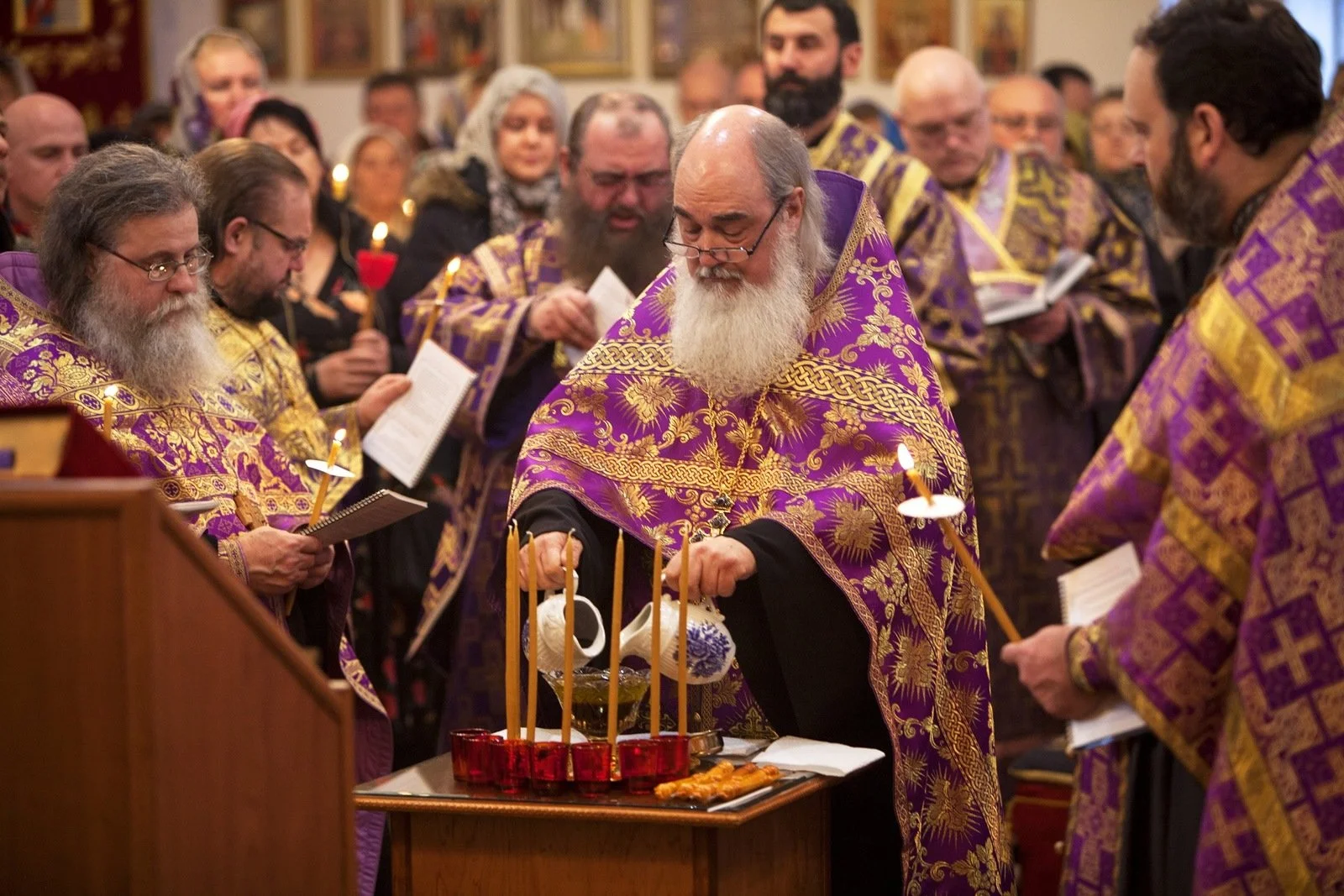
“The anointing [χρῖσμαμ] which you received from Him abides in you, and you have no need that any one should teach you; as His anointing teaches you about everything.”
I John 2.27
The Rite of Myron in Pseudo-Dionysius
The rite of myron as practiced in Syro-Palestine at the time of Pseudo-Dionysius is largely forgotten. Also called unction or chrismation, it used to be part of the Divine Liturgy, like the communion rite and baptism. Nowadays, however, it is celebrated as a separate rite, distinct from the Divine Liturgy, as the rite of healing. Romanians, however, still chrismate (rub oil on) the people on the foreheads and hands as part of the dismissal at the end of each Divine Liturgy. They also celebrate, as others, a separate liturgy of unction with the seven sets of the Scriptural readings (sever Epistles and sever Gospels) recited by seven priests on Holy Wednesday and on other occasions.
Myron is a mixture of olive and balsamic oil (Louth, 1989: 63, 64).
‘Christ’ means ‘anointed,’ which in turn means ‘chrismated’ or ‘rubbed with chrism.’ The root word is χρίω meaning “to touch on the surface, to rub.”
Chrism is defined as “a consecrated oil, usually mixed with balsam or balsam and spices, used by certain churches [in Syro-Palestine] in various rites, as in baptism, confirmation, and the like.”
As a mixture of olive oil (ἔλαιον) and balsamic oil, myron has a sweet perfume-like smell. When applied, it gets absorbed into the skin, making its application invisible, leaving only the sweet aroma behind. When applied, it changes nothing but leaves the aroma.
For Pseudo-Dionysius this symbolizes “Christ, as unchanged, in the complete incarnation among us” (EH 484A). Christ becoming man does not diminish his Divinity nor does it alter the humanity he assumes. His two natures remain the same, united without confusion. The anointment of myron operates in the same way: There is absorption without alteration. Thus, chrismation symbolizes Christ’s Incarnation: His divinity being actualized “among us” without altering (though transforming) our humanity, and the divinized humanity being actualized without diminishing or degrading His divinity. The rite of myron, in short, symbolizes (and thus actualizes) union between God and human without confusion: the humanity divinized, and the divinity humanized without mixing or confusion.
Pseudo-Dionysiu—an unknown Hierarch of the Syro-Palestinian origin (b/d. ~500)—defines myron and explains it as follows:
[A] mixture of aromatic substances which have an abundance of fragrant qualities with which those who partake [μετασχὀντες] become perfumed in accordance with the fragrance that comes to them as their share [μεθἐξεως].
Ecclesiastical Hierarchy (EH) 477C; Campbell translation.
Dionysius calls the rite of myron the “perfecting rite” (EH 472D), as he does in reference to the Eucharist (EH, 473B, 476D). As a perfecting or completing rite, it is ranked equal to the rite of the Eucharist. But the latter is also called the “arch-symbol of rites” (EH 428B) and “the rite of rites” (EH 424C).
The rite of myron (unction) is specifically designated as the rite that “completes every sacred consecration” (EH 484B; cf., 484C-D, 485A). Thus, the Romanian practice of chrismating people at the end of the Divine Liturgy is appropriate. If the goal of the ecclesiastical hierarchy, as Dionysius says, is the imitation of and union with God (CH 164D, EH 393A), the rite of myron completes or fulfills the ecclesiastical hierarchy set up to achieve the goal (EH 473B). For unction completes imitation and union with Christ that is to happen in the Liturgy.
Dionysius writes in referring to what we nowadays might call “the blessing of the oil” as follows:
After the bishop’s procession around the whole church with the fragrant incense,* the chanting of the Psalms, and the reading of the most divine Scriptures; the orders of the imperfect [the unbaptized] are excluded, just as [the baptized are excluded] in the synaxis. Then, the bishop takes the oil covered over with the twelve wings [like the two seraphims’ with 6 wings on each as described in Isaiah 6] and places it on the divine altar, while all sing the sacred and inspired canticle of the God-rapt prophets. When he has finished the prayer of consecration over it, he uses it in the most holy consecrations of the things that are sanctified in almost every hierarchical function.
EH, Ch 4.2; 473A; Campbell translation. *The Greek only reads εὔοσμου, ‘fragrant.’ John Parker translates “fragrant incense.” Colm Luibheid translates “the fragrance.” The Armenian translation has it “sweet-smelling, fragrant.” The Armenian Version of the Works Attributed to Dionysius the Areopagite, R. W. Thomson, ed., (Louvain, 1987), A86r12-13. (My thanks to Prof. Michael Papazian for this reference.) Since the bishop makes a procession “around the whole church with the fragrant [thing]” outside the sanctuary and through the nave, what he carries must be the incense, to be accompanied with the chanting of Psalms and the reading of the Scriptures. See below for the similar procession by the bishop within the sanctuary. But what he carries there (“the fragrance, sweet-smellingness,” EH 476D) must be the myron itself.
Here Dionysius does not seem to distinguish the rite of preparation/blessing of myron from the rite of chrismation/anointment/unction. The two rites became separated in the later period of the evolution (see Gorodenchuk’s discussions below).
As the “perfecting rite” (EH 472D) the rite of myron is administered to complete “in almost every hierarchical function.”
A few pages later Dionysius continues to describes the mixing of the oil as follows—still inside the sanctuary, not visible from the people in the nave:
The open consecration of the oil is not strange or invisible to those around the bishop. On the contrary, it is manifest to them while it is reverently concealed from the multitude [the baptized laymen] because its contemplation is beyond them. By hierarchical directive, it is turned away from them. The splendor of that which is all-holy shines out clearly and without intermediary to godliness men because they live on a spiritual plane, and it perfumes their spiritual faculties without concealment. … it is unostentatiously concealed by the secret contemplators of the spiritual under the enigmas of the wings…
EH, 476B-C; Campbell trans.
By “the enigmas of the wings” Dionysius is referring to the bottle of myron wrapped in 12 wings (or 12 leaves representing the wings of the two Seraphim that Isaiah describes on the occasion of his vision of God in the Temple (Isaiah 6.2).
Dionysius goes on to describe further:
… you may see the bishop carrying forth the fragrant incense* [καλὴνεὐωδίαν, ‘the beautiful and sweet smelling thing’] from the sanctuary to the holy places beyond it, teaching, by his return again to the same place, that participation [μετουσίαν] in divine things come to every holy person according to his merits, and that it remains without diminution or modification, unchangeable in its proper identity with a divine immutability.
EH, 476D; Campbell trans. Parker translates “the sweet perfume.” Luibheid translates “the lovely fragrance.” The Armenian translation has it: “fragrance, sweet-smellingness” (The Armenian Version of the Works Attributed to Dionysius the Areopagite, A89r1).
Since the bishop carries the fragrance, sweet-smellingness “from the sanctuary to the holy places” to symbolize “participation in divine things,” what he carries cannot be the incense but the myron itself.
The rite of myron is first and foremost a rite of participation, symbolizing (and thus actualizing) our “participation” in the divine by way of contact; whereas the Eucharist symbolizes the same by way of ingestion; and baptism by way of immersion. In all these sacred Symbols (or Sacraments) our participation in the divine is symbolized and thus actualized. (Dionysius never uses the Latin word sacramentum. He probably did not know Latin.)
In the following, Dionysius describes the myron being prepared for the baptism, again emphasizing participation:
So even the perfecting gift and grace of divine regeneration is accomplished with the most divine consecrations of the oil. I think that the bishop pouring the oil in effusions in the form of a cross on the purifying baptismal font illustrates for contemplative eyes the descent of Jesus in most sublime and divine humility to death itself on the cross for our regeneration in God, His generously snatching from the ancient gulf of corrupting death those who… ‘are baptized unto His death,’ and His effecting a renewal in a godly and eternal existence.
EH, 484B; Campbell trans.
Dionysius does not mention the rite of unction that we are familiar with, the rite of chrismation where the oil is smeared on the forehead and hands accompanied by the reading of Psalms or at the end of baptism.
Here Dionysius’ focus is on the pouring of myron into the water in the baptismal font, symbolizing Christ’s descent into the realm of death, to be followed by the Resurrection that “snatch[es]” us up from death, as re-enacted by the arising of the initiate from the water imbued with water mixed with myron. Both the rite of anointment and that of baptism, then, effectuate “our regeneration in God,” commencing our “godly and eternal existence.” Both baptism and unction symbolize (and thus actualize) our “participation [μετουσίαν] in divine things” (EH, 476D), materially and spiritually, i.e., by water and chrismation. Myron physically applies the “grace of divine regeneration,” the very work (ἔργον) of God’s regenerating act.
If the rite of the Eucharist symbolizes (and thus actualizes) our “participation in divine things” in the manner of ingesting, the rite of baptism and that of unction symbolize (and thus actualizes) our “participation in divine things” in the manner of immersion and chrismation. All these rites enable our participation in (μετουσία) and communion with (κοινωνία) the divine Being/Movement/Work/Energy/Grace.
If baptism joins us to Christ’s death and resurrection, the anointment of oil (myron) brings Christ to an intimate physical contact with us, symbolically and literally. Here, the symbolic and the literal enforce each other in mutual and physical application.
By being anointed (‘rubbed on’) with myron, one wears the “aroma of Christ” (2 Cor 2.15), that of the Anointed One, the Messiah. We become a messiah. We wear Him. As result, our conduct (virtue) becomes the sweet fragrance of Christ. We wear “the aroma of Christ [that rises] to God…” like prayer (2 Cor 2.15).
The rite of myron, then, is the Symbol/Sacrament through which Christ—the “well-spring of the wealth of the Divine sweetness” and “the most Divine perfumes” (EH 480A)—is imbued upon us in chrismation. In this sense, chrismation completes our imitation of Christ, as it brings to the perfection/completion of “every sacred consecration” (EH 484B). It applies the “grace of divine regeneration” (EH 484B).
The Difference Between Communion Rite and the Rite of Myron
Now, there is a significant difference between the rite of myron and the communion rite, notwithstanding the use of different materials.
The Communion is initially shared among the clergy within the sanctuary before it is brought out to the faithful in the nave (or synaxis, σύναξις, ‘gathering’) for distribution.
The rite of (blessing of) myron, in contrast—at least in Pseudo-Dionysius’ time and region—is celebrated only among the hierarchs and only within the sanctuary: “it is kept from the gaze of the multitude” (EH 476C; Parker trans.). Not even the clergy can participate in it. Unction as the rite of healing is a later development, as Gorodenchuk shows below.
The Evolution of the Rite of Unction
The description Pseudo-Dionysius gives of the rite of myron (as cited above) can hardly be recognized nowadays in any of the Byzantine rites. This is so because it has evolved and changed significantly over the centuries from his time and region.
The evolution of the rite of unction (Euchelaion-εὐχή, prayer; ἔλαιον, olive-oil) seems to have occurred, however, in complete oblivion of Pseudo-Dionysius’ treatise on the rite of myron, as cited selectively above, except for few remnants that survived in the euchelaion rubrics.
Thankfully, in 2022 Fr. Victor Gorodenchuk wrote a dissertation: The Theology of the Byzantine Rite of Holy Unction in the Context of Its Historical Evolution, in which he traced the centuries of its evolution. This ground-breaking work is probably the only systematic and comprehensive work in English so far on the topic of Holy Unction. Thus, I will present selective segments from it here below.
Citing the prominent Greek liturgical scholar, Ioannis Fountoulis (d. 2007), Gorodenchuk writes:
…the Euchelaion was originally celebrated with the Divine Liturgy and became connected with Vespers and Matins after the eleventh century. In further development over the course of the thirteenth and fourteenth centuries, Holy Unction lost its connection with the Eucharistic Liturgy and Vespers, but retained portions of the Matins service.
Victor Gorodenchuk, 2022: 42; hereafter “VG.”
By the 8th-century the Euchelaion was already well established as “the blessing of oil of the sick” (VG, 2022: 72).
The 11th-century manuscript, Paris Coislin 213, has the Euchelaion celebrated by seven priests in seven consecutive days (VG, 89-90, 92). It also instructs anointing of the family members and the house itself along with the sick, accompanied by reading of Luke 19.1-10 (regarding Jesus visiting Zaccheus’ house) on the commemoration of St Theodore (the first Sunday of Lent) and that of the resurrection of Lazarus (the last Saturday of Lent) (VG, 2022: 90, 94, 96).
More specifically, Gorodenchuk writes:
The preliminary part of the celebration prescribes for the presiding priest to pour oil into the ‘new kandila/lamp’… during the reading of Psalm 50. After the reading of the Psalm is completed, the first priest lights a wick of the lamp while saying prayer. Possibly, the reason for the selection of Psalm 50 is a connection between the themes of mercy and healing oil. This structure is repeated seven times, with each of the celebrants pouring oil with the reading of the psalm and lighting a lamp while repeating the prayer.
VG, 2022: 90.
We note here that unction was associated with healing of the sick. The connection between the oil and the sick assumes the understanding of the oil in its healing function as well as physical illness being caused by spiritual sin (the sin of the mind). The oil, then, heals both the sin of the mind and that of the body. See below for more.
The 9th-century ‘Carolingian Rite of Unction’ prescribes the service to be repeated for seven days consecutively “together with the administration of Holy Communion” (VG, 92). Since hospitals were run by the churches at the time, the seven-day service of unction was “commonplace” (VG, 93), as they took place in the hospital near the church.
In the 12th-century Typikon, Empress Irene Doukaina Komnene ordered the nuns in the Convent of the Mather of God Kecharitomene to have seven priests to celebrate the unction once a year on the eve of Palm Sunday in the church cemetery or at the burial place. The priests are to anoint the nuns “at the same time, and should leave at once [afterwards]” (VG, 94).
In the 14th-century manuscript, Synod 279, the unction is prescribed to be performed on a Saturday (VG, 95). Many churches nowadays follow this tradition.
Unctioning the whole house, as prescribed in Coislin 213, indicates that “oil was believed to be a protection against demonic forces” (VG, 96). This must be the origin of the current practice of anointing oil on a new house as well as on a new church or icon.
Unction as the Healing of the Body and the Soul
St Symeon of Thessalonica (d. 1429) comments on the anointing part of the ceremony by linking healing with the remission of sins. He writes:
After the Gospel the priest reads the prayer about the remission of sins of those one who comes to Holy Anointing. This is the first prayer and it is said in hearing of all. But after it… another prayer is said by the priest secretly. In it he also asks for the healing and for the remission of sins, calling on the Holy Father, the physician of our souls and bodies, who sent His only-begotten Son into the world to heal every illness and to deliver from death. Therefore, the first two prayers are said for the blessing of oil, and the two later ones supplicate for the one to be anointed and for the healing of soul and body.
VG 2022: 189, quoting Symeon-Euchelaion, PG 155: 525D-528C.
This is the first time when chrismation is tied to forgiveness of sin as well as healing of the sick. It is assumed that illness is caused by one’s sin. The holy oil is believed to function as an healing agent for both the body and the mind. This is a significant change in the development of the rite of unction.
Gorodenchuk attributes this development to the following historical events that occurred in Constantinople:
The disruption of the civil and ecclesiastical life of Byzantium caused by the Fourth Crusade [in 1204] presented an opportunity to introduce new liturgical forms into the practice of the Byzantine Church, especially after the retaking of Constantinople [from the Latins in 1261]. Since Patriarch Arsenios [1254-1259, 1261-1265] played an important role during this period, it is not surprising that a new arrangement composed by him, possibly still during the period of the Nicene Empire [1204-1261], would become the model imitated throughout the Byzantine world.
VG 2022: 299.
The invasion of the Latins (the Fourth Crusaders who were comprised mostly of Franks and Venetians) and their subsequent rule and liberation therefrom, according to Gorodenchuk influenced the development of the rite of unction into the rite of healing of the soul and body. However, there are several other historical events that must be considered in this regard. See Gutenberg and the Reformation and Anselm’s Substitutional Theory of Atonement.