

VISITORS’ GUIDE FOR THE NON-ORTHODOX
Some Helpful Tips for Visitors Who had Never Been to an Orthodox Church
And Some Odds and Ends
If you’d like, you can make a cross with your right three fingers across your chest starting from your forehead, down toward the ground, moving to your right shoulder, and then to your left shoulder.
When you see a Cross on an Orthodox church or an icon, you may make a cross to venerate.
When you enter the narthex, you will see some icons near you. If you’d like, you may bow down to the icons as you make a cross in front of each.
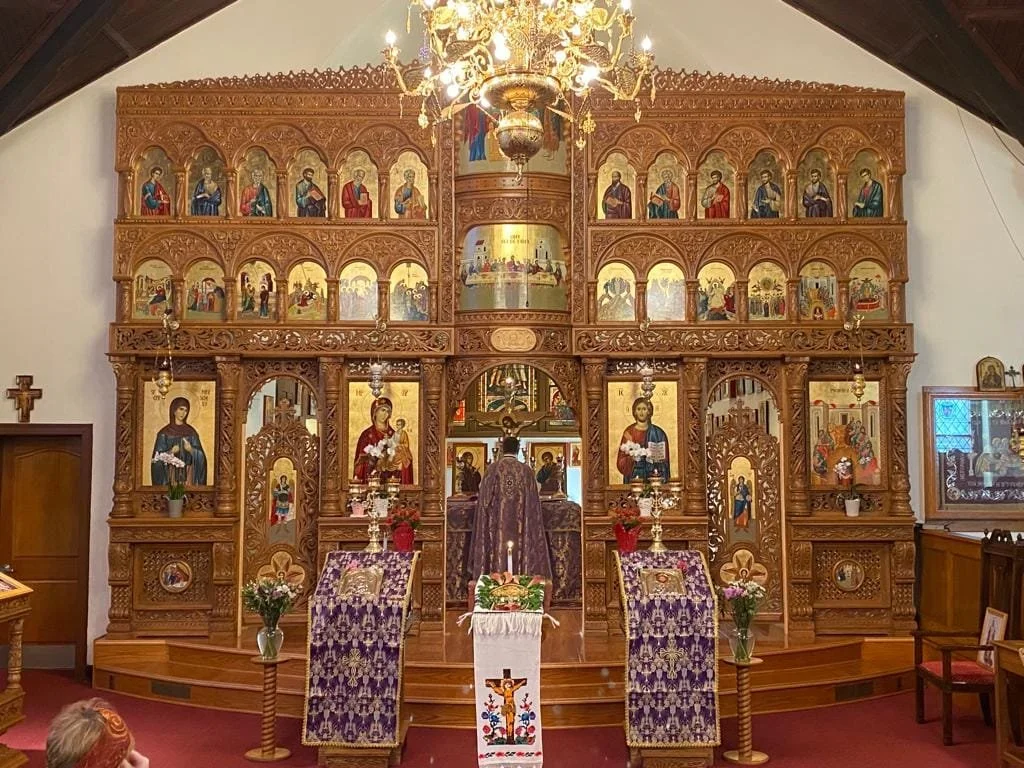
As you enter the nave and see the iconostasis (a screen or icon stand with three doors with the altar behind it, as seen in the picture above), you may once again bow and make the cross toward the altar, or you may go forward toward (but not on) the ambo (a platform in the front but before the iconostasis where sermons are delivered), approach the icons (of Christ, Mary, and of other saints prominently displayed there—depending on the church calendar), and bow slightly as you make the cross.
Each Orthodox church has the icon of the patron saint prominently displayed either in the front or back of the nave. You will see the faithful lighting candles with prayers either near the ambo on the side or in the narthex or in front of an icon of Mary.
Be seated after having paid respect (made crosses) to the icons. If you arrived before the Liturgy starts, you may hear the on-going prayer of Psalms chanted in the choir loft or at the chant stand.
When the priest, facing the altar (toward the east), says out loud: “Blessed be the Kingdom of the Father, of the Son, of the Holy Spirit….” you know that the Liturgy begins. When a deacon is present, he will say before the priest: “Master, bless…” People stand.
The most frequent prayer the choir or people chant throughout the Liturgy is: “Lord, have mercy” (Matt 17.15, 20.30, 31). This is the universal prayer that anyone can offer to God at any time on any occasions. A slight longer version of it is called Jesus’ Prayer: “Lord, Jesus Christ, Son of God, have mercy on me, a sinner.” The Jesus Prayer is known to the Orthodox more than a thousand years.
Generally, look toward the movements of the priests and deacons, as they cense, read the Scriptures, etc.
Censing is a gesture of respect. When the priest or deacon censes towards you, return the respect by bowing slightly with your right hand on your chest. Your eyes should gaze downward. You don’t make a cross toward the priest or deacon—whether censing or not. You can make a cross toward the Gospel (book), the Cross, or an icon. See Incense in the Byzantine Liturgy.
The Eucharist is celebrated toward the end of the Liturgy, which on the whole may last 2 hours, more or less. Everything in the Liturgy that precedes the Eucharist is a build up to that point.
People may recite the Nicene Creed, followed by the Lord’s Prayer, and then by the Prayer Before Communion.
The general rules that govern the requirements for receiving the communion are:
a. You must be baptized.
b. You must be an Orthodox Christian in good standing.
c. You must have been fasting strictly (no food) at least from the midnight prior to the day of the Eucharist, unless during the lent, in which case you are supposed to be fasting throughout the duration of the lent, everyday (no dairy or meat).
d. You must offer confession within the last week or month prior to receiving the Eucharist. Check with the priest for any exceptions or on how strictly these rules are enforced by the episcopate or archdiocese. (St Ambrose of Milan is famous for refusing to serve the Eucharist to Emperor Theodosius I in 390 CE for committing a massacre of thousands of citizens in Thessalonica.)
The Divine Liturgy is divided into two parts: The Liturgy of the Word and the Liturgy of the Faithful.
The Liturgy of the Word is also called the Liturgy of the Catechumens, because the catechumens (those training to be baptized) are ordered to depart the church at the end of that segment of the Liturgy—after the Gospel reading, usually followed by the sermon. They are asked to leave (“As many as are catechumens, depart. Let none of the catechumens remain”) because they are not qualified to receive the Eucharist, as they are not yet baptized. “Holy things for a holy people,” the priest says before the communion begins exclusively for the baptized. As early as 4th or 5th century, the deacon’s order for the catechumens to depart the church—which is a part of the text of the Divine Liturgy—is not obeyed, however, Those who are not baptized or baptized but not ready to receive the communion (for one reason or another) remain in the Liturgy without departing and without receiving the communion.
The choir imitates angels (Isaiah 6.1-9), who are, according to Pseudo-Dionysius, closer to God in imitation and illumination than humans. Angels belong to the celestial hierarchy. We humans belong to the ecclesiastical hierarchy—everyone, including kings and monks. Pseudo-Dionysius (b/d ~500)—who coined the term ‘hierarchy’—probably never envisioned the rise of Islam (founded in 610 CE) that conquered the great Christian cities such as Alexandria, Jerusalem, Antioch, Damascus, and Constantinople. He probably could not imagine the world not ruled by the Church.
The Liturgy is the work of God serving humans and the work of humans in response to and in cooperation with God’s work. It has nothing to do with “getting something out of it.” Rather, it is a giant prayer and praise—which is the only proper response humans can offer to God in response to His sacrifice for us and the world.
The Epistle reading and the Gospel reading are verbal icons. Sermons, too, in my opinion, are verbal icons. The homilist is a sculptor who is chiseling a statute or painting an icon in words.
Prayers that Orthodox recite are usually written many centuries ago by saints and prophets, including King David. One never prays for oneself in the litanies of the Divine Liturgy—always “let us pray…”
Each ethnic and cultural tradition the particular Orthodox church belongs to will have different style and music of the Liturgy. Within a tradition, each priest or deacon will have his own unique style and voice, too. These differences are visible in the style of the music sung and in the readings and prayers chanted. Many liturgies in America are still spoken in the respective mother tongues with their distinctive melodies and styles but carrying almost the same, universal lyrics and liturgical text.
The Byzantine Liturgies are celebrated in Palestine, Syria, Lebanon, Egypt, Ethiopia, Sudan, Greece, Romania, Bulgaria, Serbia, Armenia, Russia, Ukraine, Great Britain, Australia, India, China, Korea, Japan, and many other countries globally.
The division between Eastern Orthodox (Byzantine) and Oriental Orthodox (Armenian, Egyptian, etc.) occurred in 451 CE at the Council of Chalcedon over a dispute on the Christological terminology—whether Christ had “one person in two natures” or “one nature of God the Incarnate Logos.”
The Ukrainians Greek Catholic Church joined the Roman Catholic Church in 1596 (to avoid paying taxes) but kept the Byzantine rites.
The Acathist owes its origin to the siege of Constantinople in 626, when Patriarch Sergius, in the absence of Emperor Heraclius, organized the defense of the city and consecrated the city to the Mother of God. Acathiste à la Mère de Dieu (Acathist to Mother of God by Greco-Cathofranco.)
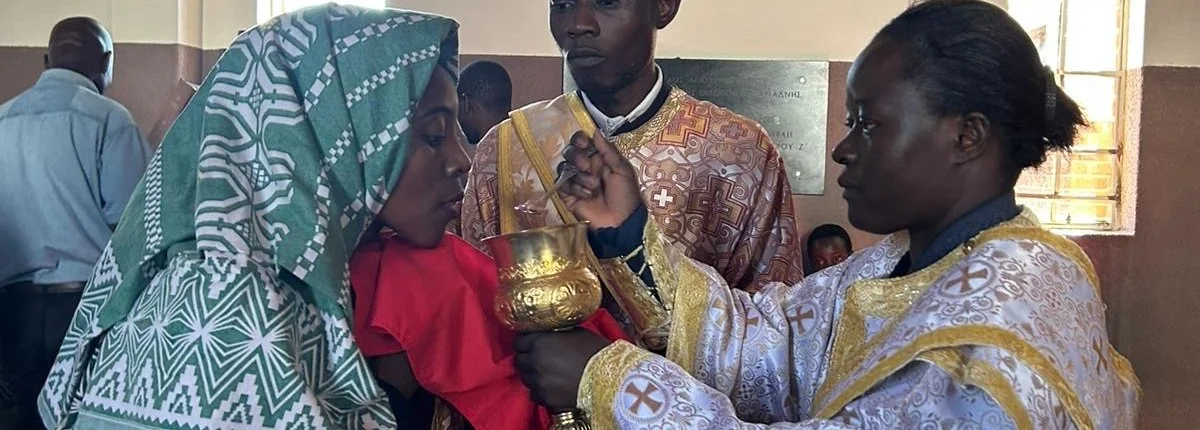
Deaconess Angelic-Phoebe Molen of Zimbabwe administering the Eucharist to a parishioner in 2024. Courtesy of Public Orthodoxy.
WHAT LITURGY IS NOT/DOES NOT DO:
Liturgy is not a tool for achieving piety. Piety or purity is required in order to participate in the Liturgy.
Liturgy does not aim to escape from the world (it is not a banquet that sets aside the miseries outside) but aims to transform and divinize the world by realizing God’s will and justice on earth—His will and justice, though, seen and interpreted “through a glass darkly” (I Cor 13.12).
Liturgy is not an imitation of heaven. Rather, it is a realization of heaven on earth—as much as possible and within our own capacity (ἐπιτηδειότης).
In the Liturgy we do not seek to receive blessings; instead, we pray for God’s blessing for one another and for the world: “Blessed is the kingdom of the Father, and of the Son, and of the Holy Spirit…..”
WHAT LITURGY IS/DOES:
In the Liturgy God gives His only begotten Son in (self) sacrifice; we in turn give ourselves to God in (self) sacrifice.
To offer ourselves to God is to offer ourselves to one another and to the world (as Christ did/does).
We are the co-workers of God when we participate in the Liturgy. God cannot do his work without us; we cannot do His work (the Liturgy) without God.
Liturgy is God’s service towards mankind and in turn our service towards one another and the world. To love/serve God is to love/serve our neighbor.
God is present in His glory; and the glory of God exhibited in the Liturgy is not aesthetical or artistic but liturgical, majestic, and communal.
The whole Divine Liturgy is one giant prayer—literally and symbolically.
The individual petitions for individual needs, concerns, or sorrows are delivered to the priest to pray on one’s behalf. The names of the living and the dead you want the priest to pray for are written in the diptych (a two columned list with the names of the living on the left and the names of the dead on the right) and given to the priest prior to the Liturgy or even during the Liturgy.