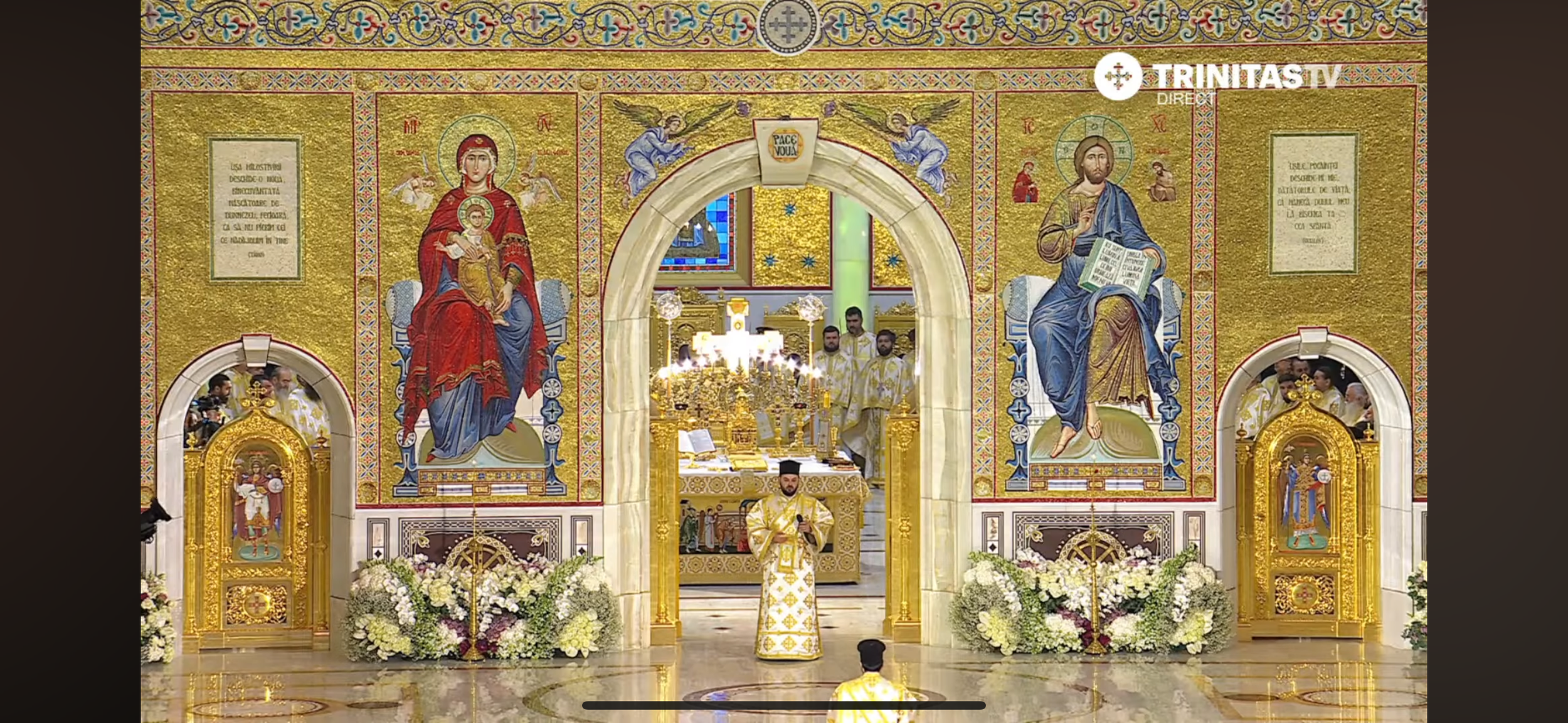
The Glory of God in the Symbols of the Liturgy
When perceived through the divine things, the ‘radiant splendor’ of the rites performed is made manifest to them in due measure…
St Maximus the Confessor, Mystagogy, 2019: 48-49.
Does the splendor of the Byzantine Liturgy belong to aesthetics? Is Hagia Sophia a work of art? Is the Liturgy a drama?
The splendor of the Byzantine Liturgy is an image (εἰκών) of the glory of God and of His redeeming work. The Liturgy is an icon of the work of God (θεουργία) rendered in cooperation with humans for their benefit. Since it is (an icon of) a divine work, it must be splendid and majestic, exhibiting God’s glory while warranting our praise (ὑμνῳδία). Since it is (an icon of) a human work, it must be performed in due diligence and with utmost attention/respect (προσοχή, ‘attention,’ ‘diligence,’ ‘care,’ ‘soberness’).
Thus, during the Divine Liturgy the deacon commands six times: “Let us attend” [πρόσχωμεν].
The Israelites referred to the presence of the LORD (YHWH) as the glory of God (כָּבוֹד, kevod) (I Sam 4.22, 6.5, Isaiah 6.3, 60.19, Ezek 1.9-11, 8.4, 9.3, 10.19, 43.2, etc.). God is not said to be present. Only is His glory. God Himself is so awesome and transcendent that every time His name was written in the scroll, for example, the scribes added the vowel sound that designates ‘Lord’ (Adonai) under the tetragrammaton, YHWH (יהוה), so that the name, derived from Exodus 3.14 (אֶֽהְיֶ֑ה אֲשֶׁ֣ר אֶֽהְיֶ֖ה, 'ehye 'ăšer 'ehye), would not have to be uttered. So awesome and transcendent is God that they would not say His name other than, and alternately, as “Lord.” (The King James version reflects this by printing “LORD” in all capital but the first letter ‘L’ in a larger font everytime.) Analogously, the Israelites would designate His presence only as His glory. Rather than being, in short, God is beyond being; as such only His glory is seen/encountered/experienced and is. God Himself is beyond being.
Hebrew has no ‘be’ verb or noun ‘being.’ God cannot be said to be or be this or that (being). When the Psalmist says, “The Lord is my shepherd,” he does not mean: God has an occupation. The Bible as the Word of God is a verbal Symbol, whereas the Sacraments are the physical Symbols, e.g., baptism, the Eucharist, unction.
‘Holiness’ or ‘transcendence,’ when referring to God, means ‘beyond being.’ Pseudo-Dionysius puts ‘beyond being’ as ‘super-essential’ (ὺπερούσια). By ‘essence’ he means Plato’s ‘form’ (οὐσία) or the essence (Being) of a thing (being). God transcends Being or essence (esse).
Is God’s glory an icon? No, because an icon is seen, touched, vidualized, etc. God’s glory is not. Only its effects are seen. After receiving the Law at the peak of Mt Sinai, Moses’ face was so radiant that it had to be covered (Ex 34.33-35).
To see the glory of God is to know/experience his presence beyond being or form. It means to be transformed by it, as was evident in Mases’s face. When God abandons his Temple, however, His glory is said to have departed from the Temple. Sheol/hades/hell is a dark place (Ps 30.3,9; Ps 116; Is 38; Jonah 2), where there is no light. God’s glory is absent. St John refers to God’s glory as God’s will. For this reason, Christ’s crucifixion reveals not the punishment but God’s glory, because it fulfills His will, saving the world (Jn 1.14, 2.11, 7.18, 8.54, 11.4, 17.5, 17.22, 17.24; cf., 3.14, 8.28, 12.32, 12.34).
Bishop Biadochus of Photice in Epirus (who attended the Council of Chalcedon in 451) agreed with the Istaelites, when he said that the presence of God is “[a] beauty without form which can be known only in glory” (Vision, 14-15, p. 173; as quoted in Lossky, 1963: 118). Similarly, Pseudo-Dionysius was fully aware of God’s utter transcendence, when he said how such a transcendent being can be known nonetheless:
We must not then dare to speak, or indeed to form any conception, of the hidden super-essential Godhead, except those things that are revealed to us from the Holy Spriptures.
The Divine Names (“DN”), 588A. The Dionysian phrase ‘super-essential’ (ὑπερούσιος) means ‘beyond being.’
Even though God is beyond being (i.e., not definable, confinable, circumscribable, measurable, or understandable in terms of any being or concept), He is not aloof, remote, or unreachable, however. He gives signs (symbols) to signify His presence, His work, His love for, and His kind inclination towards us. He gives/offers His Son. He gives/offers his Scripts. He offers us these, because He wants us to draw near Him and participate in His presence. Symbols enable a relationship without relation (relation sans relation), love without concupicence, communion without commerce. The sacred Symbols lift us up to Him and allow us to participate (μετουσία) in the divine reality, to have communion (μετουσία) with Him, and to be His partners (μετουσία)—as much as we are capable—so that we have communion (κοινωνία) with Him, wherein we may be His people, He our God (Ex 6.7; Lev 26.12; Jer 7.23; 11.4; 30.22; Ez 36.28; Zech 2.11; Jn 14.16; Heb 8.10; Rev 21.3; 21.7).
Not only are we to see His glory but also to be “vested with the splendor of Christ’s glory,” according to Clement of Alexandria (d. 215) (Stomata, 5.6.40.1; 7.13.82.2, 4). Likewise, Pseudo-Dionysius also says:
… it is not possible that the Divine Ray should otherwise illuminate us, except so far as it is enveloped … in variegated veils, and arranged naturally and appropriately…
CH, 121b-c; Parker trans.
Symbols veil the divine mysteries. But also—as veils and because they are veils—they allow us to approach, touch, taste, see, smell, and hear the divine Reality/Mystery that we otherwise could not. For those who are near God, His glory envelopes them as if they are robed in His glory, making them glorious and shining. Thus illuminated, they illuminate. The robe of glory we put on at baptism does not cover over our corruption but deifies us from within: “As many as have been baptized into Christ have put on Christ.”
God’s glory transmits itself from Him to us. For Macarius of Egypt (d. 391), the soul of those who are pure and upward moving is the throne of God, from which the glory eminates. Being engulfed in God’s glory, the soul emits God’s glory from within:
[The soul] is illuminated by the beauty of [the Lord’s] ineffable glory… she becomes all light, … the ineffable beauty of the glory of the light of Christ who ascends and takes his throne upon her.
Homily (II) 1.2 (1-2), as quoted in Golitzin, 2013: 341.
God’s glory engenders our glory that mirrors and emits His. His glory is not for us to merely behold in a distance, to gaze at it without being affected by it, or to merely appreciate aesthetically and intellectually. We must become light itself, as if, as Macarius puts it, “the whole man was swallowed up in this sweetness [of the light]” (Homily (II) 8.3 (80), as quoted in Golitzin, 2013: 341). Again, the idea is: we are robed in His glory, when we draw near Him. We participate and partake in His glory, as He endows His glary upon us in his embrace.
The Scriptures say that Christ comes in glory, clothed in a robe white as snow (Dan 7.9; cf., Rev 1.14) or “com[es] with the clouds of heaven” (Dan 7.13). Glory belongs to Christ, like the glow of a fire that radiates and purifies.
God’s glory is manifest in the symbols of the Liturgy. In fact, the Liturgy itself is a symbol of God’s glory, whether one sees it or not—whether one attributes glory to Him or not in the morsel of the Bread and Wine “coming forth on the plate and in the cup.” When we read the Scriptures during the Liturgy or when people saw Jesus in Nazareth or Jerusalem in Palestine, the same happens: Christ appears in His glory.
However, We humans often don’t see the glory of God in Jesus (or in the sacred Symbols). It was the Roman centurion, of all people, who first acknowledged Jesus as the Son of God, as he hung on the cross, when the earth shook and rocks split open (Mat 27.54). Others missed seeing Him as the Son of God. Many still do. Nevertheless, He is who He is, whether we see Him as God or not. God’s glory belongs to Him intrinsically, in Himself, whether or not one sees it. His humanity did not diminish his divinity, although it concealed it.
Aesthetics
Art or aesthetics, in contrast, belongs to human faculty and experience. The term ‘aesthetics’ comes from αἴσθησις, meaning ‘perception by the senses.’
Kant’s aesthetics can be summed up as follows: Aesthetic objects are either beautiful or sublime. The beautiful is experienced when a judgment of taste is reflectively employed. The judgment occurs when a subjective and lawful interplay between imagination and understanding results in arousing a disinterested interest accompanied by restful and contemplative delight (KU 241, 252, 258). The sublime is experienced when a (reflective) judgment is at crisis, as the subjective lawful interplay (beteen imagination and understanding) is not possible due to the excessive size or dynamic of the object in question. At the brink of the crisis (of sensibility/imagination) there occurs a subjective accord (despite the discordance) forged between imagination and reason. The result, says Kant, is the feeling of “a rapid alternation of repulsion from and attraction to … the same object,” which in turn reveals, according to him, our own sublime (supersensible) intelligiblitye we have as rational beings (KU 255-259). Whether in the case of the beautiful or the sublime, then, our mind judges it to be so in “restful contemplation” or in the subrepticious respect for our own sublimity (KU 257-58).
But it must be noted that God is neither beautiful nor sublime—contrary to Rudolf Otto’s claim in his book The Idea of the Holy: that as ‘holy’ God is the sublime in the strict Kantian sense. God is not an aesthetic object, however. He is beyond the beautiful and the sublime. His glory derails our imagination and intelligibility, as we are deified by His power, glory, and grace.
Heidegger’s aesthetics: God is not Being that withdraws in its disclosure, conceals in its giving/sending. Despite the alleged overcoming of metaphysics, Heidegger still remains within the gesture of being, in which being is said to speak throughout language (i.e., poetry, philosophy, technology). But can the language of poetry contain the glory of God? Is God’s glory reducible to phenomenality? Can the withdrawal of Being that sends each historical epoch judge history? Is the question, ‘why is there something rather than nothing?’ the ultimate?
Creationism: We believe that being is first and foremost given. It is the gift and a marvel or miracle of Creation: that which was given in the primal act of Offering or bestowing of God of Himself and by Himself. Thus, offering or sacrificing is the miracle of creation that gives being. The fact of being given is more primordial than the ‘fact of reason’ (Kant), more primordial than the question: Why is there something rather than nothing?—the question, which, according to Heidegger, founded metaphysics. . That ‘there is something’ implies that ‘there is givenness.’ Thanks to giving and being given, there can be being at all. ‘To give’ precedes ‘to be.’
If the above is true, then, liturgy (i.e., the ultimate symbol of giving or procession, starting from the altar) precedes art, literature, philosophy, commerce, and industry, like the living water that flows from the Temple in Ezekiel’s vision to rejuvenate the downstream and the seas (Ez 47). But there is no altar in the Temple’s Holy of Holies, as there is in the church where the Liturgy takes place.
Can we see God’s glory in our sense perception? Is God’s glory an aesthetic object, subject to our judgment of taste? No. God’s glory is not an aesthetic object nor is it a matter of our taste. It is beyond our senses. It exceeds the (aesthetic) judgment of our mind. God is neither beautiful nor sublime. Rather, He is majestic, just, good, fearsome, merciful, loving, angry, forgiving, etc. These are not aesthetic categories. They belong to, for lack of better words, religious or moral categories. God lies beyond aesthetics.
Glory in Humility
When Isaiah speaks of seeing “the whole earth full of his glory” and seeing “the King, the LORD of hosts” (Isaiah 6.3, 4); he comes to see his own inadequacy instead in the end: “Woe is me! I am lost…” (6.5). Seeing God revealed his own inadequacy. Such a (self) awareness is impossible in aesthetical experience. No sense perception can reveal one’s own inadequacy and shortfalls. But in contrast the glory of God convicts and humiliates Isaiah, revealing his own gross inadequacy. No works of art can achieve such an effect. Rather, God’s majesty reveals our pride and vanity, and crushes them.
Art can at best challenge our perceptual framework, gestalt, or thought paradigms or outlook. But art lacks the power to transform us to the point of seeing our own vanity and inadequacy. No art can humble the spectator. But the divine glory can and do humble us and transform us into the likeness of God.
The divine Symbols are the Mysteries of the (hidden) divine reality. As such they contain the divine glory, dignity, and majesty. As such they have the power to uplift us to the level of divinity. They enable us to join, participate, have communion with, and to be partner with God within our own capacity as His image and likeness.
Incarnation
But how do the divine Symbols reveal God’s glory?
Seeing God, is to become God (without being consubstantial with Him), is to be united with Him in participation (μετουσία) and communion (κοινωνία). Seeing God, becoming God, being united with God—all these are the same reality that we call theōsis, in which we the finite participate in the Infinite, the reality and possibility of which is grounded on the Incarnation Itself. If God can become a man, a rite/liturgy/symbol can be for us God’s own act and providence in our midst and, as such, can reveal His glory. The Incarnation, the Symbol of all symbols, enables our participation in and communion with God through the divine Symbols of the Liturgy.
For that reason, the Incarnation is the essence of Pseudo-Dionysius’ symbolic theology:
[Because] we also have been initiated[, we can] apprehend[…] these things in the present life (according to our powers), through the sacred veils of that loving kindness which in the Scriptures and the Hierarchical Traditions, enwrappeth spiritual truths in terms drawn from the world of sense, and super-essential truths in terms drawn from [b]eing, clothing with shapes and forms things which are shapeless and formless, and by a variety of separable symbols, fashioning manifold attributes of the imageless and supernatural Simplicity.
DN, 592b; C. E. Rolt, trans.
The sensible symbols are not hinderance but indispensable vehicles, like veils, by which the Divine that transcends all senses, forms, or descriptions, is nonetheless enwrapped in the sensible and forms, clothing it in “a variety of separable symbols.” Veils hide, to be sure, but in their hiding they reveal, like the veil of the bride. The bread is not a flesh but is the Flesh that clothed the Word in its property of bread. The bread as the Bread and as Christ is enigma, aporia, and the divine mystery that is ineffable, “beyond comparison,” beyond reason. It is in Itself. God is “through all and in all” (Eph 4.6).
Participation in the Liturgy
The liturgy in essence is nothing but our participation (μετουσία) in God’s act (θεουργία) and our communion with Him. Liturgy is God’s providential energy/work actualizing in symbolic rituals. As such it is the (divine) reality at work, wherein God’s will is done “on earth as it is in heaven.” Liturgy is where His Kingdom comes and is spoken of well (εὐλογία, eulogized or blessed) as being realized. We participate in the coming of His Kingdom, when we participate in the Liturgy.
Participation in the Liturgy, then, is the key to becoming divine (θέωσις). This is Dionysius’ main teaching. He says in the following passage, which, according to Golitzin, is “the most important passage in the entire [Dionysian Corpus]:”
It would not be possible for the human intellect (νοῦς) to be ordered with that immaterial imitation of the heavenly minds [i.e., the angels] unless it were to use the material guide that is proper to it, reckoning the visible beauties as reflections of the invisible splendor, the perceptible fragrances as impressions of the intelligible distributions, the material lights an icon of the immaterial gift of light, the sacred and extensive teaching [of the Scriptures] [an image] of the intellect’s inteligible fulfillment, the exterior ranks of the clergy [a image] of the harmonious and ordered state (ἕξις) [of the intellect] which is set in order (τεταγμένας) for divine things, and our partaking (μετάληψιν) of the most divine Eucharist [an icon] of our participation [μετουσίας] in Jesus Christ.
CH 121C-124A; Golitzin translation.
τάληψιν refers to partaking of the Eucharist or food (See Lampe’s Patristic Greek Lexicon); whereas μετουσίας refers to the ontological ‘participation,’ ‘communion,’ and ‘partnership.’
It would be indeed impossible and unfair for us, if God had set up an order of things by which we can become divine without also providing us with the means to do so. Thank God that He did provide us with the means. They are, in Dionysius’ reckoning, the following “material guides” that the above passage refers to, which I summarize here:
The visible beauties to lead us to the invisible splendor.
The perceptible fragrances (myron or unction) for leading us to “the hidden and sweet savored comeliness of God” (EH 473B) in His providential dealings with us and the universe.
The material lights (as in Hagia Sophia) for the immaterial gift of Light.
The teachings of the Scriptures for fulfillment of our soul.
The ranks of the clergy for harmonious and ordered way of life.
The partaking of the Eucharist for participation in Christ.
All these “material guides” or symbols/sacraments are provided for our deification (theōsis). They are not difficult for us to use. All we need to do is to become worthy of them and to use them and leave the rest to God, so that his providentially working through them may leads us to Him in communion.
The Glory of the Procession
Although relatively late in its final development (circa late 6-century), the Great Entrance is arguably one of the most splendid parts of the Divine Liturgy.
The liturgy became more splendid, ceremonial took over the customs of the ceremonial of the imperial court, a conscious effort was made to provide in the liturgy a moving, symbolic, dramatic performance (Louth, 1989: 8).
The Great Entrance refers to the procession of the deacons and the priests carrying the Gifts to be transported to the sanctuary through the nave and to be laid upon the altar so that the Eucharistic rite (Anaphora) may begin.
The procession reflects the Byzantine sense of pageantry. The 10th century book on ceremonies, De caerimoniis, records the emperor participating in the Great Entrance procession as follows:
the sovereigns with lamps in hand march in front of the gifts, with the senators and chamberlains. The scepters and other accoutrements stand in their proper order and the sovereigns, going via the solea, stand outside the holy doors,…. The holy things, having arrived on the solea, pause, and the archdeacon comes and incenses the sovereigns, then the patriarch, and after him, the holy table. And thus all the holy things enter, and after all have entered, the sovereigns greet the patriarch and then go via the right side of the bema outside [the sanctuary] and enter the metatorion [a room in Hagia Sophia].
As quoted in Taft, 2004: 195.
Here in the procession the “King of Glory” (Ps 24.7-10) comes “in the disc and in the cup,” as Narsai of Nisibi put it, preceded by the emperor and his entourage holding lamps, and followed by the priests and other bearers of the liturgical implements.
Though seemingly a royal procession, the Great Entrance can be better understood, however, in terms of the Dionysian notion of the hierarchy (ἱερός + ἀρχή, ‘holy order’)—the term Dionysius invented, according to Andrew Louth (1989: 38).
Now, hierarchy has nothing to do with power or authority. Rather, it only pertains to assimilation (ἀφομοἰωσις, becoming like) and union (becoming one) with God by participation (μετουσία). The purpose of the hierarchy is strictly spiritual—imitation and illumination:
Hierarchy [ὶεραρχἰα] is … a sacred order [τἀξις ὶερὰ], knowledge [ἐπιστἠμη], and energy [ἐνέργεια] assimilating [ἀφομοιουμένη], as accessible as possible [ἐφικτὸν], to the likeness of God [θεοειδὲς] in connection with [ἀναλόγως] illuminations [ἐλλάμψεις]—illumination which itself is endowed [ἐνδιδομένας] from God—into upliftment [ἀναγομἐνη] toward God-imitation [θεομίμητον].
Dionysius, Celestial Hierarchy (CH), Ch. 3; 164D, translation mine.
It is the deacons and the priests who transports the Gifts, starting from the sanctuary (prothesis), going through the nave, and returning to the sanctuary to hand over the Gifts to the awaiting bishop. The function of each celebrant in each of their respective roles within the hierarchy is important, as their ranking dictates what roles they are to play in the Liturgy. The movement in the Liturgy starts from the lower rank and gradually elevates into the higher rank. For example, at the time of Hagia Sophia, the non believers and the penitents cannot enter the church but stand outside the narthex in the atrium. The patriarch or the bishop enters the narthex, holding the Gospel (book), as the choir sings antiphones, and brings the Gospel into the sanctuary in the procession called “The Little Entrance.” The Epistle and the Gospel are read in the ambo by the deacon(s); whereas the Eucharist is performed in Anaphora and communed inside the sanctuary by the Hierarchs and the priests before it is brought out to the nave (syntax) to be distributed among the faithful. According to Dionysius, the deacon is to purify the believers or the catechumens; the priest is to illuminate the baptized; and the bishop or the Hierarch is to perfect the rite/initiation by performing the rite of myron (the fragrant mixture of olive and balsamic oil). God’s re-generative bestowal of loving kindness emanates from the altar in the sanctuary to the nave, pulling or uplifting the faithful back into the divine presence in the circle of procession (πρόοδος) and return (ἐπιστροφή). Both the Little Entrance (in the Liturgy of the Word) and the Great Entrance (in the Liturgy of the Faithful) symbolize and re-enact the Dionysian circle of going out (emanation) and return.
In the following short description, Archbishop Alexander Glotzin, to my knowledge, best describes the procession of the Great Entrance to be understood as part of the Eucharist:
It is thus during the Eucharist—exiting the altar to cense the entire temple, reentering the altar, and, later, inviting believers to partake of the Gifts—that the bishop provides us with an icon of the divine procession and Providence.
Golitzin, 2013: 141.
For Golitzin the Great Entrance is a symbol of God’s work of providence, the salvific work that, as Dionysius puts it, “preserves all things in their proper places without change, conflict, or deterioration…” (DN 897A). The orderly procession in hierarchy is the very movement of God’s way of redeeming/restoring the world, by which all things are put in place as they should be in their “proper virtues” (DN 897B). To participate in the divine reality (God’s providential work) within one’s own proper place is to effectuate God’s work of re-creation, so that God will be “above all and through all and in all” (Eph 4.6; cf., I Cor 8.6) within their hierarchy. We do not transgress above or below ourselves in the hierarchy to participate in God’s work/energy/operation. Remaining within our proper place, we participate in His operation to the fullest extent possible within our own capacity (ἐπιτηδειότης, κατ’ όικείαν άναλογίαν).
To be within one’s own capacity but to be so fully and maximally is to be virtuous. This is what it means to participate (μετουσία, participation, partnership, communion (CH 305C, 308A)) within the hierarchy of God’s operation. Participation in the hierarchy includes participation in the ecclesiastical hierarchy—the only order (τάξις) we have. We can imitate angels but cannot participate in the celestial hierarchy. To do so would be to transgress our created order. It would be to sin and to “stumble upon into error or disorder and suffer a diminution of the perfection of [our] proper virtues” (DN 897B). Participation within the hierarchy is the only way in which we can reap the benefits of God’s providential work.
The Pageantry of the Neo-Platonism
Steeped in the intellectual climate of Neo-Platonism, as many of the early church fathers were, it is tempting to argue that Dionysius conceived the idea of hierarchy with the following passage in mind, written by Plotinus, the father of what we now call Neo-Platonism. In the passage, Plotinus speaks of a royal procession as follows:
… just as in the procession of a great king, the lesser come first, and the greater and more dignified come after them in turn, and those who are even closer to the king are more regal, and those next even more honored. After all these, the Great King suddenly reveals himself, with the people praying to him and prostrating themselves, at least those who have not already left, thinking that it was enough to see those who preceded the king.
Plotinus, Enneads 5.5.3; 2018: 586.
Here, the revelation of the Great King happens suddenly after the gradual splendor and dignity are built up in the procession. The progressive revelation of glory is interrupted by the sudden appearance of the Great King, whose glory is incomparable—so much so that people fall down in prayer and in prostration at the sight of him. But some miss the King, because they thought “it was enough to see those who preceded the king.” Some others who remained did not see the King either, because they were “praying to him and prostrating themselves” before the King when he passed them by. The sudden appearance of the King in glory compels the onlookers to prostrate in prayer.
Plotinus here is explaining by analogy the soul’s encounter with the One, the Good, as she ascends to the height. At the top of the ascent, the encounter happens “suddenly.” Because the One transcends all being below. But when the soul sees the Good “without seeing how,” she is united with the Good, while unable to distinguish herself from the Good itself. The soul joins the Good by becoming other than herself, as she becomes “beside [her]self.” In becoming identical with the Good, the soul loses its own identity, as Plotinus explains:
For the cognition or touching of the Good is the most important thing….
[…]
Someone actually leaving all learning, up to then having been educated by instruction, settles in Beauty. Up to then he thinks, carried along in a way by the wave of the intellect, and in a way raised on high by it, puffed up in a way, he sees suddenly without seeing how. The spectacle fills his eyes with light, not making him see something else through it. The seeing was the light itself. For in the Good there is not one thing which is seen, and another thing that is its light; nor is there intellect and object of intellect, but the radiance, engendering these things later, lets them be beside itself. It itself is only the radiance engendering Intellect, without being extinguished in the act of generation, but remaining identical. Intellect comes about because the Good is.
Plotinus, Enn. 6.7.36.
Light sparks light suddenly and without distinction. The union (between the cause and the effect) obliterates the distinction and identity. Such is the Neo-Platonic ascension of the soul to the One and becoming one with the One. In this stage, the soul is “release[d] from everything here [in the world below], a way of life that takes no pleasure in things here, the refuge of a solitary in the solitary” (Enn. 6.9.11).
Although Pseudo-Dionysius heavily borrows from Plotinus, he makes a crucial break from him: that one’s ascent to God is not a complete abandonment of one’s identity or everything worldly. In becoming divine, we do not become disembodied souls like angels. Rather, we sanctify and divinize everything that we are: the world and ourselves therein, our body and soul. We do not leave our bodies, we divinize them, as we divinize our souls. This is why the following phrases Dionysius repeats throughout his writings are important: “as much as suitable” (ἐπιτηδειότης, fitness, suitableness), or (to translate literally) “in proportion to and in accordance with one’s own home base” (κατ’ όικείαν άναλογίαν, analogous). We do not become angels or gods in imitating God (θέωσις). Rather, we remain human—fully human in the way we are supposed to be within the divine order (τάξις) that God has set up for us, i.e., within the ecclesiastical hierarchy (in which both a king and a monk belong to the same order of laity).
The sudden brightness of the divine glory is associated with the Incarnation. In his Letter III, he writes:
‘Suddenly’ [ἐξαίφνης] is that which, contrary to expectation, and out of the, as yet, unmanifest, is brought into the manifest. […] … the Superessential proceeded froth out of the hidden, into the manifestation amongst us, by having taken substance as man. But, He is hidden, even after the manifestation…
Letter III, 1069B.
The glory of God manifests suddenly, beyond any expectation, beyond any understanding, beyond any knowledge. Christ makes a sudden appearance (though still hidden) at his birth (Lk 2.13), at the commencement of his earthly ministry (Matt 3.16), at Mt Tabor when he was transfigured (Matt 17.3, 5), and in his risen Body on the road to Emmaus (Lk 24.29-31). Likewise, He makes a sudden appearance (though still hidden) as He is carried “on the plate and in the cup.” Our partaking of the Eucharist symbolizes (thus makes it real) our seeing Christ, “the Light of the Father” (CH 121A). For this reason, at the first moment when the communion is completed, the choir sings: “We have seen the true Light…”
But seeing the Light is becoming the light oneself, like fire sparking fire. Here, the cause becomes indistinguishable from the effect. Once illuminated, one becomes herself the source of illumination for others. Like the spark of fire, illumination is sudden.
The Sudden Mystical Encounter
In Mystical Theology, Dionysius likens the sudden encounter with God with Moses’ speaking with God at Mt Sinai and hearing the voice of God “out of the darkness” (Deut 5.22-23; Exod 19.16-20, 34.29-35). “At the topmost pinnacle of the Divine Ascent,” Dionyisus writes, Moses “meets not with God Himself… but the place wherein He dwells” (MT, 1000D). It is here, however, where, according to Dionysius, Moses “plunges … unto the Darkness of Unknowing” (MT, 1001A). The plunge is sudden. Dionysius writes further:
… unchangeable mysteries of heavenly Truth lie hidden in the dazzling obscurity of the secret Silence, outshining all brilliance with the intensity of their darkness, and surcharging our blinded intellects with the utterly impalpable and invisible fairness of glories which exceed all beauty!
MT, 997B.
Note the pairs of opposites here: “the dazzling obscurity of the secret Silence,” the brilliance of the darkness, the “invisible fairness of glories which exceed all beauty.” The silence that dazzles, the darkness that is brilliant, the invisible beauty that exceeds physical beauty—words cannot do justice to the Mysteries of divine reality. But these pairs of opposites suggest suddenness of the encounter with the incomparable, with the Beyond. Still, however, we are capable of participating in this Mystical Reality, beyond our intellect and language—to the extend that we are capable. But I want to focus on the “secret Silence” and on “the intensity of … darkness” that Dionysius speaks of.
Golitzin notes a curious Syriac equivalent to Greek ἐξαίφνης (suddenly). Citing A Compendious Syriac Dictionary (Oxford, 1903, 1990), he observes that the Syriac word, men shelya—the equivalent of ἐξαίφνης—has meanings associated with ‘rest,’ ‘silence,’ and ‘stillness,’ which is “usually connected in Christian Syriac with the hermits, as in ἡσυχία [stillness] in Christian Greek” (Golitzin, 2013: 49). In Syriac, then, ‘suddenly’ is associated with ‘rest,’ ‘silence,’ and ‘stillness’ that is associated with the hermetic stillness in their experience with God. All three words (rest, silence, and stillness) are used one way or another to describe the state of the union with God in many patristic writings (including Palamas (d. 1359) and even in Augustine (d. 430) as well as in Plotinus, when he too describes the soul’s union with the One with the adjective ἐξαίφνης (suddenly) (Enn. 3.8.6, 5.3.6.15, 5.3.7.13-16, 5.5.3, 5.5.7-8). As we have seen above, the Great King appears “suddenly” in his procession accompanied by his entourage. When neither affirmation nor negation is adequate, silence befalls. Such is the mode in which one may encounter God, who comes nonetheless “on the plate and in the cup.”