

The Liturgy in Hagia Sophia - reconstructed |
The Liturgy in Hagia Sophia - reconstructed |

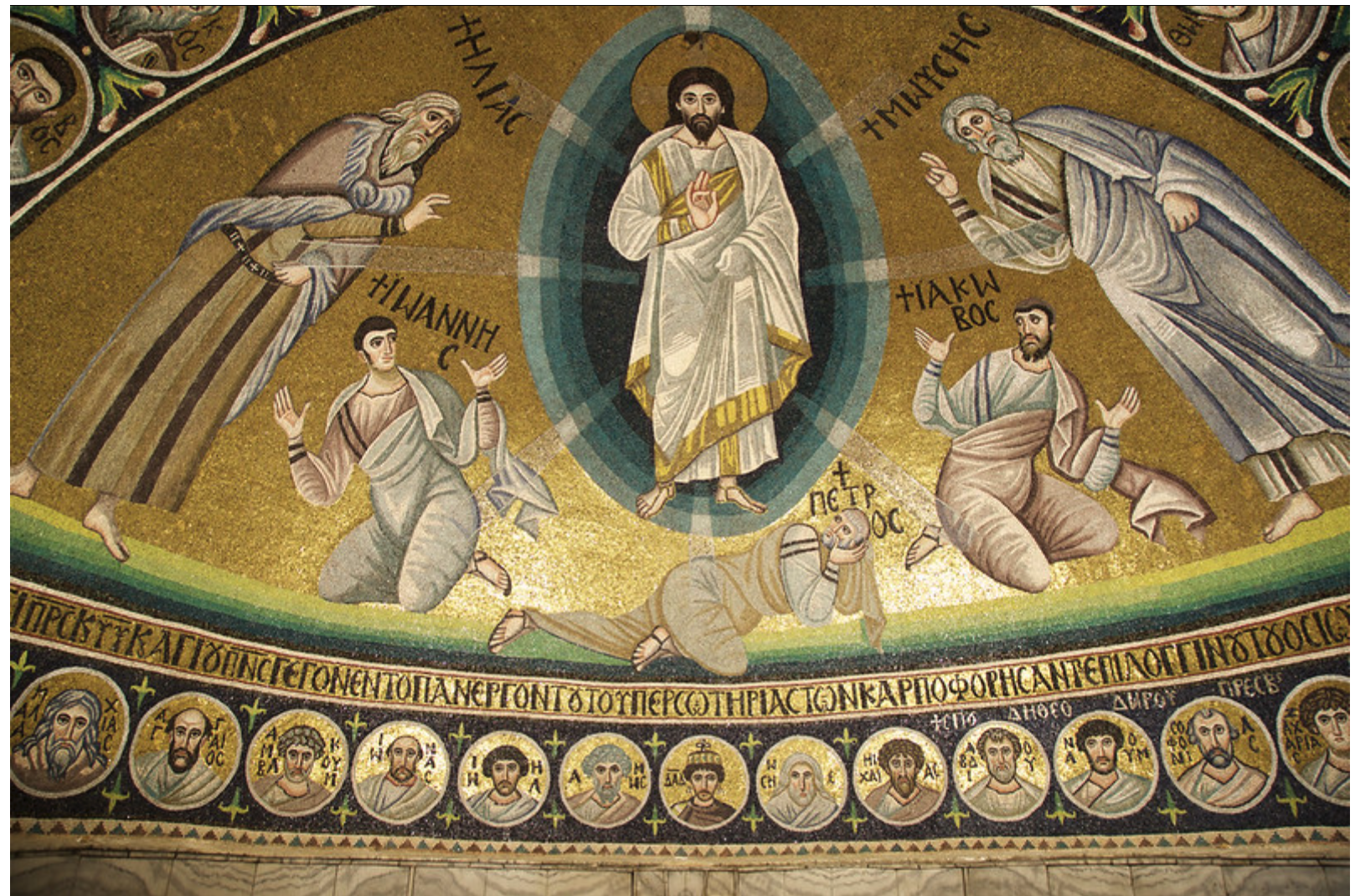
The mosaic, The Transfiguration, above the communion table in the chapel of St Catherine’s Monastery in Egypt, commissioned by Justinian the Great.
The Visiting Emissaries from Kiev
We are familiar with the visiting emissaries’ description of Hagia Sophia—the emissaries whom Prince Vladimir of Kiev dispatched to report on various religions, as recorded in the so-called Chronicle of Nestor for the year 987. Upon the report of the Russes coming, the Patriarch of Constantinople directed the clergy to prepare the church and “to array himself in his sacerdotal robes, so that the Russes might behold the glory of the God of the Greeks.” It further records:
[The clergy] burned incense, and the choirs sang hymns. The Emperor accompanied the Russes to the church, and placed them in a wide space, calling their attention to the beauty of the edifice, the chanting, and the pontifical services and the ministry of the deacons, while he explained to them the worship of his God.
When they arrived home, the emissaries reported to [Prince] Vladimir [as follows]:
The worship of the Moslems had not impressed them. As for the Germans [i.e., Latins of the Holy Roman Empire], they had seen them performing many ceremonies in their temples; but we beheld no glory there.
Then we went to Greece, and the Greeks led us to the edifices [in Constantinople] where they worship their God, and we knew not whether we were in heaven or on earth. For on earth there is no such splendor or such beauty, and we are at a loss how to describe it. We only know that God dwells there among men, and their service is fairer than the ceremonies of other nations. For we cannot forget that beauty.
Taft 2008: 54-55.
At the height of Byzantine Christendom the Divine Liturgies in Hagia Sophia were performed by a cortege of well over hundred celebrants, including the Patriarch, several Archbishops and bishops (some visiting from other regions of the Empire), and a hundred or more priests, deacons, and deaconesses (yes, the ordained deaconesses)—all in their respective robes and vestments. When the Emperor is in attendance, his procession with his own cortege, including the Empress and her attendants, would precede and add to the splendor of the liturgical processions entering the Great Church.
The bishop’s vestment was modeled after the Emperor’s robe.
It is remarkable that no one wrote any commentaries on the Liturgy of Hagia Sophia—the Liturgy that defined Byzantinism and its Church ever since—except for St Maximus the Confession and St Germanus—in the period between Justinian I (d. 565) and Iconoclasm (730-87, 813-43). (Taft, 1980/81: 49).
The ordained deaconesses delivered the consecrated Bread and Wine from the sanctuary to the southern upper gallery where the Empress and her attendants participated in the Liturgy and received communion, if and when they attended. See Taft, 1998: 56, 59, 62, 87. See also Atchison’s webpage on Empress’s Lodge.
There were no separate sections in the Church dedicated to only women until the 13th century (Taft, 2004: 199, quoting Theodore Balsamon (d. 1195, a patriarch of Antioch c. 1185-95)).
Hagia Sophia was first consecrated on December 24, 537. It was re-consecrated in 563 after 558 earthquakes (Taft, 2004: 182, 184). Justinian I reigned as Emperor between 527 and 565.
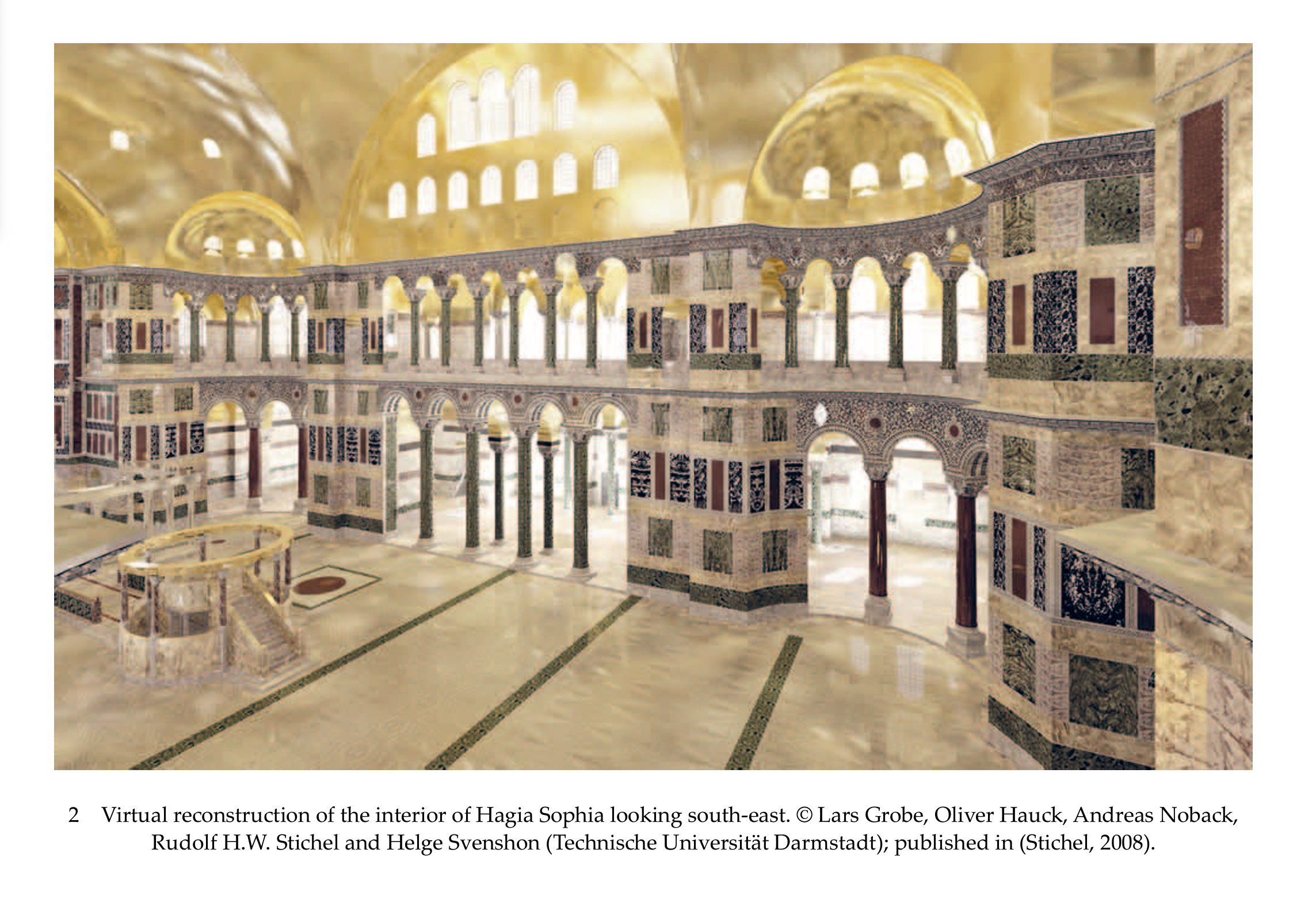
Paul the Silentiary [one who keeps silence] in 563 described the chancel barriers with 12 colonnettes sheathed with silver and silver plates mounted on the architraves as follows:
And such space as was reserved in the eastern arch of the great church for the bloodless sacrifices, neither ivory nor carved stone or copper doth limit, but he [the Emperor] fenced completely with silver metals. Not only on the walls which divide the priest from the many-tongued choir hath he set clean plates of silver, but he has also sheathed entirely with silver metals the columns themselves which are six times two in number, gleaming with far-daring rays.
[…]
And on the panels, which are in the midst of the holy screen, making a pale around the saintly men, the chisel hath carved a letter of many words; it adorns the name of out king and queen. In the middlemost spaces it hath carved out a form like a shield with its boss forming a cross. And by three doors doth the whole enclosure open to the ministrants; for on each side smaller doors were cut through by a labor-loving hand.
As quoted in Xydis, 1947: 1. See the Great Entrance for diagrams of the chancel barrier reconstructed.
In April 1204 the fourth Crusaders ransacked the city for three days, looting the treasures of Hagia Sophia and melting down the gold (from the altar) and silver (from the chancel barrier) for payment demanded by the Venetian mercenaries, who had built the naval fleet for the military campaign to retake Jerusalem. They never left Constantinople but took over the court and ruled for the next 57 years.
Constantinople was the usual travel route of the previous Crusaders before reaching Antioch and then Jerusalem, the final destination.
Before arriving at Constantinople, the fourth Crusaders were diverted to another smaller Christian city, Zara (modern Zadar, Croatia), to loot and ransack the city to compensate for the cost incurred for building the navel fleet and for sustaining the hungry army (the Franks).
When the fourth Crusaders arrived at Constantinople on June 23, 1203, the then Emperor Alexios III Angelos opposed them, as he felt the political wind blowing against “the invading army.”
But Alexios III was overthrown by a coup lead by his brother-in-law Alexios IV Angelos, who also opposed the invading army and in fact showcased a psychological intimidation by drawing (dismembering) limbs (by iron hooks) of the three captured Venetians on top of the city walls.
The Greeks and the merchants from Genoa and Piza (the enemies of Venice in rivalry) in the City hated the invading Latins (the Franks and the Venetians).
Since the June 1203 arrival, the Crusaders had been encamped outside the City wall and were beginning to get hungry and restless; while the Greeks inside the City were hurling insults and assaulted them with the Greek fire and hot oil, etc.
In fact, in July 1203 the foreign invaders inadvertently burnt the entire City when some of them (who were allowed to enter and roam around the City while the rest were camped outside the city walls) attacked a local mosque and burnt it down. The flames and ambers, aided by a strong wind, fanned out rapidly, burning almost the whole City.
Meanwhile, the bishops and abbots out in the fields, who traveled with the fourth Crusaders from now-a-day France, incited the encamping army, preaching that the Greeks inside the City were heretical and illegitimate (as the new Emperor Alexios IV took the throne by a coup) and thus were “the enemies of God.” Indeed, fighting against the Greeks, they said, was waging “a holy war.”
Every war needs to vilify and dehumanize the Other, as the earlier Crusaders have done against the Jews (on their way to Constantinople along the Rheinland) and against the Arabs (once they had arrived in West Asia).
The same vilifying and dehumanizing still occur against the Arabs Palestinians in much of the same way and same area in West Asia.
The Frankish army was able to penetrate a vulnerable part of the City wall on land and captured a monastery inside the walls but was not able to spread further out in the City due to being outnumbered.
The Venetians navy, on the other hand, attached the city walls from their navel fleet floating on the narrow sea passage on the north called the Golden Horn, and managed to break through a wall tower; then captured, and occupied another corner of the city inside the walls. When this occurred, Emperor Alexis IV (the usurper) fled the city with his mother and girlfriend, as the Greek elites followed suit. The mercenary imperial guard (the Varangians-the Danes and Swedes) then immediately surrendered the City on April 13, 2014.
Then, the unthinkable three-day rampage of pillaging, looting, and raping occurred throughout the city by the invading Christians against the defending Christians.
See Eva Schubert’s video: “When Crusaders Attacked and Burned Constantinople.”
Thereafter, the Latins ruled in Constantinople for 57 years between 1204 and 1261 with Baldwin I (a Frank) as the first Latin Emperor in Byzantium.
With the Latin invasion of Constantinople the Latin theology entered the Byzantine theology, including Anselm’s substitutional theory of atonement. See Anselm and the Byzantine Synthesis. Augustine’s City of God, for another example, was first translated into Greek by the Byzantine statesman and theologian Demetrios Kydones (c. 1324–c. 1398).
By the time Constantinople finally fell to the Ottoman Turks on May 29, 1453, much of the city’s wealth had already been plundered by the fourth Crusaders and transferred to Venice. For example, the four hippodrome chariots of Constantinople were taken to Venice and installed above the central arch of the west façade of San Marco. Also its ancient monopoly on the linen trade that connected Egypt to Europe (via the Harbor of Theodosius I at the western shore of Constantinople) had long been cut off by the muslim conquest of Cairo in the 7th century. By the time of the Ottoman Turks’ conquest, Constantinople was already in its decline.
Hagia Sophia was repurposed as a mosque by Ottoman Turks. In 1935, it opened as a museum before it reverted back to being a masque in 2020.
The four minarets at each corner of Hagia Sophia were erected by sultans to stabilize and protect the edifice from earthquakes; two were built in the 15th-century and the later two in the 16th-century. See Fred Mills’ The Race to Save Hagia Sophia.
The term ‘Byzantine’ is a modern label, dating back to 1590-1600. The Byzantinians called themselves Romans.
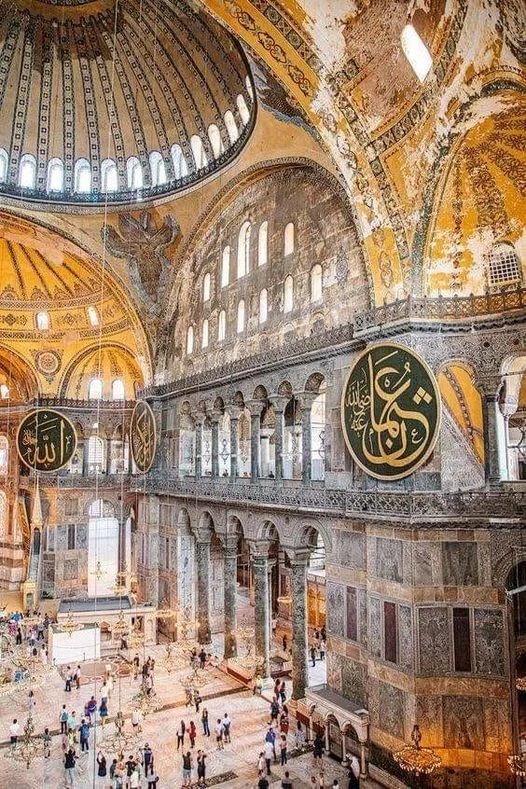
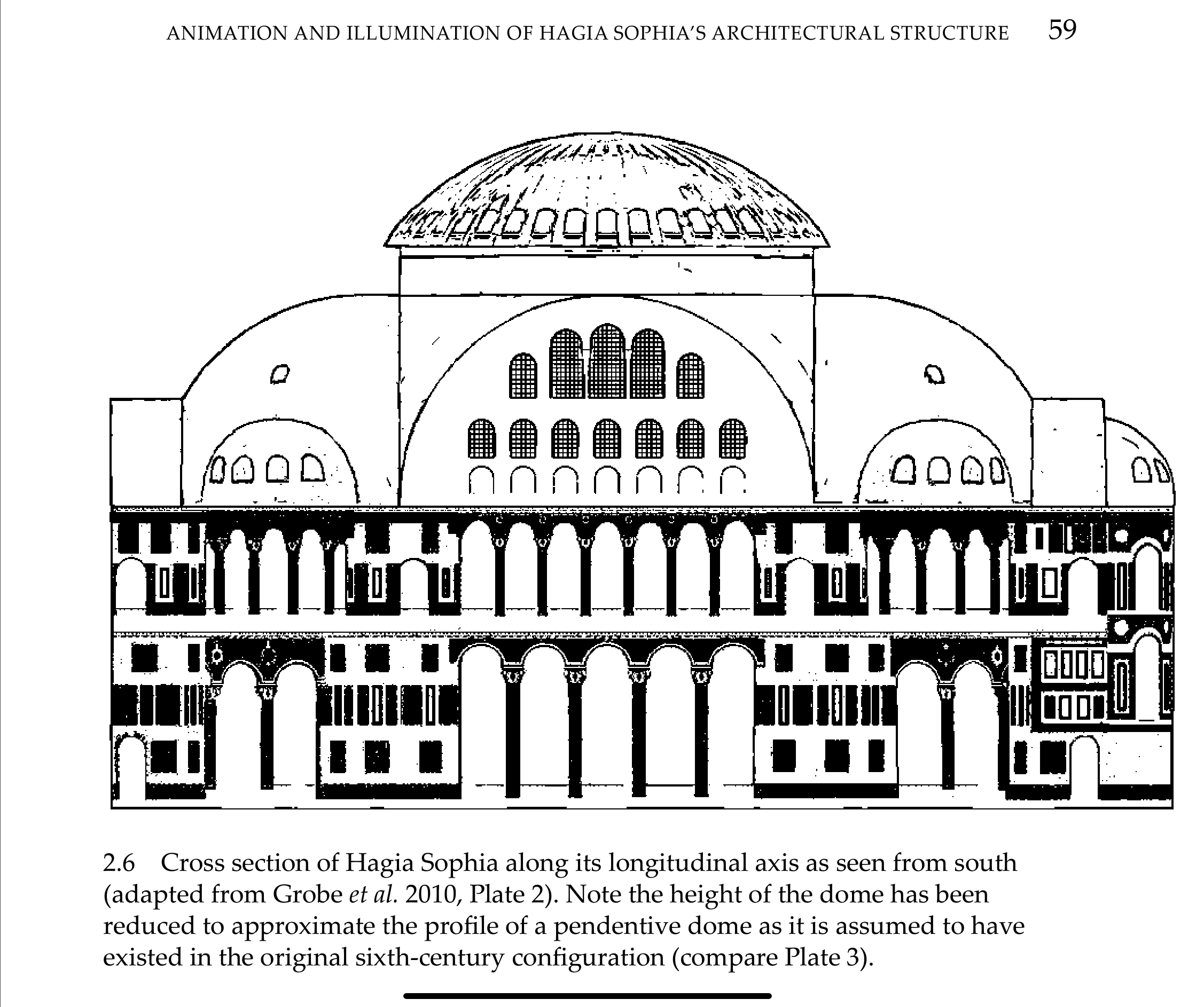
The visitors from Kiev left no structural details of Hagia Sophia. But, fortunately, we have two eminent sources, both dating from the sixth-century, that provide each of their own ‘description’ (ἔκφρασις).
Procopius of Caesarea
A court historian Procopius of Caesarea left his observation of the Great Church in his treatise De Aedificiis (On Buildings). He wrote:
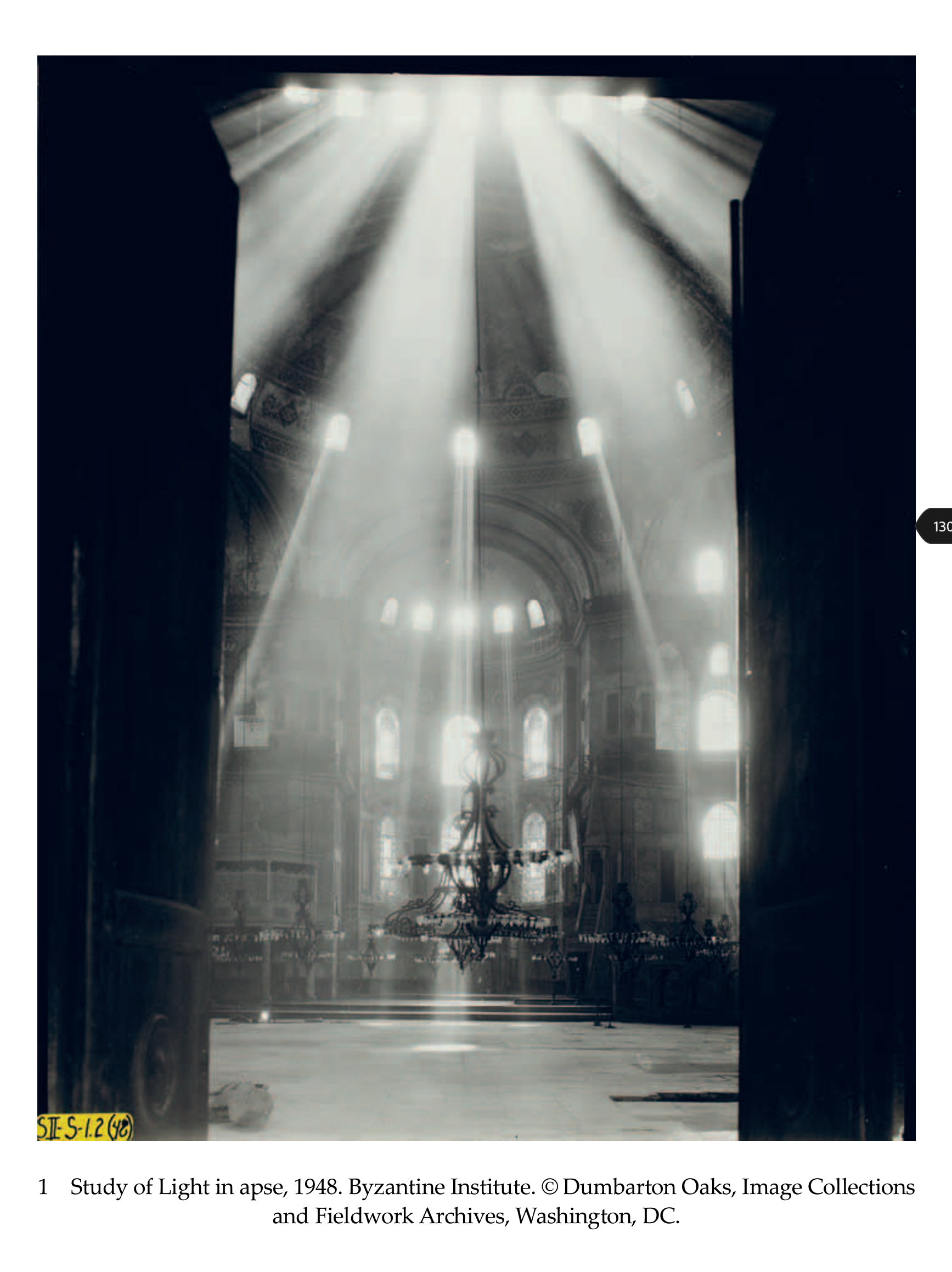
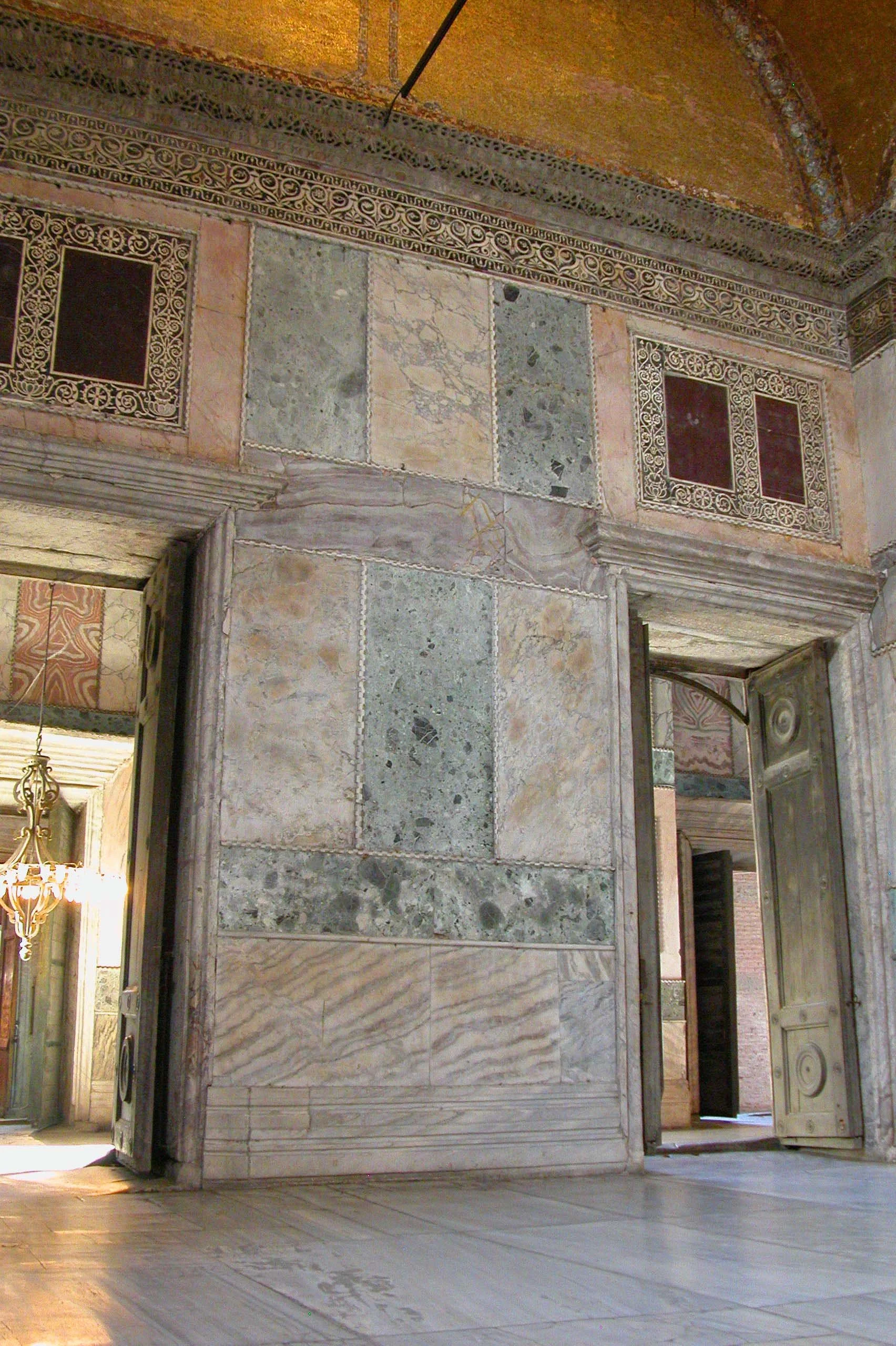
[Hagia Sophia] abounds exceedingly in sunlight and in the reflection of the sun’s rays from the marble. Indeed one might say that its interior is not illuminated from without by the sun, but that the radiance comes into being within it, such an abundance of light bathes this shrine.
Procopius 1.1.29-31, as quoted in Schibille: 2014: 13.
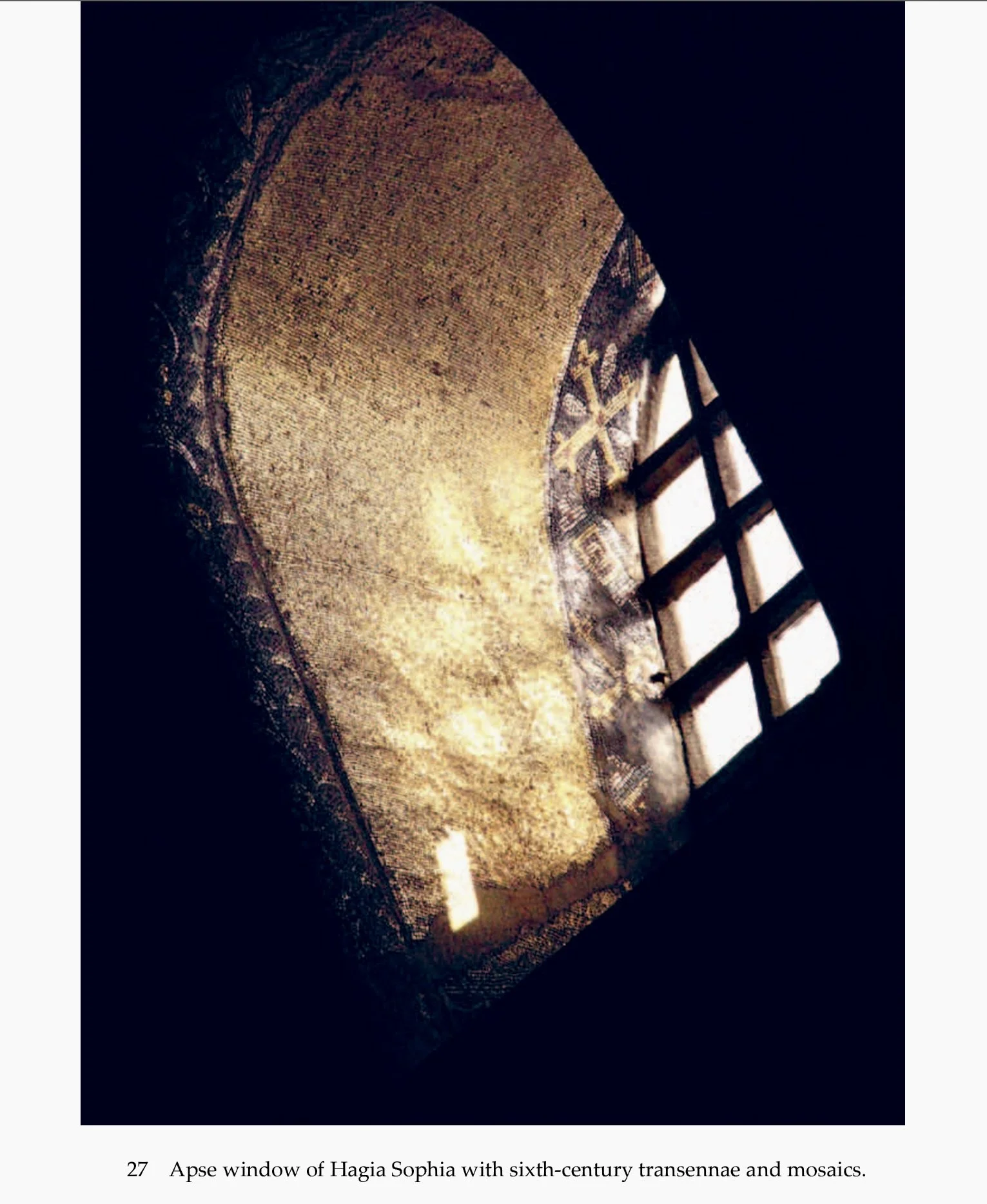
Procopius was writing around the middle of the 550’s before the original dome of the Justinianic edifice collapsed in earthquakes on May 7, 558 CE. When it was repaired, the main dome was raised about 7.5 m higher to strengthen the structure. Also several supporting walls were erected, blocking many windows of the galleries. The raising of the main dome made the 40 windows installed around the 360 degree circumscription at its foot to tilt outwardly, allowing less sunlight to come in as result.
In contrast, the original dome allowed its windows (though smaller) to admit more sunlight, about 2% more, according to Prof Nadine Schibille’s calculation; and “up to nine windows received direct sunlight at any given time of the day” (Schibille 2014: 62).
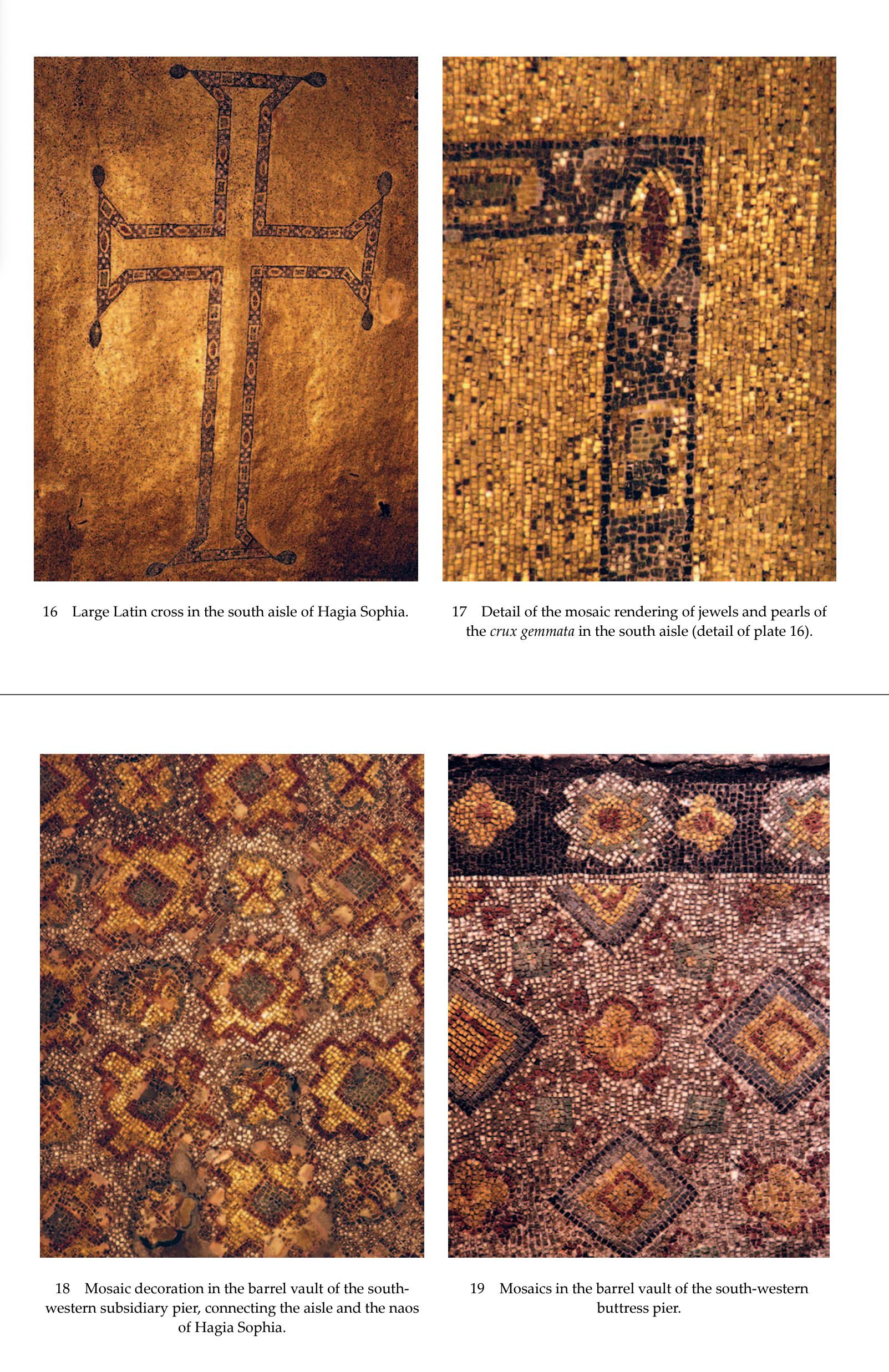
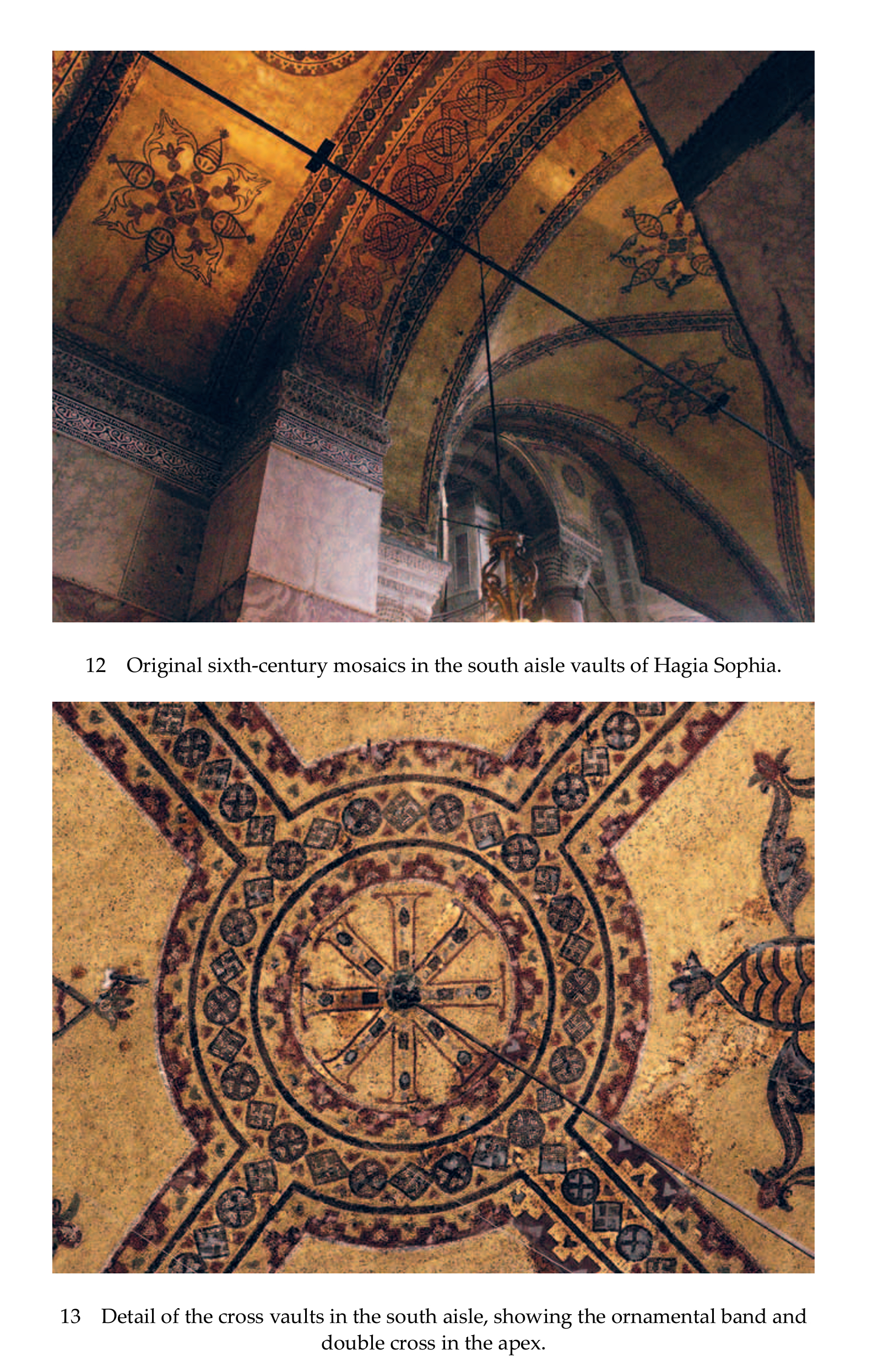
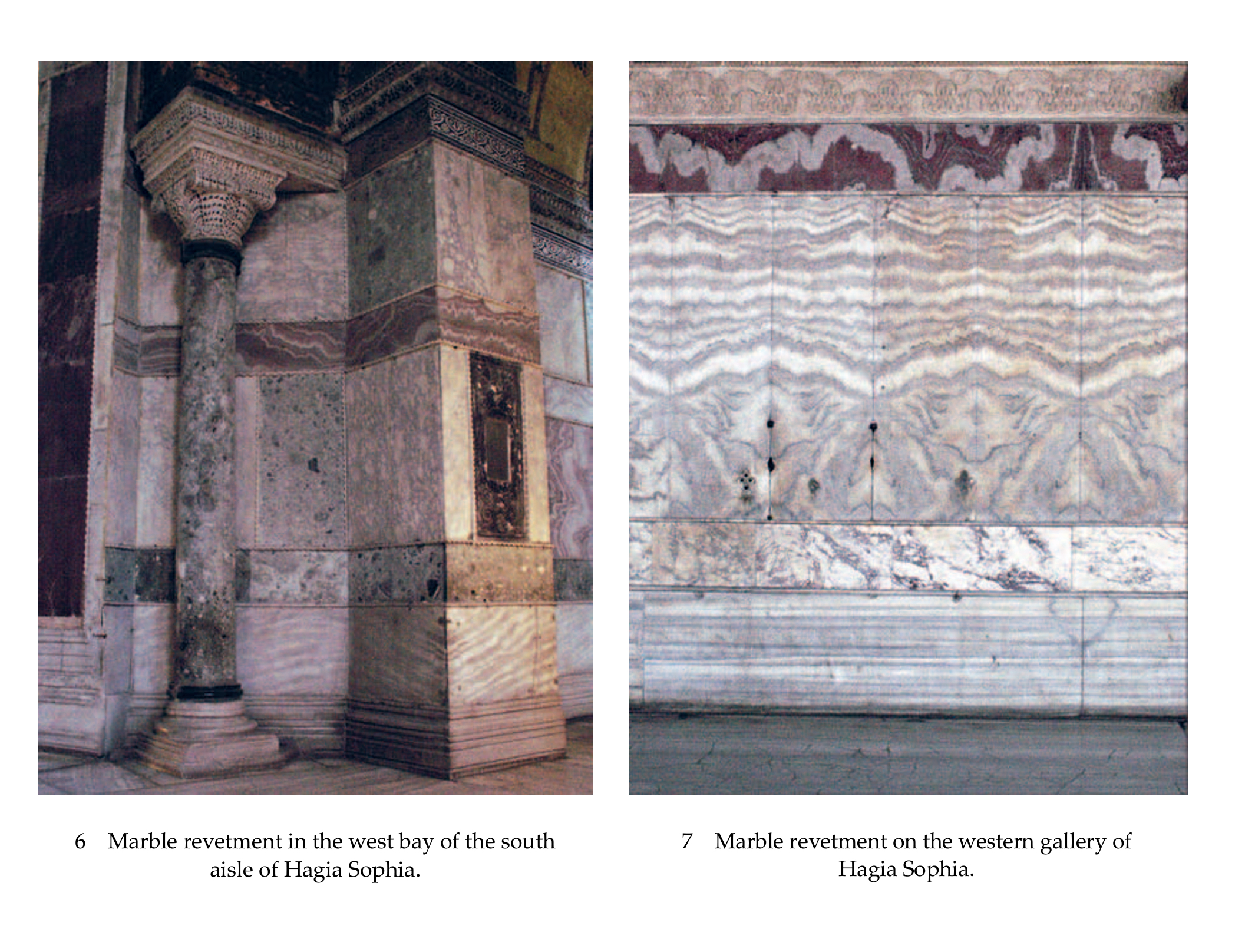
All pictures on this page, except the first, are taken from Stabile’s Hagia Sophia and the Byzantine Aesthetic Experience, 2014.
Procopius further writes about the seemingly floating vault of the main dome above the nave:
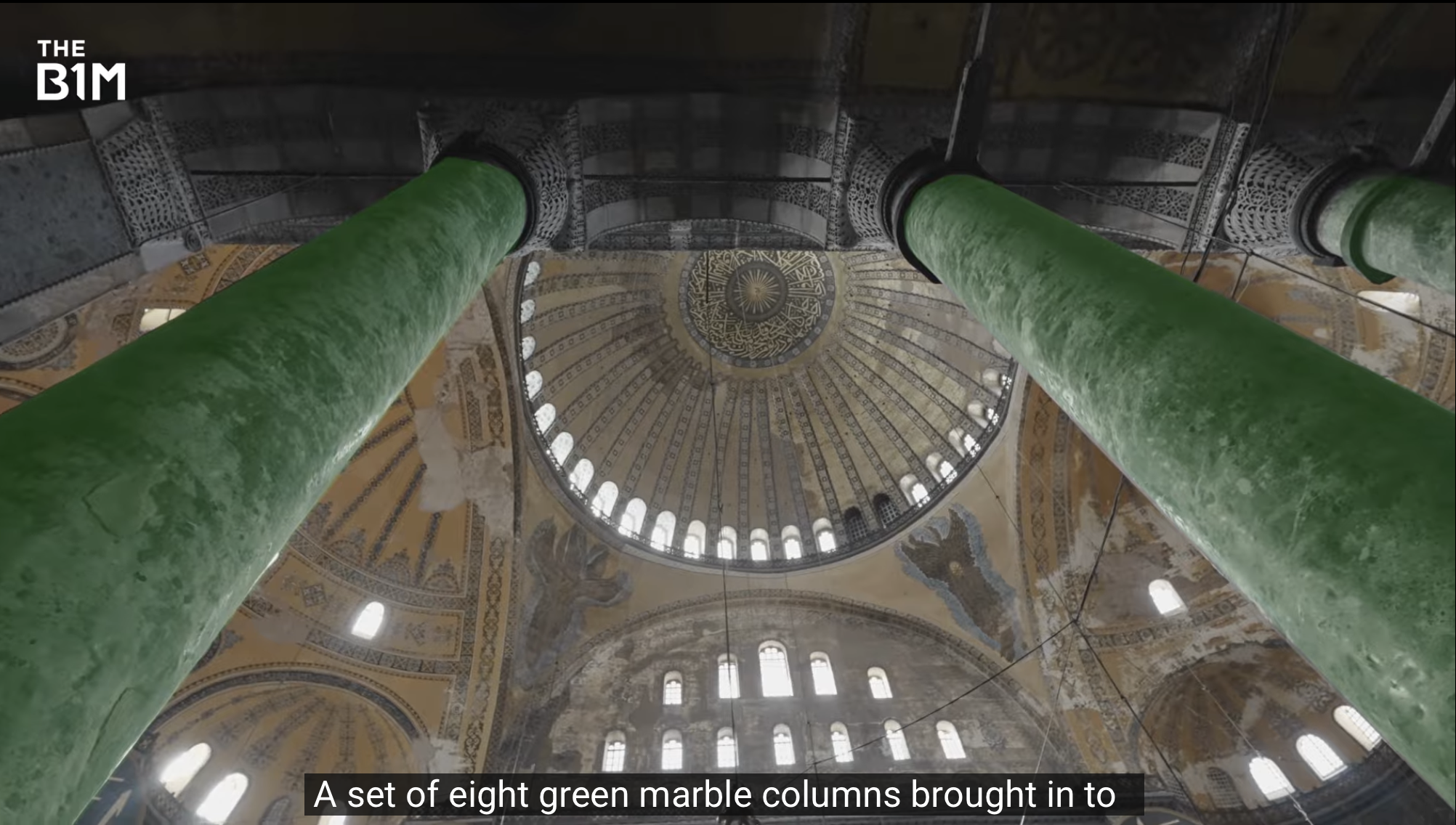
Upon the crowns of the arches rests a circular structure, cylindrical in shape; it is through this that the light of day always first smiles. For it towers above the whole earth, as I believe, and the structure is interrupted at short intervals, openings having been left intentionally, in the spaces where the perforation of the stone-work takes place, to be channels for the admission of light in sufficient measure… And upon this circle rests the huge spherical dome which makes the structure exceptionally beautiful. Yet it seems not to rest upon solid masonry, but to cover the space with its golden dome suspended from heaven. All theses details, fitted together with incredible skill in mid-air and floating off from each other and resting only on the parts next to them, produce a single and most extraordinary harmony in the work…
Procopius 1.1. 41-47, as quoted by Schibille 2014: 59.
The craftsmanship and artistry succeed in making the stone structures to look “suspended from heaven” and “floating off from each other.” Such an effect is produced by the interplay of light streaming from the windows in between cylindrical columns and the space opened up and arranged organically so as to receive the rays to recreate heaven on earth.
Paul the Silentiary
While Procopius wrote about Hagia Sophia before the 558 earthquakes, another sixth-century writer by the name of Paul the Silentiary wrote about the Great Church for the celebration of its re-consecration in 563 CE. Particularly, Silentiary wrote about the evening illumination by the candelabras and their reflected light from the multicolored mosaics inside the church as follows:
But no words are sufficient to describe the illumination in the evening… stretched from the projecting stone cornice, on whose back is planted the foot of the temple’s lofty dome, long twisted chains of beaten brass, linked in alternating curves by many hooks… And to each chain he has attached silver discs, suspended circle-wise in the air around the central confines of the church. Thus, descending from their lofty course, they float in a circle above the heads of men. The cunning craftsman has pierced the discs all over with his iron tool so that they may receive shafts of dire-wrought glass and provide pendent sources of light for men at night… in the [same circle] you will see, next to the discs, the shape of the lofty cross with many eyes upon it, and in its pierced back it holds luminous vessels. Thus hangs the circling choir of bright lights… And in a smaller, inner circle you will find a second crown bearing lights along its rim, while in the very centre another noble disc rises shining in the air, so that darkness is made to flee.
Silentiary verses (Ekphrasis toi naoi tes Hagias Sophias) 806-838, as quoted in Schibille 2014: 71.
Moreover, Silentiary observed the diversity of colors emitted from the marble stones curried and transported from afar and the mosaics decorating the interior of the Church:
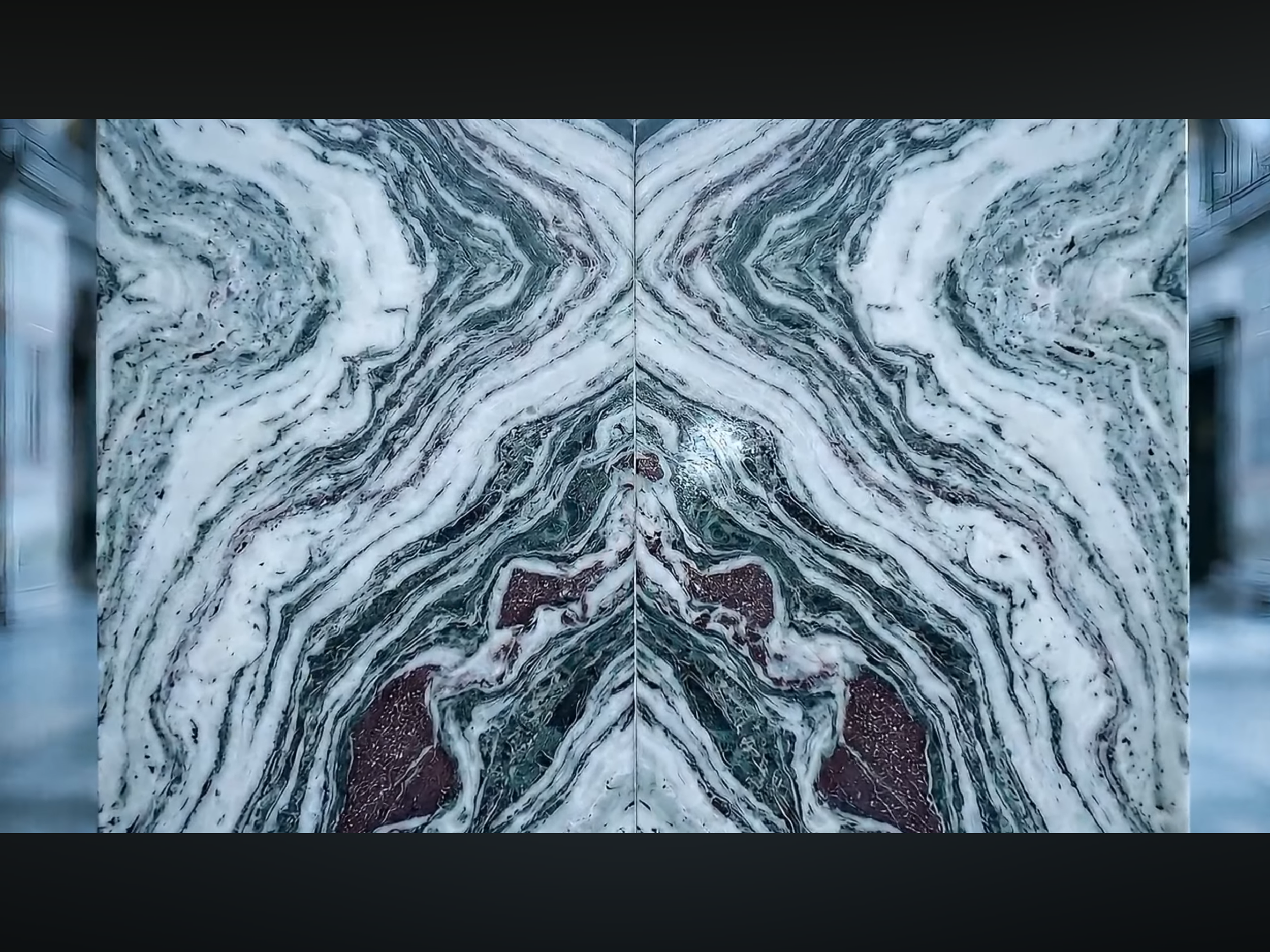
… the speckled Phrygian stone, sometimes rosy mixed with white, sometimes gleaming with purple and silver flowers. There is a wealth of porphyry stone, too, besprinkled with little bright stars… You may see the bright green stone of Laconia [salvaged from the Temple of Artemis at Ephesus] and the glittering marble with wavy veins… of the Iasian [iasian] peaks, exhibiting slanting streaks of blood-red and livid white; the pale yellow with swirling red from the Lydian headland; the glittering crocus-like golden stone… of the Moorish hills; that of glittering black upon which the Celtic crags, deep in ice, have poured here and there an abundance of milk; the pale onyx with client of precious metal; and that which the land of Atrax yields… in parts vivid green not unlike emerald, in others of a darker green, almost blue. It has spots resembling snow next to flashes (marmaryges) of black so that in one stone various beauties mingle.
Silentiary verses 617-646, as quoted by Schibille 2014: 20.
As Prof. Schibille aptly summarizes it, “[t]he colors of the marble surfaces literally transform the ecclesiastical space into a blossoming meadow in spring” (2014: 21). The colors and patters of the stones works of the interior designs recreate the beauty of the earth in her diversity.
Hagia Sophia recreates heaven on earth and consecrates earth by symbols of heaven. It does not mimic heaven. It transforms the earth into a heaven. This seems to be the intent on the part of the Justinian artists and craftsmen.
Prof. Nadine Schibille
Prof. Nadine Schibille’s analyses of Hagia Sophia—largely based on the two sixth-century ekphraseis, the architecture, the mosaic designs and artistry, and the stone materials and colors—are indeed remarkable and comprehensive (Hagia Sophia and the Byzantine Aesthetic Experience, Farnham Surrey, England: Ashgate Pub. Limited, 2014). However, in that fine work, the liturgies and the vigils that took place inside the edifice that she admires and studies, are entirely missing. This is understandable, though regrettable. As the title of her book suggests, her aim is to offer an aesthetic analysis of Hagia Sophia, an analysis of the experiences that the Byzantitians at her heyday might have experienced. Schillibe’s work belongs to aesthetics, an art criticism, that analyzes the aesthetic experience of being there in the Church. In her view, aesthetic experience can be excluded from religious experience. Is this separation, even if possible, not arbitrary?
In any event, given the objective, it is fitting that Prof. Schibille employs the sixth-century ekphraseis authored by Procopius and Silentiary, as referenced above.
Ekphrasis (ἔκφρασις, ‘a description’) was “a literary device defined as a description of an event or object[. Its purpose] was to evoke by verbal means the same effects that the actual visual experience would have elicited and to thus communicate meaning” (Schibille, 2014: 4). Ekphraseis, in short, are not religious works.
But does an aesthetic analysis do justice to an edifice conceived in theology and constructed to produce religious experience? Is aesthetics compatible with theology and can it be separated from the latter when it comes to a religious edifice? To pose a similar question: Is a church or icon a work of art?
These questions are simply set aside by Prof. Schibille, who in the last two chapters endeavors to ground the Byzantine aesthetics she analyzes on Neo-Platonists’ aestheticism (i.e., that of Plato, Plotinus, Proclus, Iamblichus, and of Pseudo-Dionysius). We must note, however, that these thinkers themselves, perhaps Plato excluded, were highly religious, although Proclus and Iamblichus were pagan. Like many other patristics, Pseudo-Dionysius thought and breathed the Neo-Platonic milieu of his time. But their Christian experiences enabled them to transform and baptize Neo-Platonism into Christian theology.
Notwithstanding the lack of religious dimensions, what Prof. Schibille writes on the very first page of her work is entirely correct:
The architects created an ecclesiastical space within which the concept of divine immanence and transcendence could be apprehended in the material form of color and light.
Schibille, 2014: 1.
Can art express the “divine immanence and transcendence”? Can human intellect comprehend such reality, I ask further?
In any event, I for one find Prof. Schibille’s work enormously helpful (despite its non theological nature) to engage in a theological and philosophical analysis of Hagia Sophia and of her Liturgy.
I believe, as I will show (employing Schibille’s analyses, at least in part) that Pseudo Dionysius’ theology explains in large part the design and function of Hagia Sophia—a crowning achievement of the art and culture of Byzantium. In my view, Dionysius’ treatise on the Byzantine liturgy explains better than any other works the purpose, design, and the effects of Hagia Sophia. I would even venture to say that there is an osmosis between Hagia Sophia and the Byzantine liturgy. They mutually contributed to each other in their respective formation and, in the case of the Liturgy, its evolution. As Robert F. Taft writes:
… the Byzantine rite is basically the rite of the Great Church.
The Great Entrance, 2004: 33.
As the cathedral church of this [Byzantine] rite, [Hagia Sophia] not only served the cult of the city; it formed it.
Taft, 2004: 182.
Indeed, the builders of Hagia Sophia (including the architects Anthemius and Isidore) must have wanted to create (the experience of) divine immanence and transcendence to be ‘experienced’ at the same time: transcendence in immanence and immanence of transcendence.
Through the use of light, color, the materials employed by the craftsmanship, the builders have largely succeeded in accomplishing their goal, as Schibille’s work amply demonstrates, and as the visitors from Kiev, as quoted above, attest.
I would go further. The edifice is “an ecclesiastical space” first and foremost, rather than a work of art. As such, I submit, it is entirely a theological construct: a symbol—I would say to be more precise—of Orthodox Church in her faith and practice with a rich theological tradition, which arguably apexed in the eighth century with a few later exceptions.
To be sure, the building that expresses the heights of Byzantine art and culture took a great engineering feat; but it was ultimately a means to an end: to uplift the liturgical celebrants to achieve theōsis (θέωσις, divinization, becoming God in His image).
More specifically, Orthodox Christians then and now believe that the Bread and the Cup consecrated in the Eucharistic rite (and our activities with and around them) are the symbols (sacraments) of the reality/Mysteries of Christ’s sacrificial presence—the mystical reality actualized by the order and structure (ordo, τάξις) of the Divine Liturgy, which in turn can only take place in consecrated churches, such as Hagia Sophia, in accordance with established tradition(s) of the Church.
If the church itself is the symbol of the Body of Christ (I Cor 12, Eph 1.22-23, Rom 12.4-5, Col 1.18), the rituals (i.e., initiations) performed therein are yet another symbol of Christ and His work—the divine work that culminates as sacrifice on the altar in the sanctuary, the work that emanates and overflows from the altar and proceeds beyond and over the parameters of the church and into the community (κοινωνία, communion) at large.
The divine work (i.e., God’s service to mankind) overflows like the living water springing from the altar in the temple, giving life to the otherwise dead rivers and seas, as depicted in Ezekiel 47, or like the living water flowing through the center of the new Jerusalem, nourishing the trees and fruits on both sides of the river banks, as depicted in Rev 22.
The aim of the Liturgy, then, is to create and recreate the divine reality (the Mystery at its core) on earth and thereby to transform and to redeem the fallen world therein, so that God’s goodness, love, and justice may permeate and overflow throughout. The Divine Liturgy is both the reality and symbol of the divine work accomplished by human participation (in the company of angels, the co-celebrants with us), emanating, exceeding, and overflowing the bounds of the church and beyond.
Thus, the Liturgy begins:
Blessed be the kingdom of the Father, of the Son, and of the Holy Spirit….
Pseudo-Dionysius
In Celestial Hierarchy (CH), Pseudo-Dionysius the Areopagite (b./d. ~500) presents Christ first and foremost as “the Light of the Father” (CH 121A). For him the Divine Liturgy culminates when we are illuminated (φωτίζομενοι) by the Light, when we achieve illumination (φωτισμός), which in turn enables us to illuminate (φωτίζω) others. Φωτίζω (‘I illuminate’) also means to teach, to baptize (Taft, 2001: 176). Φωτισμός (illumination) is synonymous with baptism (Lampe, 1510).
To imitate Christ is to be taught and illuminated by Him, thereby becoming a light, like Him, so as in turn to illuminate others. By joining Christ in baptism, we become Christ ourselves and become illuminated by His light and thereby illuminating others. Baptism is the physical and symbolic way of Christ’s teaching: “… follow me” (Matt 16.24).
We join Christ in the Eucharist, too. Since Christ is Light, to be united with Him in communion (κοινωνία) is to receive and become light ourselves. Archbishop Alexander Golitzin puts it best:
for Dionysius the Glory of God, the heavenly fire, and especially the divine light, is present in Christ, who in turn appears on the altar of the consecrated eucharistic elements and in the heart—or intellect—of the baptized Christian.
Golitzin, Mystagogy: a Monastic Reading of Dionysius Areopagita, 2013: 4.
Thus, the first hymn the choir sings after receiving the communion is:
We have seen the true Light…
To receive the Light is to see it, to become it, to be illuminated by it, and to illuminate. Thus, we sing: “Receive the Body of Christ and taste the fountain of Life.”
For St Palamas (d. 1359), the divine light is God’s energy: “God is called light not according to His essence, but according to His energy” (Against Akyndymos, PG 150, col. 823; as quoted by Lossky, 1974: 58). But, according to Lossky, “[t]he theology of Light is not a metaphor” (1974: 68). Referring to the Transfiguration, Lossky explains, quoting Palamas:
‘… by a transmutation of their senses the disciples of the Lord passed from the flesh to the Spirit’ [PG 151, col. 433B]. In order to see the divine light with corporeal eyes, as the disciples did on Mount Tabor, one must participate in this light, one must be transformed by it to a greater or lesser degree… ‘He who participates in the divine energy… becomes himself, in a sense, Light; he is united to the Light and with the Light he sees in full consciousness all that remains hidden for those who have not this grace; he thus surpasses not only the corporeal senses, but also all that can be known [by the mind]… for the pure of heart see God… who, being the Light, abides in them and reveals Himself to those who love Him, to His beloved ones…’ [Sermon for the Feast of the Presentation of the Blessed Virgin in the Temple, ed., Sophocles, pp. 176-177; cited by Krivoshein, p. 138].
Lossky, 1974: 61.
To see the Light is to become the light, as precondition before seeing, as the condition that is transformed by the Light to see it, and as the result of having seen the Light. Light sparks light and thus becomes one, while enabling separation and multiplication.
Now, as Prof. Schibille demonstrates, light plays the central role in the design of Hagia Sophia and experience therein. In Dionysius, as in other patristics, Christ as the Light plays the central role as well. The analogy between the role of light in Hagia Sophia and that of light in patristic theology should not be missed.
Given the fact that light is the central motif both in Hagia Sophia and in Dionysius’ writings, and given the fact that Pseudo-Dionysius was considered as authority by both sides of the Nestorian debates at the Council of Chalcedon in 532—only 5 years earlier when Hagia Sophia was dedicated (in December 537), it is reasonable to assume that Hagia Sophia was conceived and constructed with Dionysius’ Ecclesiastical Hierarchy and his other theological works in mind.
Although no one knows who Dionysius the Areopagite actually was, the scholars generally agree that he lived around 500 CE and that he was a high ranking clergy in the Palestine-Syria area in the Levont. Golitzin surmises Pseudo-Dionysius’ hometown to be one of “the Jewish-Christian villages and communities of Aramaic-speaking Palestine” (2013: 55) and speculates, following other scholars, that Pseudo-Dionysius might be Peter the Iberian, who was consecrated as a bishop in 452 by patriarch Theodosius in Jerusalem and died in 491 on the coast near Jamnia (2013: 401-404).
The identity of Pseudo-Dionysius is not as important as the place and time in which he lived. For his writings cannot be understood without knowing his contemporaries and his predecessors whom he admired, such as Origen of Alexandria, Evagrius Ponticus, St Gregory of Nysa, and many others.
Pseudo-Dionysius’ writings were so widely accepted as authoritative that he was cited by both sides in the Nestorian debates held during the Council of Chalcedon, convoked by the Emperor Justinian the Great in 532. (Golitzin, 2013: xix). Five years later, in December 537, Hagio Sophia, was dedicated, commissioned by the same Emperor.
My thesis that Pseudo-Dionysius was one of the major influences in the design of Hagia Sophia is further supported by the additional fact that the Liturgy that Dionysius commented on in his Ecclesiastical Hierarchy was similar in some parts with that performed in Hagia Sophia, although he refers to the rite of myron/oil that was known only in the Syrian Orthodox Church and thus probably not practiced in Hagia Sophia.
The Byzantine Liturgy of Constantinople is known as a synthesis between Alexandrian and Antiochian theological and liturgical approaches.
John Chrysostom, the bishop of Antioch (in Syro-Palestine), for example, is known to have brought to Constantinople—when he became the Archbishop of Constantinople in 398—the Anaphora portions containing the institution of the Lord’s Supper (Anaphora) that was already established and liturgical practiced in the churches in Antioch.
Given the synthesis that was taking place in Constantinople, it is reasonable to propose that the Liturgy that Dionysius commented on in his Ecclesiastical Hierarchy (practiced is Syro-Palestine) was similar in many respects with that performed in Hagia Sophia in early 6th-century—especially after Chrysostom imported some liturgical practices from Antioch.
According to the surviving records, the rite of myron was recorded as being performed, according to Louth, only in the Syrian Orthodox Church “probably from the time of Denys himself” and later by the Syrian bishop Jacob of Seraph (c. 451-521), Jacob of Edessa (c. 640-708), and George (c. 640-724), Bishop of the Arabians (Louth, 1989: 64).
The liturgy of myron (the “most perfecting rite,” EH 473B, Campbell trans.) is performed exclusively by bishops, archbishops, or patriarchs, and is “kept [away] from the gaze of the multitude,” as it is performed in the sanctuary behind the iconostasis (EH 476C).
Dionysius (known as Denys in France since 9th century) speaks of placing the [bottle of] myron on the Divine Altar “veiled under twelve sacred wings [layers]” (EH 473A), referring to the vision of God Isaiah had along with the appearance of a pair of seraphim, each covering itself with the six-wings while flying with the two middle wings (Isaiah 6.1-8).
For Dionysius the myron—though hidden behind the 12 layers of wings—reveals to us in its fragrance “Jesus Himself, as being a well-spring of the wealth of the Divine sweetness” (EH 480A). It is the consecrated myron that “completes every consecration” (EH 484A; Campbell, 1981: 59; trans. altered). See Unction for more.
In any event, if John Chrysostom introduced to the Divine Liturgy of the Great Church the Institution narrative of the Lord’s Supper, it is plausible to assume that Pseudo-Dionysius, too, about 100 years later could have influenced the formation of the Liturgy in Hagia Sophia.
The relationship between Hagia Sophia and the Byzantine Liturgy was one of osmosis. They mutually contributed toward formation of each other. As Robert F. Taft puts it,
As the cathedral church of this rite, it [Hagia Sophia] not only served the cult of the city; it formed it.
Taft, 2004: 182.
Theology of Pseudo-Dionysius and Hagia Sophia
Since the Great Church (Hagia Sophia) was constructed in order to perform the Liturgy, and since Pseudo-Dionyisus carried the day as a widely known theological authority, it is plausible that the creators of Hagia Sophia—such as the two architects, Anthemius of Tralles and Isidore of Miletus—would have read and been influenced by Pseudo-Dionaysius’ Ecclesiastical Hierarchy and his other works.
The connection between Pseudo-Dionysius and Hagia Sophia grows deeper, if we consider the theological idea that they both share: the reality of the Incarnation actualized in the materiality of the symbols. As Schibille aptly notes,
The architects created an ecclesiastical space within which the concept of divine immanence and transcendence could be apprehended in the material form of color and light.
Schibille, 2014: 1.
Hagia Sophia is an architectural symbol that joins divine transcendence and divine immanence together in a single “ecclesiastical space.” This paradoxical conjunction of the transcendent in the imminent and the imminent in the transcendent has its root in the incarnation reality of God-man, Christ—the Incarnational reality which is also the central doctrine in Dionysius, as Golitzin puts it succinctly:
In Jesus, Dionysius tells us, transcendence and immanence have met and been joined.
Golitzin, 2013: 43.
A symbol is the material and visible joinder where the divine and the human are brought into conjunction with one another. (Συμβάλλω means: to throw together, dash together; to throw together; come together, join, unite; collect, contract, make a contract with, contribute, jumble up together.) The physical church is the ecclesiastical space/place where God’s work is done in conjunction and cooperation with human work, i.e., liturgy. Liturgy, then, is a symbolic (thus, actual) work of the incarnation reality that continues to the present. Liturgy effectuates the Incarnation here and now, whenever and wherever the Liturgy is performed.
To be sure, liturgy can take place in any other churches, besides Hagia Sohpia; and the Incarnation is discussed in any other theological works, besides Dionysius.’ But the historical and theological proximity between Hagia Sophia and Pseudo-Dionaysius’ work, both of whom share the motif of light as central, is too close to ignore. The connection becomes even tighter, as we will see.
The Mosaic of Transfiguration at St Catherine’s Monastery
The connection that links Hagia Sophia to Dionysius can be further strengthened by the fact that the artists who created the mosaics in Hagia Sophia were probably the same artists who also created the mosaic of the Transfiguration in St Catherine’s Monastery at the foot of Mt Sinai—the monastery that was also commissioned by Emperor Justinian I, the same Emperor who also commissioned Hagia Sophia.
Golitzin describes the the mosaic of Christ’s Transfiguration as follows:
Christ is depicted clothed in brilliant white and gold. Rays shoot out from his Person to strike Elijah and Moses at his right and left, together with the stunned disciples at his feet—including… the figure of Peter, directly below, who is awakening from sleep into mystical vision. […] In addition, the mandorla around Christ has a curious feature, also usually reproduced in later Byzantine icons. It is banded. At its outer edge a pale shade, roughly the same hue as the rays, its several rings of color grow increasingly dark as we move inward until, immediately around the Person of Christ, the innermost ring is a midnight blue verging on black.
Golitzin, 2013: 58.
The banded layers of light gradually getting darker toward the center of the mandoria until, suddenly, the bright white clothes of Christ strikes the eyes in stark contrast, create the effect that, according to Golitzin, is “a depiction of mystical vision sited directly over the table of the Eucharist.” It depicts the ”light, overpowering, coming forth from the depth of silent divinity and, still, hidden even in the manifestation” (Golitzin, 2013: 58).
The allusion to the mystical experience in Moses at Mt Sinai as well as that of the disciples at Mt Tabor is clear: Moses enters in the cloud of darkness when God spoke to him “face to face” (Exod 33.11, cf., 24.17; Deut 5.22). Dionysius refers to the cloud of darkness as “the Ray of that divine Darkness” or “the Darkness of Unknowing” (MT 1000A, 1001A)—the darkness of unknowing, which is prerequisite to the mystical encounter with God, according to Dionysius.
“Suddenly”
The mosaic, then, depicts the moment of theōsis (θέωσις), the moment when the disciples see Christ as Who He is: the Light. The same theōsis happens, according to Dionysius, when one partakes of the Eucharist. But this moment of theōsis is to happen “suddenly” (ἐξαίφνης), according to Dionysius. The Light suddenly breaks through the cloud of unknowing, as it were. In Letter III Dionysius writes:
‘Sudden’ is that which, contrary to expectation, and out of the, as yet, unmanifest, is brought into the manifest. …the Superessential proceeded forth out of the hidden, into the manifestation amongst us, by having taken substance as man. But, He is hidden, even after the manifestation, or to speak more divinely, even in the manifestation, for in truth this of Jesus has been kept hidden, and the mystery with respect to Him has been reached by no word nor mind, but even when spoken, remains unsaid, and when conceived unknown.
Letter III, 1069B.
The mosaic at St Catherine’s Monastery at the foot of Mt Sinai clearly depicts the moment of “sudden” encounter that the disciples had at Mt Tabor; and the mosaic is strategically placed above the Eucharist table in the apse of the chapel, flanked by another mosaic depicting Moses encountering God in the burning bush and received the Law on Mt Sinai. Golitzin remarks, referring to the mosaic of Transfiguration: “Whoever… commissioned that image knew his Dionysius very well indeed” (2013: 58).
If St Catherine’s Monastery’s mosaic of the Transfiguration is inspired by Dionysius’ mystical theology, as Golitzin suggests it is; it is highly likely that the same artists or group of artists would have contributed toward the design and creation of Hagia Sophia under Dionysius’ influence. As already noted, both the Monastery and Hagia Sophia were commissioned by the same Emperor Justinian the Great. It is likely that Dionysius’s theology must have provided the governing principles in conceiving and constructing both the Great Church and the mosaic of the Transfiguration above the Eucharist altar in the chapel of St Catherine Monastery at the foot Mt. Sinai.
As Golitzin notes, the term ‘suddenly’ (ἐξαίφνης) is closely associated with the soul’s “touching of the Good” in Plotinus, in which, as Plotinus puts it, “there is not one thing which is seen, and another thing that is its light; nor is there intellect and object of intellect, but the radiance, engendering these things later, lets them be beside itself. It itself is only the radiance engendering Intellect…” (Enneads 6.7.36; cf. 5.3.17; 5.5.7; cf., Plato’s Symposium, 210E4).
Light sparkles light without the distinction between the subject and the object or between the cause and the effect. The cause and the effect merge in the spark of light that radiates indistinguishably. And the illumination happens suddenly. This is the mode of our encounter with Christ in theōsis in the Eucharist, according to Dionysius.
The Sudden Appearance of the King in the Procession
Indeed, Plotinus speaks of the sudden appearance in “a great king” in the procession:
… just as in the procession of a great king, the lesser come first, and the greater and more dignified come after them in turn, and those who are even closer to the king are more regal, and those next even more honored. After all these, the Great King suddenly reveals himself, with the people praying to him and prostrating themselves, at least those who have not already left, thinking that it was enough to see those who preceded the king.
Plotinus, Enneads 5.5.3; 2018: 586.
Note the gradual increase in dignity and grandeur as one gets closer to the king. But the king’s glory exceeds all of them, because his appearance is sudden and dazzling in degree far superior to those near him. At such a sight people prostrate in prayer and adoration. Plotinus, though pagan, took mysticism seriously. The “refuge of a solitary in the solitary” he promoted (Enn. 6.9.11) is a mystical one, the language and concepts of which had strongly influenced Pseudo-Dionysius.
See for more Let US Attend and the Glory of God.